





















The DVLA business plan 2026 2027, officially published on 19 October 2026, outlines significant changes to driving licence processing, vehicle registration, digital services, artificial intelligence and the administration of vehicle taxation.
For motorists, the most noticeable commitments include faster online applications, improved customer support and new digital account features.
However, the financial and commercial implications extend considerably further.
The Driver and Vehicle Licensing Agency (DVLA) expects to manage expenditure of £629 million during 2026–27 while delivering more than £5 million in efficiency savings and increasing the proportion of transactions completed digitally to 85%.
The agency also plans to achieve a 99% dispatch target for qualifying online driving licence and vehicle registration certificate applications within three working days.
For fleet operators, motor traders, logistics companies, insurers and businesses employing professional drivers, these changes could influence administrative workloads, compliance procedures and long-term vehicle operating costs.
Our analysis of the published financial forecasts identifies another important development: DVLA’s projected net operating income is falling from £124 million in 2025–26 to £57 million in 2026–27, representing a reduction of approximately 54%.
This does not mean the agency is making an operating loss. Instead, it highlights the financial pressure associated with higher planned expenditure and continued service modernisation.
What Is the DVLA Business Plan 2026 to 2027?
The DVLA business plan is an official government document outlining the agency’s operational priorities, financial forecasts and measurable performance commitments for the financial year ending 31 March 2027.
DVLA is an executive agency of the Department for Transport and is responsible for several essential administrative functions, including issuing driving licences, maintaining vehicle registration records and collecting Vehicle Excise Duty (VED).
The organisation maintains records covering approximately 53 million drivers and 47 million vehicles.
It also collects more than £8 billion in vehicle tax annually for HM Treasury.
The 2026–27 plan is particularly important because it marks the beginning of DVLA’s new strategic programme covering 2026 to 2030.
Its priorities focus on improving public services, increasing operational efficiency, strengthening digital infrastructure and making better use of government-held data.
What Are the Three Main Priorities?
| Strategic priority | Main objective | Expected implications |
| Customer experience | Faster, more accessible and reliable services | Reduced processing delays and improved customer support |
| Digital services and responsible data use | Greater digital adoption, AI implementation and modern infrastructure | More streamlined transactions and better information management |
| Workforce development | Improve skills, wellbeing and organisational resilience | Stronger internal capability and service delivery |
These priorities are supported by individual targets covering finance, technology, environmental performance and workforce development.
DVLA Chief Executive Tim Moss CBE describes the new strategic period as an important stage in the agency’s development.
In the official foreword, he states:
“They expect those services to be fast, simple and reliable.”
That expectation is commercially significant.
For businesses whose operations depend on licensed drivers and correctly registered vehicles, administrative delays can affect productivity, staff availability and customer commitments.
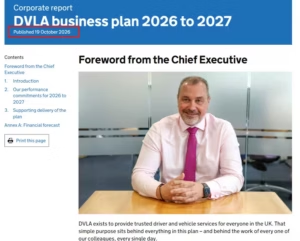
The official DVLA business plan 2026 to 2027, published on 19 October 2026, establishes the agency’s priorities for customer services, financial efficiency and digital transformation.
What Are the Main DVLA Targets for 2026–27?
The most important feature of the new business plan is its use of measurable operational targets.
Rather than focusing entirely on broad service improvement, DVLA has identified specific percentages, deadlines and processing times.
| Performance area | DVLA target | Deadline or measurement |
| Online driving licence applications | 99% dispatched within 3 working days | 2026–27 |
| Online vehicle registration certificate applications | 99% dispatched within 3 working days | 2026–27 |
| Medical licensing decisions | Average of 45 working days | March 2027 |
| Calls and online chat | Average answer time below 10 minutes | January 2027 |
| Complaint resolution | 90% resolved within 20 days | December 2026 |
| Improved complaint resolution | 90% resolved within 15 days | March 2027 |
| Core digital service availability | Greater than 99.5% | 2026–27 |
| Digital transaction adoption | 85% | March 2027 |
| Efficiency savings | More than £5 million | 2026–27 |
| Carbon emissions reduction | At least 8% against the stated baseline | 2026–27 |
| UK Customer Satisfaction Index | Improve towards the 75.2% target | March 2027 |
Our assessment is that these targets provide a clearer framework for evaluating whether operational improvements are actually being delivered.
However, a target should not be confused with a completed result.
For example, the three-working-day commitment relates to dispatching qualifying online applications. It does not guarantee that a licence will arrive at a customer’s address within three days.
Likewise, the medical licensing target measures average decision time, meaning some applications may take considerably longer.
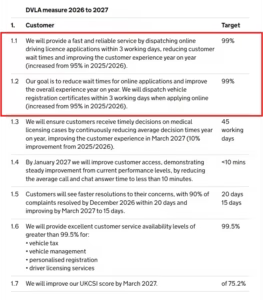
DVLA’s official 2026–27 performance measures include 99% online application dispatch targets, improved medical licensing times and new customer service commitments.
How Does the DVLA Business Plan 2026–27 Compare With 2025–26?
Comparing the latest targets with the previous business plan provides a more useful indication of the agency’s ambitions.
Several measures have become more demanding.
Driving Licence and Vehicle Registration Processing
Under the 2025–26 business plan, DVLA targeted dispatching 95% of qualifying online driving licence and vehicle registration certificate applications within three working days.
The new target is 99%.
That represents an increase of four percentage points.
Although this may appear modest, the operational difference could be meaningful because it reduces the permitted proportion of applications falling outside the target.
For businesses processing vehicle registrations regularly, greater reliability may help reduce uncertainty around administration.
However, the target does not establish that every type of registration, postal application or complex transaction will receive the same turnaround time.
Medical Licensing Decisions
The previous business plan specified an average medical licensing decision target of 50 working days.
The new objective is 45 working days by March 2027.
This represents a planned 10% reduction.
Medical licensing is particularly important for professional drivers whose employment may depend on DVLA confirming that they satisfy the relevant medical requirements.
A shorter average processing period could help employers manage staffing more effectively.
Nevertheless, employers should continue to assess individual driving entitlement and avoid assuming that an application will automatically be approved within the average processing window.
Digital Transaction Growth
The 2025–26 business plan targeted digital transactions above 84%.
For 2026–27, DVLA is aiming for 85%.
This represents an increase of at least one percentage point compared with the previous threshold, although the two figures are targets rather than evidence of the latest actual performance.
From a business management perspective, digital adoption can offer advantages through automation, faster information access and lower manual processing requirements.
The financial benefits will depend on how effectively those digital services replace existing administrative work.
What Digital Changes Will DVLA Introduce in 2026 and 2027?
Digital transformation is one of the most commercially significant elements of the latest business plan.
DVLA intends to expand its Driver and vehicles account, modernise its technology infrastructure and increase the use of automation across customer-facing services.
1. Vehicle Tax Through the Driver and Vehicles Account
DVLA aims to enable customers to tax their vehicles through the Driver and vehicles account by March 2027.
The objective is to bring more services into a connected digital environment.
For individual motorists, this could reduce the need to navigate different online processes.
Businesses may also benefit indirectly through improved administrative convenience, although the plan does not establish that every fleet or bulk-processing requirement will be available through an individual customer account.
2. Digital MOT Reminders
Another commitment is the introduction of digital MOT reminders through the Driver and vehicles account by December 2026.
This development could help motorists keep track of important vehicle compliance dates.
For small businesses operating several vehicles, digital reminders may provide an additional administrative safeguard.
However, employers should continue maintaining their own compliance records rather than relying exclusively on reminder notifications.
3. Modernising DVLA’s Driver Register
DVLA plans to migrate its drivers register from legacy mainframe infrastructure to its cloud platform by November 2026.
This is one of the more technically important commitments.
Legacy systems can become expensive to maintain and difficult to integrate with newer applications.
Modern cloud infrastructure can potentially improve scalability, resilience, maintainability and the development of future digital services.
Our assessment is that successful migration would represent an important foundation for longer-term operational improvement.
However, the real measure of success will be whether the transition maintains data integrity, security and service availability.
4. Digital Driving Licences
DVLA is also continuing work with government partners to support digital driving licence functionality within the GOV.UK Wallet and GOV.UK app.
Digital credentials could eventually influence how driving information is accessed and verified.
However, the business plan should not be interpreted as confirmation that every business, insurer, rental company or employer can already rely on digital driving licences.
Organisations should continue following existing identity and licence-verification requirements until the relevant services and acceptance arrangements are available.
DVLA Financial Forecast 2026–27: What Do the Numbers Reveal?
The financial forecasts provide one of the strongest reasons for businesses and financial analysts to examine the plan carefully.
Although service improvements dominate many public announcements, the accompanying financial data shows a substantial shift in DVLA’s anticipated operating position.
DVLA Financial Performance Comparison
| Financial measure | 2025–26 unaudited outturn | 2026–27 forecast | Change |
| Total income | £694m | £686m | -1.2% |
| Total expenditure | £570m | £629m | +10.4% |
| Net operating income | £124m | £57m | -54.0% |
| Staff costs | £258m | £273m | +5.8% |
| ICT charges | £62m | £73m | +17.7% |
| Postage and printing | £87m | £96m | +10.3% |
| Medical practitioners | £19m | £25m | +31.6% |
| Capital | £21m | £41m | +95.2% |
Figures are rounded. The 2025–26 numbers are unaudited outturn figures, while the 2026–27 figures are forecasts rather than completed financial results.
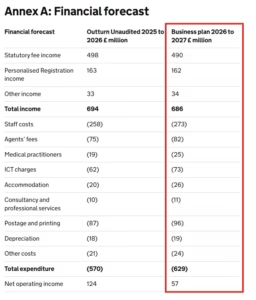
DVLA’s official financial forecast shows planned expenditure of £629 million and net operating income of £57 million for 2026–27.
Why Is DVLA’s Net Operating Income Expected to Fall by 54%?
The difference primarily reflects the combination of lower forecast income and higher planned expenditure.
Total income is projected to decline by approximately £8 million, while expenditure is expected to rise by £59 million.
Consequently, net operating income is forecast to fall by £67 million.
This is not necessarily evidence of financial distress.
DVLA is a government executive agency, not a conventional private company operating solely to maximise shareholder profits.
Its financial performance must therefore be assessed alongside statutory obligations, funding arrangements, technology investment and service quality.
Nevertheless, the figures raise reasonable questions about how rapidly efficiency benefits will materialise.
If expenditure rises faster than income, service improvements must justify the additional resources being committed.
Why Are Technology Costs Increasing?
ICT charges are expected to increase from £62 million to £73 million.
That represents approximately 17.7% growth.
This coincides with DVLA’s programme of digital transformation, including cloud migration, new customer services and increased use of AI.
It would be inaccurate to attribute the entire ICT increase to one particular project because the published forecast does not provide that level of project-by-project detail.
However, the higher spending illustrates the financial commitment associated with technological modernisation.
A successful transformation should eventually demonstrate measurable improvements in reliability, productivity or transaction costs.
Without such evidence, technology expenditure alone does not establish value for money.
Why Does Postage and Printing Spending Remain High?
The forecast includes £96 million for postage and printing, compared with £87 million in 2025–26.
This is approximately a 10.3% increase.
The figure is noteworthy because DVLA simultaneously intends to increase digital transaction adoption.
There is no automatic contradiction.
Physical documents, correspondence requirements, service volumes and supplier costs can continue to influence spending even as more services move online.
However, our assessment is that postage and printing should remain an important expenditure category to monitor.
If digital adoption rises sustainably, stakeholders will reasonably want to understand how that affects physical processing costs over subsequent years.
Does the £5 Million Savings Target Mean DVLA Will Spend Less?
No.
The plan aims to deliver more than £5 million in efficiency savings, but total expenditure is still forecast to increase.
The £5 million threshold represents approximately 0.8% of the agency’s £629 million expenditure forecast.
Savings can occur within individual processes while total spending rises because of other commitments.
DVLA states that efficiency benefits will be reinvested to protect and improve services.
From a financial management perspective, the important questions are whether the savings are recurring, whether they are realised and whether customers experience measurable improvements.
Another distinction is essential: the more than £8 billion in annual vehicle tax collected for HM Treasury is not the same as DVLA’s £686 million forecast agency income.
Confusing the two would significantly misrepresent the organisation’s financial position.
How Will the DVLA Business Plan Affect UK Businesses and Fleet Operators?
The plan’s commercial impact will vary considerably between organisations.
Businesses with large vehicle fleets or substantial numbers of professional drivers will generally have more exposure to DVLA-related administration than businesses with limited transport requirements.
Fleet Management and Vehicle Administration
Faster processing of online registration certificates could improve administrative predictability when eligible transactions fall within the new targets.
Fleet managers should review how driving entitlement, vehicle registration, tax renewals and ownership changes are recorded.
Greater digital access may reduce individual administrative tasks, but the benefits will depend on whether existing business processes can integrate effectively with the available services.
Logistics and Delivery Businesses
For delivery companies, maintaining valid driver licences and compliant vehicles is fundamental to operating legally.
Medical licensing times may be particularly relevant where the right to drive depends on a medical decision.
Small delivery businesses and self-employed couriers should also assess the wider relationship between vehicle taxation, insurance and operating expenses.
For example, the financial viability of delivery work depends on more than gross revenue. Our breakdown of Amazon Flex vehicle requirements, insurance and delivery costs illustrates why vehicle-related expenditure needs to be included when estimating actual business earnings.
DVLA’s reforms may improve administrative services, but they will not eliminate the need for drivers and operators to manage their compliance obligations.
Motor Traders and Vehicle Dealerships
Dealerships depend on accurate registration information and reliable processing.
The commitment to faster qualifying online vehicle registration certificate applications may benefit some aspects of vehicle administration.
Digital systems could also support more convenient access to information.
However, businesses should distinguish a published service target from confirmed improvement in the specific transactions they use.
Insurance and Vehicle Data Services
Insurers rely on accurate information when assessing vehicle and driver-related risks.
DVLA’s emphasis on responsible data use, improved records and modernised technology may support a stronger information environment.
However, future integrations, data access permissions and commercial availability should not be assumed merely because the agency is investing in digital infrastructure.
What Is Electric Vehicle Excise Duty, and Why Does the 2026–27 Plan Mention It?
One of the most financially important commitments concerns preparations for Electric Vehicle Excise Duty, commonly abbreviated to eVED.
The government intends to introduce this new mileage-based tax from 1 April 2028.
The 2026–27 DVLA business plan includes work needed to support that intended implementation date.
The proposed tax is separate from existing vehicle taxation arrangements and is intended to make contributions more closely reflect the distance travelled by qualifying vehicles.
Under the published proposals, the initial rates are:
| Vehicle category | Proposed eVED rate |
| Battery electric cars | 3p per mile |
| Hydrogen fuel-cell cars | 3p per mile |
| Plug-in hybrid cars | 1.5p per mile |
These rates relate to qualifying cars, not a blanket charge on every electrically powered commercial vehicle.
The measure requires the necessary legislation and implementation arrangements, so businesses should monitor the final rules before treating the proposals as settled operating costs.
How Much Could eVED Cost a Business?
The following examples show the additional annual mileage-based charge using the government’s published initial rates.
| Annual mileage | Battery electric or hydrogen car | Plug-in hybrid car |
| 8,000 miles | £240 | £120 |
| 12,000 miles | £360 | £180 |
| 20,000 miles | £600 | £300 |
These are illustrative calculations, not personalised tax assessments. They exclude existing VED, insurance, charging, maintenance and other expenses.
Consider a business operating 50 qualifying battery electric cars, each travelling 15,000 miles annually.
At 3p per mile, the illustrative annual eVED cost would be £22,500 across the fleet.
For a business with thin operating margins, that additional expenditure could be commercially relevant.
It may influence vehicle selection, pricing, leasing decisions and transport budgets.
Will Businesses Need to Report Vehicle Mileage?
Under the proposed system, drivers or registered keepers will provide an odometer reading and estimate mileage for the coming tax period.
Payments may be made upfront or spread across the year, with a later reconciliation against actual mileage.
For businesses operating multiple vehicles, accurate mileage records will become especially valuable.
The government has also indicated that special arrangements are intended for leasing and rental businesses, including the ability to estimate mileage centrally.
These details matter because large fleets may otherwise face more substantial administrative costs than individual motorists.
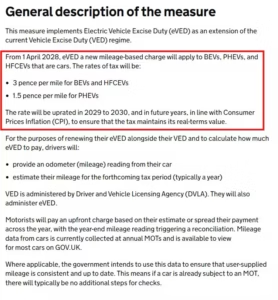
The government’s Electric Vehicle Excise Duty proposals set out mileage-based rates of 3p and 1.5p per mile for qualifying cars from April 2028.
How Will DVLA Use Artificial Intelligence and Customer Data?
DVLA intends to implement an AI Action Delivery Plan by March 2027.
The programme includes applications involving complaints, contact centre support, government communications and software development.
The identified uses include:
- Copilot support in complaints handling.
- Gov Voice.
- AI assistance within the contact centre.
- AI-supported software development.
These projects are intended to improve efficiency and operational decision-making.
For public bodies processing substantial amounts of personal information, however, AI adoption introduces governance considerations.
DVLA’s plan explicitly includes ethics, legal compliance, transparency, data protection and accountability.
Our assessment is that these safeguards are essential, particularly where technology may contribute to decisions affecting an individual’s ability to drive.
The success of AI should therefore be measured through more than reductions in processing time.
Accuracy, fairness, transparency and the availability of appropriate human oversight are equally important considerations.
Businesses using comparable technologies should apply similar principles when introducing automation into customer support, compliance and employee management.
What Are DVLA’s Workforce and Sustainability Commitments?
The business plan also contains objectives concerning employee development, wellbeing and environmental performance.
| Area | Commitment |
| Apprenticeships | Minimum of 110 |
| Employee development | £3 million budget, with 95% utilisation targeted |
| Wellbeing training | 70% of employees to receive Prevail training |
| Sickness absence | Reduction of more than 10% |
| Workplace accidents | Reduction of 15% |
| Carbon emissions | Reduction of at least 8% against the 2024–25 baseline |
A 95% utilisation target on a £3 million development budget would be equivalent to £2.85 million.
For a large public organisation undergoing technological change, workforce investment is important because digital infrastructure alone cannot deliver effective services.
Employees need appropriate skills, management support and operational training.
The environmental objectives also sit alongside DVLA’s broader commitment to supporting the transition towards lower-emission transport.
Its programme includes reducing emissions associated with business travel and buildings while increasing the use of zero-emission vehicles within the agency’s fleet.
Important DVLA Business Plan Deadlines for 2026 and 2027
Several major commitments have specific target dates.
| Date | Planned development |
| November 2026 | Migration of the drivers register to the cloud platform |
| December 2026 | Digital MOT reminders through the Driver and vehicles account |
| December 2026 | 90% of complaints resolved within 20 days |
| January 2027 | Average call and chat answering time below 10 minutes |
| March 2027 | Vehicle tax functionality through the Driver and vehicles account |
| March 2027 | Digital transaction share of 85% |
| March 2027 | Average medical licensing decision time of 45 working days |
| March 2027 | 90% of complaints resolved within 15 days |
| March 2027 | Implementation of the AI Action Delivery Plan |
| April 2028 | Intended commencement of Electric Vehicle Excise Duty |
These dates represent planned milestones, not confirmation that the services have already been launched.
Business owners should pay particular attention to the distinction when updating operational procedures.
What Should UK Business Owners Do in Response to the DVLA Plan?
The most practical response is not to redesign every vehicle-related process immediately.
Instead, businesses should identify areas where upcoming changes could affect compliance, expenditure or administrative efficiency.
Review Driver and Vehicle Records
Businesses should ensure that employee driving entitlement and vehicle registration information are accurate and appropriately verified.
Driving licence status should be checked using the proper processes rather than relying solely on employees presenting historical documents.
Reassess Fleet Operating Budgets
Organisations operating qualifying electric and plug-in hybrid cars should begin modelling the potential impact of eVED from 2028.
This is especially important for higher-mileage fleets.
The purpose is not to assume that every proposed detail is final, but to understand the sensitivity of operating costs to future taxation.
Monitor Digital Services
Finance and operations teams should review new DVLA digital functions as they become available.
However, internal systems should not be changed until the organisation has confirmed that the relevant services support its requirements.
Maintain Compliance Contingencies
Although DVLA is targeting high levels of digital availability, no major online service is completely immune from disruption.
Businesses should maintain appropriate records, renewal schedules and procedures for dealing with unavailable services.
Turn Targets Into Measurable Business Objectives
There is also a broader management lesson.
DVLA’s approach connects operational improvements to numerical targets, deadlines and financial forecasts.
Private businesses can apply a similar framework when developing internal plans.
For entrepreneurs who want to create measurable objectives rather than rely on general growth ambitions, writing a business plan with realistic financial forecasts and performance milestones provides a useful starting point.
The important principle is to measure actual outcomes against the original assumptions and revise plans when the evidence changes.
What Are the Main Risks and Weaknesses in DVLA’s 2026–27 Business Plan?
Our financial and operational assessment identifies several areas that deserve further scrutiny.
- Financial pressure: Planned expenditure is rising by approximately 10.4%, while forecast income is declining by 1.2%. This makes the value delivered by additional spending especially important.
- Technology implementation risk: Major system migrations can involve operational and data-security challenges. Delivery against the November 2026 milestone will be important.
- Customer service performance: The 99% application dispatch targets are ambitious, but they do not apply universally to postal and complex applications.
- Unfinished performance measurement: DVLA intends to develop stronger measures for customer satisfaction, transaction costs and productivity. Their absence as fully developed comparable measures limits independent assessment of efficiency improvements.
- Business administration costs: The introduction of eVED could create additional processes for fleet operators, especially where large numbers of qualifying vehicles are involved.
- Planned versus actual outcomes: As the 2026–27 period is still underway, commitments should be evaluated against subsequently published performance results rather than treated as achievements.
These points do not demonstrate that the plan will fail.
They identify the areas where clearer reporting and measurable results will be needed to establish success.
Our Expert Assessment: How Strong Is the DVLA Business Plan 2026–27?
We evaluated the published plan against five editorial criteria: the clarity of its targets, potential customer benefits, financial transparency, commercial relevance and evidence supporting delivery.
The percentages below are our analytical assessments, not official DVLA ratings, customer survey findings or independently audited performance results.
| Assessment category | Our editorial rating | Assessment |
| Clarity of targets | 90% | Numerous measurable performance commitments |
| Potential customer benefits | 85% | Meaningful ambitions for service speed and accessibility |
| Financial transparency | 80% | Clear high-level forecasts, but limited project-level detail |
| Relevance to UK businesses | 78% | Important implications for fleets, drivers and future taxation |
| Delivery evidence | 62% | Several improvements remain scheduled, with outcomes yet to be demonstrated |
| Overall editorial rating | 79% | Promising but unproven |
The overall rating is the rounded, equally weighted average of the five categories.
The strongest aspect of the plan is its measurable service commitments.
The weaker area is the limited evidence currently available to establish that all planned improvements will produce the intended outcomes.
For business owners, it is therefore reasonable to view the plan as a potentially important modernisation programme while continuing to monitor actual performance.
Final Verdict: What Does the DVLA Business Plan 2026 to 2027 Mean for the UK?
The DVLA business plan 2026 to 2027 represents a significant programme of administrative and technological change.
Its central commitments include faster online licence processing, improved customer support, greater digital adoption, modernised technology systems and preparation for future vehicle taxation arrangements.
For businesses, the implications reach beyond the convenience of individual DVLA transactions.
Fleet administration, driver compliance, electric vehicle costs and operational efficiency all deserve attention.
The financial forecasts also introduce an important consideration.
With total expenditure expected to reach £629 million and net operating income projected to fall by approximately 54%, the agency will need to demonstrate that increased spending delivers meaningful improvements.
The £5 million-plus efficiency savings commitment is encouraging, but the wider financial position makes productivity and value for money particularly important.
Our overall assessment is that the plan offers a credible framework for modernisation, supported by clearer performance targets than broad policy statements alone.
However, the decisive measure will be delivery.
For UK entrepreneurs, employers and fleet operators, the sensible approach is to understand the deadlines, review likely financial exposure and evaluate new services as they become operational.
Frequently Asked Questions
When Was the DVLA Business Plan 2026 to 2027 Published?
The official business plan was published on 19 October 2026 and covers the financial year ending 31 March 2027.
What Is the Main Objective of DVLA’s 2026–27 Business Plan?
Its main objectives are to improve customer experience, modernise digital services, use data responsibly and strengthen organisational performance.
What Is DVLA’s New Driving Licence Processing Target?
DVLA aims to dispatch 99% of qualifying online driving licence applications within three working days. This is a dispatch target, not a guaranteed delivery time.
How Much Does DVLA Expect to Spend in 2026–27?
The agency forecasts total expenditure of £629 million, compared with unaudited expenditure of £570 million in 2025–26.
Is DVLA Making a Financial Loss in 2026–27?
The plan forecasts positive net operating income of £57 million. That is lower than the previous year’s unaudited £124 million, but it is not an operating loss.
Will DVLA Introduce Digital MOT Reminders?
DVLA aims to introduce digital MOT reminders through the Driver and vehicles account by December 2026.
When Will Electric Vehicle Excise Duty Start?
The government intends to introduce the new mileage-based Electric Vehicle Excise Duty from 1 April 2028, subject to the required legislation and implementation arrangements.
Will the DVLA Business Plan Affect Fleet Operators?
Yes. Changes to registration services, driver licensing processes, digital systems and future vehicle taxation could affect fleet administration and operating costs.
What Is DVLA’s Digital Transaction Target?
DVLA aims for 85% of its transactions to be completed through digital channels by March 2027.
Where Can I Read the Official DVLA Business Plan?
The full DVLA business plan 2026 to 2027 is available through the government’s official publication service in HTML and PDF formats.