





















Business Asset Disposal Relief can reduce the Capital Gains Tax bill when an individual sells a qualifying business, partnership interest or shares in a trading company.
Previously known as Entrepreneurs’ Relief, Business Asset Disposal Relief, or BADR, remains available in the 2026/27 tax year, although it is less generous than it once was.
For qualifying disposals made from 6 April 2026, the Business Asset Disposal Relief rate is 18%. The rate was 14% between 6 April 2025 and 5 April 2026 and 10% for qualifying disposals made on or before 5 April 2025.
The relief also has a £1 million lifetime limit on qualifying gains per individual. This is a lifetime allowance rather than an amount that resets every tax year.
For business owners preparing to sell, however, simply knowing the 18% rate is not enough. BADR has detailed ownership, employment, trading and timing conditions, and the exact structure of a transaction can determine whether the relief is available at all.
What Is Business Asset Disposal Relief?
Business Asset Disposal Relief is a Capital Gains Tax relief available when certain qualifying business assets are disposed of.
It was previously called Entrepreneurs’ Relief before being renamed in 2020.
The relief does not remove Capital Gains Tax completely. Instead, it applies a special CGT rate to qualifying gains within the individual’s available lifetime limit.
For disposals from 6 April 2026, qualifying BADR gains are taxed at 18%.
That needs to be compared with the normal CGT rates applying to individuals in 2026/27:
| Type of gain | 2026/27 CGT rate |
| Gains within available basic-rate band | 18% |
| Gains above basic-rate band | 24% |
| Qualifying BADR gains | 18% |
| BADR lifetime qualifying-gain limit | £1 million |
| Individual CGT Annual Exempt Amount | £3,000 |
The ordinary CGT rates for individuals are 18% and 24%, while the individual Annual Exempt Amount is £3,000 for 2026/27.
The difference is particularly important for owners whose gains would otherwise be taxed at 24%. BADR can reduce that part of a qualifying gain to 18%.
Who Can Claim Business Asset Disposal Relief?
BADR is principally available to individuals actively involved in qualifying businesses rather than to companies themselves.
Depending on the circumstances, relief can apply when disposing of:
- All or part of a sole-trader business
- An interest in a business partnership
- Qualifying shares or securities in a personal trading company
- Certain assets personally owned but used by a partnership or personal company
- Certain business assets following the cessation of a business or
- Qualifying trust business assets where the relevant conditions are satisfied.
A company cannot simply claim BADR against its own Corporation Tax liability. This distinction becomes particularly important when deciding between a company selling its assets and shareholders selling their shares.
What Are the Business Asset Disposal Relief Conditions for Sole Traders?
A sole trader disposing of the whole or part of a business must generally have owned the business for at least two years before the disposal.
A disposal of part of a business must normally represent a genuine part of the underlying business. Simply selling an individual asset while continuing the same business does not automatically qualify.
For example, imagine a sole trader has operated an engineering business for ten years.
If the owner sells the entire engineering operation, qualifying assets within the disposal may potentially qualify for BADR.
However, if the owner simply sells one machine while continuing exactly the same engineering business, the disposal of that machine alone would not normally constitute a disposal of the whole or part of the business for BADR purposes.
This distinction is easy to overlook because BADR is sometimes described too broadly as a relief on the sale of “business assets”.
The relief is more specific than that.
How Does BADR Work for Business Partnerships?
Partners can potentially qualify when disposing of all or part of their interest in a trading partnership, provided the relevant qualifying conditions have been met.
The business generally needs to have been owned for the required two-year qualifying period.
BADR can also become relevant where an individual owns an asset personally but allows the partnership to use it.
A common example would be a commercial property personally owned by one partner but occupied by the partnership for its trade.
That property may potentially constitute an associated disposal when the partner withdraws from the partnership and disposes of the relevant business interest at the same time.
However, associated-disposal rules contain additional conditions and restrictions.
Can Company Directors Claim Business Asset Disposal Relief When Selling Shares?
Potentially, but owning shares in a company is not enough by itself.
For ordinary non-EMI shares, several conditions generally need to be satisfied throughout the two-year qualifying period before disposal.
The individual normally needs to:
- Be an employee or office holder of the company, or of another company within the same group
- Hold at least 5% of the company’s ordinary share capital
- Have at least 5% of the voting rights and
- Meet an additional 5% economic-interest test.
The company must also normally be a trading company or the holding company of a trading group.
The 5% Test Is More Than Owning 5% of the Shares
One of the most important BADR details is that simply seeing “5%” next to someone’s name on the share register does not necessarily settle the question.
For ordinary shares, the shareholder generally needs at least:
5% of ordinary share capital + 5% of voting rights
and must also satisfy an economic-interest condition.
Broadly, the shareholder must be entitled to at least 5% of either:
- Distributable profits and assets available on a winding up or
- Proceeds that would be received if all the company’s ordinary share capital were sold.
Different share classes, growth shares, preference arrangements and unusual articles of association can therefore complicate BADR eligibility even where somebody appears to own 5% or more of the company.
Does the Company Have to Be a Trading Company?
Yes, for an ordinary share disposal the company must generally be a trading company or the holding company of a trading group during the relevant period.
This can become problematic where a company has substantial non-trading or investment activities.
For instance, businesses can accumulate:
- Investment portfolios
- Investment properties
- Significant investment activity
- Substantial non-trading income or
- Other assets unconnected with the company’s trade.
The existence of investments does not automatically mean BADR is lost. However, where non-trading activity becomes significant, the company’s status requires careful examination.
This is therefore an issue worth reviewing well before a planned sale rather than discovering during transaction due diligence that the company’s BADR position is uncertain.
What Happens If Your Shareholding Falls Below 5%?
Growing companies frequently issue additional shares when bringing in investors.
That can dilute a founder’s holding.
For example, suppose a founder originally owns 8% of a company but a funding round causes the holding to fall to 4.5%.
Ordinarily, falling below the required ownership threshold could affect BADR on a later disposal.
However, special dilution rules may allow an individual to elect to be treated as making a disposal and reacquisition immediately before the share issue that caused the dilution.
This can preserve BADR in respect of the gain accrued while the qualifying conditions were met, subject to the detailed election requirements.
This is an important planning issue for founders because waiting until the eventual company sale to examine dilution may be too late.
Do EMI Shares Qualify for Business Asset Disposal Relief?
Enterprise Management Incentive shares receive different BADR treatment.
For qualifying EMI shares, the ordinary 5% shareholding requirement does not generally need to be met.
Instead, important conditions include the option having been granted at least two years before the shares are disposed of.
GOV.UK states that qualifying shares need to have been acquired after 5 April 2013 and that the option must have been granted at least two years before the sale.
This makes BADR particularly reant to employees and directors holding relatively small stakes acquired through qualifying EMI options.
However, disqualifying events, the timing of exercise and other EMI requirements can affect the final tax treatment.
What Happens When a Business Stops Trading?
Ceasing to trade does not necessarily mean BADR disappears immediately.
Where the qualifying conditions are met, assets may still qualify where they are disposed of within the relevant post-cessation period.
For a sole trader or partnership business that has ceased, qualifying business assets generally need to be disposed of within three years of cessation.
A similar three-year rule can apply when a company stops being a trading company before qualifying shares are sold.
For example:
A business stops trading on 30 September 2026 after satisfying the required ownership conditions.
The owner does not necessarily have to dispose of every remaining qualifying asset on 30 September itself.
But delaying disposal beyond the permitted post-cessation window can jeopardise BADR.
Can You Claim BADR on a Commercial Property Used by Your Company?
Potentially.
An individual may own a property personally while their partnership or personal company uses it for business.
Selling that asset can sometimes qualify as an associated disposal if it accompanies a qualifying withdrawal from the underlying business.
But the rules are not as simple as saying:
“My company used the building, so the property qualifies.”
The associated-disposal conditions must be satisfied.
HMRC also states that relief can be restricted where:
- The asset was only used by the business for part of the ownership period
- Only part of the asset was used for the business
- The owner was involved in the business for only part of the relevant period or
- Rent was charged for the business’s use of the asset.
Receiving commercial rent can therefore reduce the proportion of the gain qualifying for BADR.
This is particularly important for directors who personally own their trading premises.
Can Landlords Claim Business Asset Disposal Relief?
Ordinary property letting is generally not treated as a trade for BADR purposes.
Historically, qualifying Furnished Holiday Letting businesses could benefit from special capital-gains treatment.
That position has changed.
The special Furnished Holiday Lettings tax regime was abolished from 6 April 2025 for Income Tax and Capital Gains Tax purposes.
HMRC states that an FHL business is no longer treated as a trade for BADR purposes from that date, subject to limited transitional circumstances involving businesses that genuinely ceased before the abolition date.
Owners relying on older articles saying holiday lets automatically qualify for BADR should therefore be particularly careful.
How Much Business Asset Disposal Relief Can You Claim?
The current lifetime limit is £1 million of qualifying gains per individual.
This does not mean the maximum tax saving is £1 million.
It means up to £1 million of qualifying lifetime gains can potentially receive the BADR rate.
It is also not a £1 million annual allowance.
Suppose someone previously claimed BADR on £350,000 of qualifying gains.
Their remaining lifetime capacity would normally be:
£1,000,000 − £350,000 = £650,000
A later qualifying disposal producing an £800,000 gain could therefore potentially receive BADR on only £650,000, assuming all other conditions are satisfied.
The balance would be taxed under the applicable ordinary CGT rules.
HMRC therefore recommends maintaining records of previous BADR claims.
Can a Husband and Wife Each Claim £1 Million?
Potentially.
The lifetime limit applies to the individual.
Spouses and civil partners therefore have separate BADR lifetime limits, provided each person independently meets the qualifying conditions for the relevant disposal.
Simply transferring shares shortly before a sale does not automatically create eligibility for a second £1 million BADR limit because the recipient must satisfy the relevant ownership, employment and qualifying-period requirements.
For owners contemplating succession or family ownership arrangements, this is one reason tax planning should begin well before a transaction is agreed.
How Is Business Asset Disposal Relief Calculated?
A simplified calculation starts with the qualifying capital gain.
Broadly:
Sale proceeds − allowable acquisition cost − allowable disposal costs − other relevant allowable costs = capital gain
Applicable capital losses and the Annual Exempt Amount may then affect the taxable gain.
For 2026/27, the individual Capital Gains Tax Annual Exempt Amount is £3,000.
Example of BADR in 2026/27
Suppose an owner sells qualifying company shares and makes a gain of £500,000.
Assume:
- The full gain qualifies for badr
- There are no other capital gains or losses
- The £3,000 annual exempt amount is available and
- The owner has not previously used any of their £1 million badr lifetime limit.
Taxable gain:
£500,000 − £3,000 = £497,000
BADR tax at 18%:
£497,000 × 18% = £89,460
If the same £497,000 would otherwise all have been taxed at the normal 24% CGT rate:
£497,000 × 24% = £119,280
Potential difference:
£119,280 − £89,460 = £29,820
The calculation demonstrates why BADR can remain valuable despite its rate increasing to 18%.
Actual calculations can be more complicated where somebody has other gains, capital losses, part of their basic-rate band available or previous BADR claims.
Is BADR Still Worth Claiming at 18%?
Yes, where the normal alternative would be the 24% CGT rate and the qualifying conditions are satisfied.
The headline difference is six percentage points.
On £1 million of taxable qualifying gains, ignoring allowances and other complications purely for illustration:
| Tax treatment | Rate | Tax on £1m |
| BADR | 18% | £180,000 |
| Normal higher CGT rate | 24% | £240,000 |
| Illustrative difference | — | £60,000 |
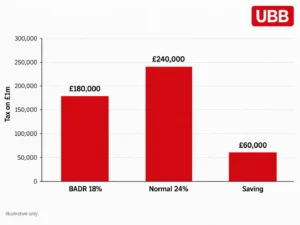
For someone whose gain would otherwise fall wholly within the ordinary 18% CGT rate, the immediate rate advantage can be limited or nonexistent.
However, a large business-sale gain can itself push significant amounts above the basic-rate band, so the calculation should be made using the owner’s full income-and-gains position rather than simply their normal Income Tax status.
Does the £3,000 Capital Gains Tax Allowance Apply With BADR?
Yes.
The Annual Exempt Amount remains relevant when calculating an individual’s overall taxable capital gains.
For 2026/27, the allowance is £3,000.
Where a person has gains subject to different CGT rates, the tax rules permit the allowance to be used in the way that produces the most beneficial tax result.
BADR should therefore not be calculated in isolation from other disposals made during the tax year.
What Is the Difference Between a Share Sale and an Asset Sale?
This is one of the most important issues for limited-company owners.
Suppose a company operates a profitable manufacturing business.
There are two fundamentally different ways a buyer might acquire it.
Share Sale
The shareholders sell their shares in the limited company.
The shareholders themselves potentially realise capital gains.
If the BADR conditions are satisfied, qualifying gains on the shares may benefit from the 18% BADR rate.
Company Asset Sale
Instead of buying the company, the buyer purchases assets such as:
- Equipment
- Intellectual property
- Contracts
- Stock
- Premises and
- Goodwill.
The company receives the proceeds.
The company may therefore face Corporation Tax consequences rather than the shareholder immediately making a personal capital gain.
The shareholder may then incur further tax when extracting the sale proceeds from the company.
That means an offer of £1 million for company shares can produce a substantially different after-tax outcome from the company selling £1 million of underlying assets.
Anyone preparing for an exit should therefore consider transaction structure alongside how to value a business. The headline valuation does not by itself determine how much money the owner ultimately retains.
Does Goodwill Always Qualify for BADR?
No.
Goodwill can qualify in some genuine business disposals, but special restrictions apply.
In particular, HMRC rules can prevent BADR applying to goodwill where an individual transfers a business to a close company and the individual, together with relevant connected persons, retains the required interest in the purchasing company.
This restriction is designed to stop certain incorporations or connected-company transfers from automatically generating BADR on internally created goodwill.
Business owners incorporating an existing sole-trader or partnership business should therefore not assume that placing a value on goodwill automatically creates a BADR-qualifying gain.
When Must Business Asset Disposal Relief Be Claimed?
BADR is not automatically applied simply because a disposal meets the conditions.
A claim must be made.
Individuals can generally claim through their Self Assessment tax return or by using the appropriate BADR claim procedure.
The deadline is the first anniversary of 31 January following the end of the tax year in which the qualifying disposal occurred.
For example, HMRC confirms that the deadline for claiming BADR on a qualifying disposal during the 2025/26 tax year is 31 January 2028.
Records supporting the claim should therefore be retained carefully.
These might include:
- Share registers
- Articles of association
- Employment or director records
- Option agreements
- Partnership agreements
- Acquisition documents
- Business accounts
- Evidence of trading activity
- Sale contracts
- Professional fees
- Previous badr claims and
- Evidence relating to personally owned business assets.
Can You Claim BADR More Than Once?
Yes.
There is no restriction saying BADR can only be claimed on one business sale.
An individual can potentially make several qualifying claims over their lifetime.
However, the total qualifying gains receiving BADR are subject to the available £1 million lifetime limit.
A founder could therefore sell one business, claim BADR and later claim again when selling another qualifying business, provided unused lifetime capacity remains and the later transaction independently satisfies the rules.
What Happens If a Business Sale Straddles a BADR Rate Change?
Sale timing can matter, particularly where tax rates change between tax years.
However, attempting to create an earlier disposal date simply through contractual arrangements can be affected by anti-forestalling legislation.
HMRC has specific rules dealing with unconditional contracts entered into before the 2025 and 2026 BADR rate increases.
For arrangements involving the April 2026 increase, HMRC states that an unconditional contract entered into during 2025/26 but completed on or after 6 April 2026 can be treated under the anti-forestalling rules so that the disposal date is the completion date unless the relevant conditions for disapplying the rule are satisfied.
The practical lesson is that sale timing should not be manipulated solely on the assumption that signing a contract automatically secures an earlier BADR rate.
What Are the Most Common Business Asset Disposal Relief Mistakes?
Several recurring issues can cause an expected BADR claim to fail or be reduced.
Assuming Every Business Asset Qualifies
Selling a van, machine or property from a continuing business does not automatically constitute a qualifying disposal of the business.
Checking the 5% Shareholding Too Late
Different share classes, investor funding and dilution can cause problems even where the founder believes they own 5%.
Ignoring Economic Rights
Voting rights and nominal share ownership are only part of the test. Profit, winding-up or sale-proceeds entitlements can also matter.
Leaving Tax Planning Until a Buyer Is Found
BADR conditions commonly need to be satisfied over two years. Some problems cannot be repaired a few weeks before completion.
Assuming an Investment Company Is a Trading Company
Substantial investment or non-trading activity can create eligibility questions.
Charging Rent on a Personally Owned Business Asset
Rent received for an asset used by the owner’s company or partnership can restrict relief on an associated disposal.
Relying on Old Furnished Holiday Let Guidance
The special FHL treatment ended from April 2025.
Forgetting Previous Entrepreneurs’ Relief Claims
Earlier Entrepreneurs’ Relief and BADR claims can use part or all of the individual’s lifetime limit.
Confusing a Company Asset Sale With a Share Sale
The tax consequences can be fundamentally different.
What Should Business Owners Check Before Selling?
BADR planning ideally begins before the business goes to market.
A useful pre-sale review should examine:
- Business structure: Is the owner a sole trader, partner or shareholder?
- Ownership period: Have the necessary conditions existed for at least two years?
- Trading status: Is the company genuinely a trading company or trading group?
- Share percentage: Does the shareholder satisfy the 5% ownership and voting tests?
- Economic rights: Does the shareholder meet the required profit, winding-up or sale-proceeds test?
- Employment: Has the shareholder been an employee or office holder throughout the qualifying period?
- Share dilution: Have funding rounds affected the 5% threshold?
- EMI status: Are shares derived from qualifying EMI options?
- Personally owned assets: Are premises or other assets owned outside the company?
- Rent: Has the business paid the owner for using those assets?
- Previous claims: How much of the £1 million lifetime limit remains?
- Transaction structure: Is the proposed deal a share sale or an asset sale?
- Cessation: Has the business already stopped trading?
- Other gains and losses: How will they affect the CGT calculation?
- Documentation: Is sufficient evidence available to support the claim?
Reviewing these issues before heads of terms are signed provides far more scope to identify problems than checking BADR after completion.
What Other Capital Gains Tax Reliefs Might Apply?
BADR is not the only relief available in connection with business assets.
Depending on the circumstances, other regimes can include:
- Business Asset Rollover Relief
- Gift Hold-Over Relief
- Incorporation Relief
- Investors’ Relief and
- reliefs connected with qualifying investment schemes.
These reliefs achieve different outcomes.
Some reduce the rate of tax, while others postpone a gain until a later event.
They should therefore not be treated as interchangeable alternatives to BADR.
Is Business Asset Disposal Relief the Same as Entrepreneurs’ Relief?
Essentially, Business Asset Disposal Relief is the modern name for Entrepreneurs’ Relief.
The relief was renamed from 6 April 2020.
Older contracts, tax returns, articles and professional documents may therefore still refer to Entrepreneurs’ Relief.
Previous qualifying claims made under the old name remain relevant when calculating how much of the current lifetime limit an individual has already used.
Final Thoughts
Business Asset Disposal Relief remains an important consideration for UK business owners selling a qualifying business or company shares in 2026.
From 6 April 2026, qualifying gains are taxed at 18%, compared with the ordinary CGT rate of up to 24% for individuals. The relief continues to apply to a maximum of £1 million of qualifying lifetime gains per person.
But the headline rate is only one part of the calculation.
Sole traders must consider whether they are genuinely disposing of all or part of a business. Company shareholders need to examine the two-year ownership requirement, employment status, trading-company status, 5% voting and shareholding requirements and economic rights.
EMI shareholders have different rules, while personally owned assets, share dilution, cessation dates and previous BADR claims can create additional complications.
The structure of the sale matters just as much. A shareholder selling company shares and a company selling its underlying assets can face very different tax consequences even where the buyer is paying the same headline price.
For that reason, BADR should normally be reviewed as part of business-sale planning rather than treated as a calculation to perform once the deal has already completed.
Frequently Asked Questions
What is the Business Asset Disposal Relief rate in 2026?
For qualifying disposals made from 6 April 2026, the BADR Capital Gains Tax rate is 18%.
What is the Business Asset Disposal Relief lifetime limit?
An individual can generally claim BADR on up to £1 million of qualifying gains over their lifetime.
How long must you own a business to qualify for BADR?
The relevant qualifying conditions generally need to be satisfied for at least two years before the disposal or relevant cessation date.
Do you need to own 5% of a company to claim BADR?
For ordinary company shares, a 5% shareholding, voting-right and economic-interest test generally applies. Special rules apply to qualifying EMI shares.
Can a sole trader claim Business Asset Disposal Relief?
Yes. A sole trader can potentially claim BADR when disposing of the whole or a qualifying part of a business after meeting the required conditions.
Can landlords claim BADR?
Ordinary property letting generally does not qualify as a trade. The special Furnished Holiday Lettings CGT treatment ended from 6 April 2025, subject to limited transitional circumstances.
Can BADR be claimed after a business closes?
Potentially. Qualifying assets can in certain circumstances be disposed of within three years after the business ceases.
Can you claim Business Asset Disposal Relief more than once?
Yes. Multiple claims are possible, but total qualifying gains remain subject to the individual’s available lifetime BADR limit.
Can a company claim BADR?
BADR is generally claimed by qualifying individuals and certain trustees rather than by the trading company itself.
Does the £3,000 CGT allowance apply to BADR?
Yes. For individuals, the Capital Gains Tax Annual Exempt Amount is £3,000 for 2026/27 and should be considered when calculating the final taxable gains.
Is Business Asset Disposal Relief automatically given?
No. A qualifying taxpayer must make a valid claim within the applicable HMRC deadline.
Is Business Asset Disposal Relief still worth claiming in 2026?
It can be. Where qualifying gains would otherwise be taxed at the 24% CGT rate, the 18% BADR rate can still produce a significant tax saving.