



















How much will UC pay towards private rent in 2027? Universal Credit can cover some or all of an eligible tenant’s rent, but there is no fixed national payment. The amount normally depends on the property’s location, household bedroom entitlement, eligible rent and the claimant’s overall Universal Credit circumstances.
For most private tenants, the starting housing costs calculation uses whichever is lower: their eligible monthly rent or their applicable Local Housing Allowance (LHA) rate.
For example, a household paying £1,100 monthly rent with an LHA limit of £850 would normally have a maximum housing costs amount of £850 before other relevant adjustments. That represents 77.3% of the rent, leaving a monthly shortfall of £250.
The most important development for 2027 is that the government has confirmed another freeze in Local Housing Allowance rates.
On 28 October 2026, the Department for Work and Pensions confirmed that LHA rates would not increase in 2027–28 across Great Britain. These rates were previously frozen for 2026–27 at the levels introduced in April 2024.
However, the government has also published proposed increases to several other Universal Credit amounts for April 2027. This means some households may receive more Universal Credit overall without receiving a higher LHA allowance.
Our analysis examines the official figures, the financial implications for private tenants and the practical differences between a household’s maximum housing costs element and its actual monthly Universal Credit payment.
How Much Will Universal Credit Pay Towards Private Rent in 2027?
Universal Credit can recognise up to 100% of eligible private rent where the contractual rent is no higher than the applicable LHA ceiling. However, the claimant’s total UC award can still be reduced by earnings, capital, the benefit cap or other deductions.
The basic calculation is:
Starting UC housing costs amount = Lower of eligible monthly rent or applicable monthly LHA rate.
The following table demonstrates how this works using an illustrative £900 monthly LHA rate.
| Monthly private rent | Starting housing amount | Monthly shortfall | Rent covered |
| £700 | £700 | £0 | 100% |
| £900 | £900 | £0 | 100% |
| £1,000 | £900 | £100 | 90% |
| £1,200 | £900 | £300 | 75% |
| £1,500 | £900 | £600 | 60% |
| £1,800 | £900 | £900 | 50% |
These are illustrative calculations, not guaranteed UC payments or national LHA rates.
The table highlights an important financial principle.
Once eligible rent exceeds the applicable LHA ceiling, a further rent increase does not normally increase the housing costs element.
Someone paying £1,500 with a £900 LHA limit therefore faces a £600 monthly shortfall, equivalent to £7,200 annually.
This is why renters should calculate the actual affordability of a tenancy rather than assuming that Universal Credit will increase whenever their landlord raises the rent.
What Are the New Universal Credit Private Rent Rules for 2027?
The most significant confirmed policy decision is the continued freeze in Local Housing Allowance.
During 2024–25, rates were restored to levels based on the 30th percentile of local rental market data, subject to the relevant rules and limits.
Rates then remained unchanged for 2025–26 and 2026–27. The government has confirmed they will continue at existing levels for 2027–28.
On 10 November 2026, Work and Pensions Minister Sir Stephen Timms confirmed in a parliamentary answer that the government had decided to maintain LHA rates in 2027–28.
The decision means that the rates will not automatically follow increases in private market rents.
| Policy area | 2026–27 position | 2027–28 position |
| Local Housing Allowance | Frozen at April 2024 levels | Freeze confirmed |
| Maximum bedrooms under LHA | Four-bedroom rate | No announced change |
| Universal Credit earnings taper | 55% | No announced change |
| Benefit cap | Existing limits apply | Freeze confirmed |
| Standard UC allowances | 2026–27 amounts | Increases proposed |
| Non-dependant housing contribution | £96.55 monthly | £99.93 monthly proposed |
| Lower work allowance for eligible UC households with housing costs | £427 monthly | £442 monthly proposed |
The 2027–28 Universal Credit figures in the final three rows are from the government’s proposed rates published on 11 November 2026. They should not be treated as implemented payments before the relevant start date and final approvals.
What Does This Mean Financially?
The key distinction is that the housing allowance limit is being frozen, even though certain other parts of Universal Credit are scheduled to rise.
A household might receive a slightly higher overall UC payment in 2027 while continuing to experience the same or a larger gap between its LHA ceiling and actual rent.
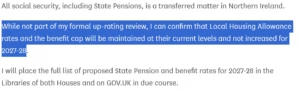
Department for Work and Pensions written statement of 28 October 2026 confirming that Local Housing Allowance rates and the benefit cap will not increase for 2027–28.
What Are the Local Housing Allowance Rates for 2026–27 and 2027–28?
Local Housing Allowance is not a single payment rate across the United Kingdom.
Instead, it is calculated by geographical areas known as Broad Rental Market Areas, or BRMAs.
Each area has separate amounts for shared accommodation and properties requiring one, two, three or four bedrooms.
Our comparison of official monthly Universal Credit LHA figures demonstrates how widely the allowances vary across regions.
| Broad Rental Market Area | Shared rate | 1 bedroom | 2 bedrooms | 3 bedrooms |
| Birmingham | £341.58 | £695 | £750 | £825 |
| Central Greater Manchester | £411.58 | £775 | £875 | £950 |
| Leeds | £347.62 | £675 | £775 | £850 |
| Bristol | £511.33 | £900 | £1,095 | £1,300 |
| Central London | £829.83 | £1,439.97 | £1,793.98 | £2,160.02 |
| Greater Glasgow | £450 | £695 | £850 | £970 |
| Lothian | £475 | £750 | £970 | £1,375 |
| Cardiff | £366.10 | £650 | £825 | £925 |
| Swansea | £375 | £525 | £550 | £600 |
Source basis: Official DWP monthly Universal Credit LHA tables for April 2026 to March 2027. The confirmed 2027–28 freeze means these existing Great Britain rates are expected to continue; the formal 2027–28 area tables should still be checked when published.
These are the rates for the named rental market areas, not necessarily every postcode commonly described as part of the same city.
For example, Central London’s rate should not be applied automatically to every London borough.
A household’s exact postcode can place it within a different BRMA and therefore produce a different allowance.
Northern Ireland has separate published rates and administrative arrangements. For example, the Belfast BRMA has a 2026–27 monthly shared accommodation rate of £329.15, a one-bedroom rate of £605.47 and a two-bedroom rate of £676.86.
Claimants should consult nidirect or the Northern Ireland Housing Executive for their applicable rates rather than assume the Great Britain table applies.
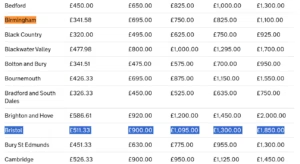
Official DWP monthly Universal Credit Local Housing Allowance rates for 2026–27, comparing shared accommodation and one-to-four-bedroom allowances.
How Can You Check How Much UC Will Pay Towards Your Rent by Postcode?
The most reliable way to estimate private rent support is to check the property’s actual postcode rather than use a national average or an allowance quoted for a neighbouring town.
Follow these steps.
Step 1: Identify Who Lives in the Property.
Record the adults, children and their ages, along with any circumstances involving disability, overnight care or other relevant bedroom-entitlement exceptions.
Step 2: Calculate the Bedroom Entitlement.
Universal Credit uses the number of bedrooms the household is recognised as needing. This can differ from the number of bedrooms in the rented property.
Step 3: Check the Applicable Local Rate.
Visit the official Local Housing Allowance postcode checker.
Enter the property’s postcode, select the relevant bedroom entitlement and choose the appropriate period.
The checker will help identify the applicable local rate. Since its search fields are designed around Housing Benefit periods and can display weekly amounts, Universal Credit claimants should also check the DWP’s published monthly UC tables or their UC statement.
Step 4: Compare the Rate With Eligible Rent.
If the property costs £1,050 monthly and the applicable UC LHA limit is £825, the starting housing amount is normally £825.
Step 5: Estimate the Total Uc Award.
Check earnings, savings, other adults living at the property, the benefit cap and other applicable deductions.
Step 6: Calculate the Amount the Household Must Cover.
Subtract the starting housing amount from eligible rent, then separately consider whether the household’s total UC payment is further reduced.
For a more complete entitlement estimate, the government lists free benefits calculators, including Turn2us, entitledto and Policy in Practice.
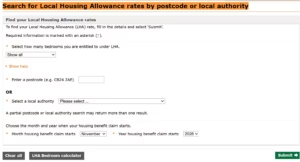
Valuation Office Agency postcode search showing the fields used to check Local Housing Allowance rates for a specific rental property.
How Much Private Rent Could UC Cover for Different Households?
Our financial comparison shows why household circumstances and regional rental limits matter more than a single advertised monthly allowance.
The examples below use published 2026–27 LHA figures as the basis for calculating possible housing coverage.
| Household example | Monthly rent | LHA ceiling | Shortfall | Starting rent coverage |
| Single under 35, Birmingham, shared rate applies | £750 | £341.58 | £408.42 | 45.5% |
| Single aged 35+, Birmingham, one-bedroom rate | £700 | £695 | £5 | 99.3% |
| Single aged 35+, Leeds, one-bedroom rate | £900 | £675 | £225 | 75% |
| Family entitled to two bedrooms, Bristol | £1,250 | £1,095 | £155 | 87.6% |
| Family entitled to two bedrooms, Cardiff | £1,000 | £825 | £175 | 82.5% |
| Couple entitled to one bedroom, Lothian | £1,100 | £750 | £350 | 68.2% |
| Couple entitled to one bedroom, Central London | £1,800 | £1,439.97 | £360.03 | 80% |
All examples are illustrative. They assume the stated LHA category applies and exclude other UC reductions. A family may have a different bedroom entitlement from the one assumed here.
Consider the Leeds example.
A tenant paying £900 monthly rent with a £675 allowance limit must find £225 every month.
Over twelve months, this represents £2,700.
For a household with limited disposable income, this amount can materially affect spending on food, electricity, transport and other essentials.
Our analysis suggests that the most useful percentage is not simply the proportion of rent covered by LHA, but the proportion of total household income remaining after rent and other essential expenses.
How Many Bedrooms Will Universal Credit Pay for in 2027?
Universal Credit normally uses bedroom allocation rules based on the household’s composition.
For standard private renting calculations, the following rules apply.
| Household members | Normal bedroom arrangement |
| Adult couple | One bedroom together |
| Single adult aged 16 or over | One bedroom |
| Two children under 10 | Expected to share, regardless of sex |
| Two children under 16 of the same sex | Expected to share |
| Children who cannot be paired under these rules | Separate bedroom entitlement may apply |
| Qualifying disabled adult or child | Extra bedroom may be allowed |
| Qualifying non-resident overnight carer | Additional bedroom may be allowed |
For example, a couple with two children aged six and eight would normally be recognised as needing two bedrooms.
However, a family with children who cannot share under the applicable rules could qualify for additional bedrooms.
A larger house does not automatically create a higher housing allowance.
If a couple without children rents a three-bedroom property, the household will normally remain subject to the one-bedroom LHA rate.
Similarly, private tenants are not simply subject to the same spare-bedroom percentage reductions applied to qualifying council or housing association tenants.
The relevant private renting calculation is normally determined by the applicable LHA bedroom category.
Can Disabled People Qualify for an Extra Bedroom?
Yes, in qualifying circumstances.
An additional bedroom can be recognised where an adult or child cannot reasonably share because of a relevant disability or medical condition, or where overnight care from a non-resident carer meets the rules.
However, receiving a disability benefit does not automatically give every claimant an additional bedroom.
The precise entitlement depends on the qualifying benefit, care requirements and statutory conditions.
Disability may also affect access to other household support. For example, some households can qualify for Council Tax reductions linked to disability under separate rules.
How Much UC Will Pay Towards Rent if You Are Single and Under 35?
A single claimant under 35 who lives alone and has no dependent children will generally be restricted to the shared accommodation LHA rate.
This can apply even if they choose to rent a self-contained one-bedroom flat.
For example, in Birmingham, the shared accommodation rate for 2026–27 is £341.58 per month.
If an eligible claimant rents a flat for £750 monthly, the starting housing costs amount may be limited to £341.58.
The calculation is:
- Monthly rent: £750
- Applicable shared accommodation rate: £341.58
- Monthly shortfall: £408.42
- Annual shortfall: £4,901.04
- Starting rent coverage: 45.5%
This example illustrates why someone under 35 should check their shared accommodation status before agreeing to a tenancy.
However, important exceptions exist.
Some claimants can qualify for more than the shared rate, including eligible care leavers, qualifying former hostel residents, people covered by certain MAPPA arrangements, some victims of domestic abuse or modern slavery, and claimants receiving specified disability benefits.
The rules and supporting evidence differ by exception.
A claimant should therefore check the relevant exemption rather than assume that being under 35 permanently restricts them to shared accommodation support.
Will UC Pay More Private Rent if You Have Children?
Having children can increase the household’s recognised bedroom entitlement and therefore the applicable LHA limit.
Consider a parent with one child who qualifies for the two-bedroom LHA rate in Cardiff.
The official 2026–27 Cardiff two-bedroom rate is £825 per month.
If the household rents a two-bedroom property for £1,000 monthly, the starting housing amount would normally be £825.
That produces:
- £175 monthly shortfall.
- £2,100 annual shortfall.
- 82.5% of rent recognised in the initial housing calculation.
A larger family may qualify for the three-bedroom or four-bedroom LHA rate depending on who lives in the household.
However, the maximum LHA bedroom category remains four bedrooms, even where a household requires more accommodation.
Children may also increase overall Universal Credit through child-related elements, subject to the relevant eligibility rules.
That additional UC entitlement is not the same as receiving a higher LHA bedroom rate.
Does Working Affect How Much UC Pays Towards Private Rent?
Yes. Employment earnings can reduce the overall Universal Credit award, although working does not automatically make someone ineligible for help with private rent.
Universal Credit generally uses a 55% earnings taper.
This means that for every £1 of relevant earnings above any applicable work allowance, the UC award is reduced by 55p.
Not every claimant qualifies for a work allowance. It generally applies where the claimant or their partner has responsibility for a child or limited capability for work.
For 2026–27, the lower monthly work allowance for qualifying households receiving housing costs is £427.
The proposed figure for 2027–28 is £442.
Example: Working Single Parent in 2026 Versus 2027
Consider a single parent aged 25 or over with one qualifying child born after 6 April 2017.
Assume the household has a recognised £825 monthly housing costs element and £1,200 of monthly earnings counted for UC purposes.
| UC calculation | 2026–27 | Proposed 2027–28 |
| Standard allowance | £424.90 | £443.21 |
| Child element | £303.94 | £314.58 |
| Housing costs element | £825 | £825 |
| Maximum award before earnings reduction | £1,553.84 | £1,582.79 |
| Applicable lower work allowance | £427 | £442 |
| Earnings above allowance | £773 | £758 |
| Earnings deduction at 55% | £425.15 | £416.90 |
| Illustrative UC payment | £1,128.69 | £1,165.89 |
This simplified example assumes no other elements, deductions or benefit-cap reduction.
The proposed 2027 figures would produce an increase of £37.20 in the household’s monthly UC payment.
However, the housing element itself would remain at £825.
This demonstrates the difference between an increase in overall Universal Credit and an increase in private rent support.
The financial implication: A renter must plan around their total earnings and UC award, not treat the housing costs element as a separate guaranteed cash payment.
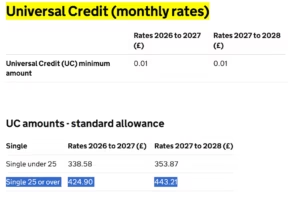
Government’s proposed Universal Credit standard allowances and work allowances for 2027–28, compared with 2026–27.
Can Self-Employed People Receive Universal Credit Towards Private Rent?
Yes. Self-employed people can receive Universal Credit housing support if their overall circumstances meet the eligibility requirements.
This includes qualifying sole traders, freelancers and some business owners.
However, the calculation can be more complicated than for someone receiving a regular salary.
Self-employed claimants generally have to report business income and allowable expenses for each Universal Credit assessment period.
Where the Minimum Income Floor applies, the DWP may calculate entitlement using an assumed level of earnings rather than the individual’s actual income in a particular month.
Some eligible claimants can receive a start-up period of up to twelve months during which the Minimum Income Floor does not apply.
For entrepreneurs, this creates an important cash-flow issue.
A business owner may have a profitable quarter but experience a month when customers pay invoices late. Universal Credit’s monthly assessment can respond differently to those fluctuations from the way annual business accounts are calculated.
Someone starting a small business in the UK while receiving Universal Credit should consider how self-employment reporting, business profits and the Minimum Income Floor could affect their housing budget.
The appropriate planning method is to calculate the household’s ability to pay rent during weaker trading months, rather than rely exclusively on annual projected profits.
Can Savings or Another Adult Reduce UC Rent Support?
Yes. Two households living in similar properties can receive very different Universal Credit payments because their financial circumstances differ.
Savings and Capital
The normal Universal Credit capital rules are:
| Assessable household capital | General treatment |
| £6,000 or less | Normally no capital-related reduction |
| Above £6,000 and up to £16,000 | Tariff-income reduction applies |
| Above £16,000 | Normally ineligible, subject to exceptions |
For assessable capital above £6,000, Universal Credit normally applies a monthly reduction of £4.35 for every £250, or part of £250, above the threshold.
For example, £10,000 in assessable savings can produce a monthly tariff-income reduction of £69.60.
This affects the overall UC award rather than changing the property’s LHA rate.
Other Adults in the Property
A non-dependant adult aged 21 or over who is not the claimant’s partner may lead to a housing costs contribution being deducted.
The standard monthly contribution is £96.55 in 2026–27, with £99.93 proposed for 2027–28.
There are several exceptions, including circumstances involving disability benefits, care responsibilities, Pension Credit and certain other arrangements.
The contribution should not be assumed to apply automatically to every adult living in the property.
Can the Benefit Cap Stop UC Covering Your Full Private Rent?
The benefit cap can reduce the total amount of benefit received by some working-age households.
For 2026–27, the monthly cap figures are:
| Household | Greater London | Outside Greater London |
| Couple or single parent | £2,110.25 | £1,835 |
| Single adult without children | £1,413.92 | £1,229.42 |
The government has confirmed that the benefit cap will remain frozen for 2027–28.
Some households are exempt from the cap, including where certain earnings, disability-related or caring conditions are satisfied.
For larger families, the benefit cap can be particularly important even where the local LHA rate is relatively high.
An eligible housing element of £1,500 does not necessarily mean the household will receive that amount on top of its other benefits.
The overall award must still be calculated.
How Much Rent Will UC Pay if Your Landlord Increases It in 2027?
An increase in contractual rent does not automatically produce an equivalent increase in Universal Credit.
Suppose a household’s applicable LHA ceiling remains £900 monthly.
| Financial position | Before rent rise | After rent rise |
| Monthly rent | £950 | £1,100 |
| LHA ceiling | £900 | £900 |
| Starting housing amount | £900 | £900 |
| Monthly shortfall | £50 | £200 |
| Annual shortfall | £600 | £2,400 |
The rent increase is approximately 15.8%.
However, because the LHA limit remains unchanged, the annual housing shortfall increases by £1,800.
That illustrates a significant weakness in planning household expenditure around a frozen benefit ceiling.
Claimants should report rent changes promptly through Universal Credit and supply evidence if required.
They should also distinguish between the amount they legally owe the landlord and the amount the DWP will recognise.
For landlords, sustainable rental pricing also depends on operating costs, maintenance and taxation. Changes to portfolio landlord taxation in 2027 may affect property investment decisions, but they do not automatically increase tenants’ Universal Credit housing entitlements.
What Can You Do if UC Does Not Cover Your Full Private Rent?
Tenants should first confirm whether the shortfall arises because of their LHA ceiling, a reduction to the overall UC award, incorrect household information or missing housing evidence.
Once the calculation is understood, additional support may be available.
England: Crisis and Resilience Fund Housing Payments
From 1 April 2026, Discretionary Housing Payments were replaced in England by Housing Payments under the Crisis and Resilience Fund.
Local authorities can provide discretionary help towards eligible housing-related costs, including rent shortfalls and certain deposits, rent-in-advance costs or moving expenses.
The amount and duration of assistance depend on the council’s assessment and scheme arrangements.
Scotland and Wales: Discretionary Housing Payments
Eligible claimants can continue to seek Discretionary Housing Payments through their local authorities.
These payments are separate from ordinary Universal Credit and are not automatically guaranteed.
Northern Ireland: Separate housing assistance
Private tenants may apply for additional discretionary housing support through the Northern Ireland Housing Executive, subject to eligibility.
For someone facing a housing shortfall, our recommended financial assessment involves three questions:
- What is the verified monthly housing costs amount?
- How much money remains after rent and essential expenditure?
- Is the difficulty temporary, or does the tenancy create a recurring shortfall that cannot be covered sustainably?
A temporary support payment may help a household avoid immediate arrears, but it should not be treated as a permanent increase in LHA entitlement.
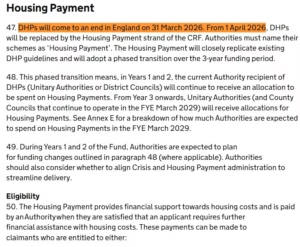
Official GOV.UK Crisis and Resilience Fund guidance explaining Housing Payments and their replacement of Discretionary Housing Payments in England from April 2026.
Can You Get UC Help With a Rent Deposit or Your First Month’s Rent?
The regular Universal Credit housing costs element is not designed to provide a separate automatic payment for a tenancy deposit.
However, qualifying claimants may be able to obtain assistance through local discretionary schemes or certain Universal Credit advances.
A first-payment advance can help with immediate financial needs while someone waits for their first ordinary UC payment.
It normally has to be repaid, and repayments can reduce future monthly payments.
A Budgeting Advance is different and may help with specified one-off costs such as a tenancy deposit or removal expenses, where the qualifying conditions are met.
It is not generally available for ordinary ongoing rent payments.
Tenants should be cautious about online promises of guaranteed emergency UC payments. There is no legitimate Universal Credit £1,500 loophole giving everyone an extra £1,500.
Similarly, households should not assume that an additional nationwide payment will automatically cover a rent shortfall. The position on Universal Credit cost of living payments is separate from ordinary monthly housing entitlement.
How Does UC Pay Private Rent in England, Scotland, Wales and Northern Ireland?
Payment arrangements are not identical throughout the United Kingdom.
| Nation | Usual Universal Credit housing payment arrangement |
| England | Usually paid to the claimant as part of monthly UC |
| Wales | Usually paid to the claimant as part of monthly UC |
| Scotland | Claimants can choose direct landlord payments or receive the housing amount themselves under Scottish Choices |
| Northern Ireland | Housing support is normally paid directly to the landlord, with options to request other arrangements where permitted |
In England and Wales, an Alternative Payment Arrangement can sometimes be established where someone struggles to manage rent or is experiencing arrears.
That may allow a managed payment to the landlord.
However, paying the landlord directly does not remove the LHA ceiling or increase the household’s underlying entitlement.
For tenants receiving payments themselves, careful budgeting is important because rent may become due before the next UC payment date.
A Universal Credit payment that arrives early because of a bank holiday also does not increase entitlement. Our coverage of DWP payment date changes explains why payment timing and payment amount are separate issues.
What Evidence Do You Need to Claim UC Towards Private Rent?
The DWP may ask for proof that the claimant is responsible for eligible housing costs and lives at the property.
Relevant evidence can include:
- A signed tenancy agreement.
- A rent statement or rent book.
- A landlord or letting-agent letter confirming the tenancy.
- The property’s full address and postcode.
- The monthly, weekly or four-weekly rent amount.
- The tenancy start date.
- Information about the landlord and any eligible service charges.
A written tenancy agreement is useful, but the absence of one does not necessarily mean the claim must fail. Other acceptable evidence may be considered.
Households should also update Universal Credit when circumstances change.
Examples include a new address, rent increase, changes in the people living at the property or a change affecting bedroom entitlement.
If the housing amount appears incorrect, the claimant should first examine their UC statement and check whether the DWP has recorded the correct rent, bedroom category and address.
Where there is an incorrect formal decision, a mandatory reconsideration may be available, usually requested within one month of the decision, subject to the relevant rules.
What Should You Check Before Signing a Private Tenancy in 2027?
Before agreeing to a new rental property, claimants should establish the difference between the advertised rent and the housing support they are likely to receive.
A useful affordability assessment should include the following.
Monthly Housing Affordability
Calculate:
- Contractual rent.
- Verified LHA ceiling.
- Estimated actual UC award.
- Earnings and other household income.
- Council Tax, energy bills and essential living expenses.
- Any savings needed for irregular expenditure.
- The impact of possible future rent increases.
Consider two hypothetical properties.
| Property A | Property B | |
| Monthly rent | £900 | £1,100 |
| Applicable LHA ceiling | £850 | £850 |
| Starting monthly housing amount | £850 | £850 |
| Monthly rent shortfall | £50 | £250 |
| Annual rent shortfall | £600 | £3,000 |
| Starting rent coverage | 94.4% | 77.3% |
Although Property B costs £200 more per month, it does not produce any additional housing entitlement in this example.
Over one year, the household would need £2,400 more from other resources to rent Property B.
Our findings suggest that tenants should place greater emphasis on predictable monthly housing costs and the risk of recurring rent shortfalls, particularly while LHA rates are frozen.
A property that appears affordable only because of a temporary advance or discretionary payment may create financial difficulties later.
Final Assessment: How Much Private Rent Will UC Pay in 2027?
How much Universal Credit pays towards private rent in 2027 will continue to depend primarily on the applicable Local Housing Allowance, eligible rent and individual household circumstances.
The most important confirmed development is that LHA rates will remain frozen in 2027–28 across Great Britain, even though several other Universal Credit amounts are proposed to increase.
Our calculations show that housing coverage can vary substantially between households, with illustrative examples ranging from 45.5% to 100% before other UC adjustments.
The practical priority is to check the property’s postcode, establish the correct bedroom entitlement and calculate the full household budget using verified benefit information.
Where the resulting housing shortfall is unaffordable, tenants should check local discretionary support and obtain advice before committing to a tenancy or allowing rent arrears to accumulate.
Frequently Asked Questions
Will Universal Credit pay £1,000 a month towards private rent in 2027?
It can recognise £1,000 monthly where the eligible rent is at least £1,000 and the applicable LHA ceiling is also at least £1,000. The actual UC award can still be affected by earnings, the benefit cap and other circumstances.
Will Universal Credit cover 100% of private rent?
Potentially. If eligible rent is no higher than the applicable LHA rate, the starting housing costs calculation can recognise 100% of that rent. This does not guarantee the household’s final UC payment will cover every pound.
Is the LHA rate increasing in April 2027?
No general increase has been announced for Great Britain. The government confirmed in October 2026 that LHA rates would remain at their current levels for 2027–28.
How much rent will UC pay for a single person over 35?
A single claimant aged 35 or over will normally be assessed against the one-bedroom LHA rate, subject to the relevant circumstances. The amount depends on the property location and eligible rent.
Can UC pay private rent if you work full-time?
Yes. Full-time employment does not automatically prevent entitlement. However, earnings and the household’s wider circumstances affect the total UC award.
Can you claim UC rent support if you rent from a family member?
It depends on the arrangement. Renting from a close relative who lives in the same property is normally restricted. Renting a separate property from a relative may qualify where the tenancy and liability are genuine and the relevant rules are satisfied.
Can you receive Housing Benefit and Universal Credit housing costs together?
Normally, the same rent liability cannot be covered through both systems simultaneously. Certain temporary or supported accommodation arrangements can involve Housing Benefit for rent while Universal Credit covers living costs.
What happens if my landlord increases the rent above the LHA limit?
The tenant normally remains responsible for the amount above the LHA ceiling. They should report the rent change, verify their UC calculation and check eligibility for additional local housing assistance.