




















Choosing the best business savings accounts in the UK is not simply about finding the bank advertising the highest interest rate. A savings account offering 4.81% AER may look attractive, but the money could be locked away for 12 months.
Another provider may offer instant access while paying a slightly lower rate, making it more suitable for payroll, VAT liabilities and unexpected business expenses.
We analysed published business savings rates, minimum deposits, withdrawal conditions, eligibility requirements, promotional offers and account-management features across traditional banks and specialist savings providers.
Our comparison considers what matters financially to UK sole traders, limited companies, partnerships and growing businesses. The aim is to identify accounts that offer competitive returns without compromising cash-flow stability.
Interest rates and account information reviewed: 9 October 2026. Variable rates, account availability and promotional offers may change.
What Are the Best Business Savings Accounts in the UK?
Based on our comparison, Shawbrook offers one of the strongest all-round easy-access options, paying 4.18% AER variable, with a £1,000 minimum balance and next-working-day withdrawals.
For businesses that can leave money untouched for 12 months, Shawbrook’s one-year fixed bond pays 4.81% AER. Redwood Bank is another competitive fixed-rate provider, offering 4.80% AER.
However, businesses should not automatically select these accounts without evaluating when the money might be needed.
For example, a consultancy holding £40,000 for future tax liabilities may value easy access more highly than a fixed-rate return. An established construction company with £150,000 of genuinely surplus reserves might use a combination of easy-access and fixed-term accounts.
Best Business Savings Accounts Compared
| Rank | Business Savings Account | Interest Rate (AER) | Access | Our Rating |
| 1 | Shawbrook Easy Access | 4.18% variable | Next working day | 96% |
| 2 | Cynergy Business Saver | 3.90% variable | Easy access | 94% |
| 3 | Virgin Money Business Access | 3.50% variable | Instant access | 93% |
| 4 | Allica Savings Pot | Up to 4.08% variable | Instant access | 90% |
| 5 | Tide Instant Saver | Up to 4.00% variable, promotional | Instant access | 89% |
| 6 | Monzo Business Savings Pot | Up to 3.25% variable | Instant access | 88% |
| 7 | Shawbrook 1-Year Business Bond | 4.81% fixed | 12-month lock | 95% |
| 8 | Redwood 1-Year Business Bond | 4.80% fixed | 12-month lock | 94% |
| 9 | Aldermore 1-Year Fixed | 4.40% fixed | 12-month lock | 90% |
| 10 | Redwood 95-Day Saver | 4.05% variable | 95 days’ notice | 91% |
| 11 | Aldermore 95-Day Notice | 4.00% variable | 95 days’ notice | 89% |
| 12 | Recognise Bank Easy Access | 3.15%–3.55% variable | Easy access | 89% |
| 13 | OakNorth Business Notice | Up to 3.65% variable | 30–125 days’ notice | 84% |
| 14 | NatWest Business Reserve | 0.85%–1.46% variable | Instant access | 75% |
| 15 | Santander Business Everyday Saver | 0.80% variable | Instant access | 73% |
About our ratings: These are editorial suitability scores, not customer-satisfaction percentages or independently conducted consumer surveys.
Our assessment weights the interest-rate proposition, accessibility, eligibility, account requirements and clarity of terms.
Each account is evaluated for its intended use, so a fixed-term product is not directly interchangeable with an easy-access product.
The ranking prioritises the suitability of products within their respective categories rather than sorting every account solely by its headline AER.
How Did We Compare These Business Savings Accounts?
Our analysis focuses on five factors that can materially affect the return and usefulness of business savings.
| Evaluation Factor | Weight |
| Interest rates and overall value | 35% |
| Access to funds and withdrawal flexibility | 30% |
| Eligibility and account restrictions | 15% |
| Minimum deposits and balance conditions | 10% |
| Security, transparency and administration | 10% |
The percentage ratings are judgement-based assessments informed by these factors; they are not presented as the results of a numerical customer survey.
We also distinguished between three different savings products:
- Easy-access accounts: Generally allow withdrawals without a notice period, although the money may not arrive immediately.
- Notice accounts: Require advance notice, commonly 35, 95 or 125 days.
- Fixed-rate bonds: Offer a contractual interest rate for a specified period, normally restricting withdrawals until maturity.
This distinction is particularly important because the highest advertised rate is not necessarily the most commercially useful.
1. Shawbrook Easy Access Business Account
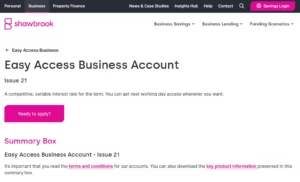
Check the Shawbrook Business Savings Accounts Here
Best Overall Business Savings Account for Competitive Interest and Flexibility
- Interest Rate: 4.18% AER variable
- Minimum Balance: £1,000
- Maximum Balance: £500,000
- Withdrawals: Next working day, subject to processing times
- Interest Payments: Monthly or annually
- Account Management: Online
- FSCS Protection: Eligible deposits up to £120,000
- Our Rating: 96% — Excellent
Shawbrook takes our top position because of its combination of interest rate, relatively accessible minimum deposit and withdrawal flexibility.
Its Issue 21 Easy Access Business Account pays 4.18% AER variable, effective 9 October 2026.
This is particularly noteworthy because some comparison websites still show the previous 3.86% account rate.
Why We Rate Shawbrook Highly?
The first advantage is the minimum balance. A business does not need £50,000 or £100,000 to benefit from the advertised rate.
The second is flexibility. Businesses can make repeated withdrawals, although payments normally reach the nominated account on the next working day rather than immediately.
For example, assuming the rate stayed at 4.18% for one year and annual interest was compounded:
| Average Savings Balance | Illustrative Annual Interest |
| £10,000 | £418 |
| £25,000 | £1,045 |
| £50,000 | £2,090 |
| £100,000 | £4,180 |
These figures are before tax and assume an unchanged rate, no withdrawals and the balance remaining invested for the whole year.
Who Should Consider Shawbrook?
Shawbrook is especially attractive to sole traders and eligible limited companies with regular cash reserves.
However, it does not accept every business structure. Its product terms exclude LLPs and impose limits on shareholders and authorised signatories.
The £1,000 minimum balance also matters. If savings fall below that amount, the account pays a substantially lower rate.
Our verdict: 4.8/5 (96%)
An excellent option for a UK business seeking a strong variable return without committing funds to a long fixed term.
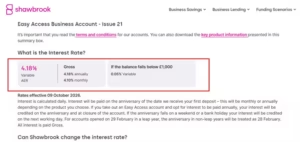
Shawbrook Easy Access Business Account Issue 21, displaying 4.18% AER variable and the rate effective from 9 October 2026.
2. Cynergy Bank Business Saver
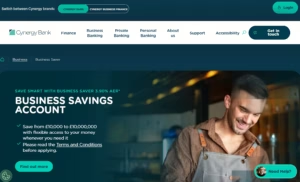
Check the Cynergy Business Savings Accounts Here
Best for Established Companies Holding £10,000 or More
- Interest Rate: 3.90% AER variable
- Minimum Deposit: £10,000
- Maximum Deposit: £10 million
- Interest Payments: Monthly
- Access: Flexible withdrawal requests
- Fees: No standard withdrawal fees
- Our Rating: 94% — Excellent
Cynergy Bank offers a competitive solution for companies wanting flexible savings without a fixed-term commitment.
Its Business Saver pays 3.90% AER variable, with interest calculated daily and paid monthly.
The account is suitable for eligible UK limited companies, LLPs and partnerships.
However, it is not available to sole traders, charities or trusts under the published eligibility criteria.
Why Choose Cynergy Bank?
Cynergy is particularly useful for businesses managing larger cash balances.
Its £10 million maximum balance makes it operationally suitable for organisations holding significant reserves, although FSCS protection remains subject to the separate £120,000 eligibility limit.
We also value the ability to manage the account online and through mobile banking.
The main restriction is its £10,000 minimum deposit and the requirement to nominate an existing business current account in the same legal name.
Potential Drawbacks
Cynergy’s published rate is variable rather than fixed. Businesses cannot assume that 3.90% will remain unchanged for a full year.
Withdrawal instructions are also subject to processing arrangements and payment cut-off times.
Our verdict: 4.7/5 (94%)
A competitive choice for incorporated SMEs and partnerships with meaningful cash reserves.

Cynergy Bank Business Saver showing 3.90% AER, £10,000 minimum deposit and flexible withdrawal conditions.
3. Virgin Money Business Access Savings Account
Check the Virgin Money Business Savings Accounts Here
Best for Sole Traders and Smaller Businesses Starting From £1
- Interest Rate: 3.50% AER variable
- Minimum Deposit: £1
- Maximum Deposit: £2 million
- Interest Payments: Monthly
- Withdrawals: Flexible electronic transfers
- Standard Account Fees: None
- Our Rating: 93% — Excellent
Virgin Money stands out because businesses can begin saving with only £1.
For smaller businesses, this removes one of the biggest barriers associated with specialist savings providers: high minimum deposits.
The Business Access Savings Account Issue 44 pays 3.50% AER variable, with monthly interest.
Why Choose Virgin Money?
Our analysis places considerable value on accessibility.
A sole trader saving £500 each month may not yet meet the minimum deposit required by specialist providers, but they can still benefit from an interest-paying account.
Virgin Money supports eligible sole traders, partnerships, LLPs and limited companies.
The account also permits additional deposits and online withdrawals to a nominated business account.
What Should Businesses Check?
The Business Access Savings Account operates separately from Virgin Money’s main business current-account interface.
Business owners expecting all account balances to appear in one application should review these arrangements.
Businesses should also check the implications of Virgin Money’s transfer into Nationwide for their wider banking arrangements and deposit-protection exposure.
Our verdict: 4.65/5 (93%)
One of the most accessible savings options for freelancers, smaller companies and businesses gradually building reserves.
4. Allica Bank Savings Pot
Check the Allica Business Savings Accounts Here
Best for Established SMEs Seeking Integrated Banking and Savings
- Headline Rate: Up to 4.08% AER variable
- Underlying Standard Rate: 2.83% AER
- Eligibility: Generally established businesses with £50,000 or more available to deposit, or qualifying borrowing arrangements
- Savings Access: Instant
- Interest Payments: Monthly
- Our Rating: 90% — Very Good
Allica Bank has a different proposition from a conventional standalone savings account.
Its Savings Pot is integrated with its Business Rewards Account, combining business banking functionality with interest on surplus funds.
The headline rate of up to 4.08% AER deserves particular attention because it includes conditional boosts.
How Does Allica’s Interest Rate Work?
Its published offer includes:
- A 2.83% AER standard rate.
- A 0.50% AER boost linked to qualifying monthly outgoing bank-transfer activity.
- A 0.50% AER switching boost for six months, subject to conditions.
- A 0.25% AER welcome boost for three months for eligible new customers.
These incentives have different eligibility requirements and durations.
Therefore, the maximum advertised rate should not be treated as the guaranteed ongoing return for every business.
Why Choose Allica?
Allica is particularly attractive to established businesses that want a combined financial-management system.
Features include payment permissions, accounting integrations, business cards, relationship management and savings functionality.
However, companies should assess the full banking relationship.
For example, the current account can incur a £25 monthly fee if the relevant balance conditions are not satisfied, unless an applicable exemption applies.
Our verdict: 4.5/5 (90%)
Strong for established SMEs that can use the broader banking package, but its conditional interest boosts require careful evaluation.
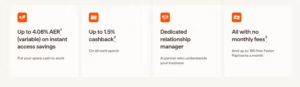
Allica Bank Savings Pot advertising up to 4.08% AER with qualifying interest boosts.
5. Tide Instant Saver

Check the Tide Business Savings Accounts Here
Best for Digital-First Businesses Wanting Promotional Interest
- Advertised Rate: Up to 4.00% AER variable
- Promotional Period: Four months for eligible new members
- Minimum Savings: £1
- Withdrawals: Instant access
- Interest Payments: Monthly
- Savings Provider: ClearBank
- Our Rating: 89% — Very Good
Tide offers one of the more interesting introductory propositions among digital business banking platforms.
Its Instant Saver advertises up to 4.00% AER variable for the first four months.
However, the maximum advertised rate applies to the relevant high-balance tier, not automatically to every business depositing £1,000 or £10,000.
For eligible new members, the introductory rate for balances below £1 million is 3.75% AER under the published tier structure.
What Happens After Four Months?
The standard interest rate depends on the Tide membership plan and applicable balance limits.
Published standard plan rates include:
| Tide Plan | Standard Savings Rate |
| Free | Up to 2.00% AER |
| Smart | Up to 2.50% AER |
| Pro | Up to 3.00% AER |
| Max | Up to 3.25% AER |
Conditions and balance tiers apply, including limits beyond which no interest may be earned.
Businesses should therefore calculate the return across 12 months rather than assuming the four-month promotional rate continues indefinitely.
Why Choose Tide?
Tide is useful for entrepreneurs who already manage invoices, payments and business administration through its platform.
However, an owner should not subscribe to an expensive plan solely for a slightly higher savings rate without calculating whether the additional interest exceeds the membership cost.
Our verdict: 4.45/5 (89%)
Convenient for digital businesses, particularly during the introductory period, but less straightforward than standalone savings products.
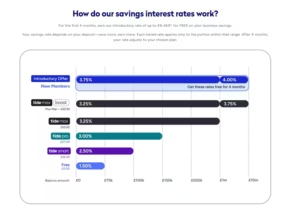
Tide Instant Saver advertising up to 4.00% AER for eligible new customers, subject to balance tiers and a four-month promotional period.
6. Monzo Business Instant Access Savings Pot

Check the Monzo Business Savings Accounts Here
Best for App-Based Savings and Day-to-Day Financial Organisation
- Interest Rate: Up to 3.25% AER variable
- Minimum Deposit: None
- Access: Instant through Monzo Business
- Interest Payments: Monthly
- Best For: Eligible sole traders and limited companies
- Our Rating: 88% — Very Good
Monzo combines business banking with accessible savings management.
Its Instant Access Savings Pot allows users to separate money for specific objectives while earning variable interest.
Why Choose Monzo?
The main advantage is convenience.
Businesses can create savings arrangements for expenses such as tax, equipment purchases and future operating costs.
For example, a marketing agency might organise its finances around:
- VAT reserves.
- Corporation Tax provisions.
- Annual software renewals.
- Equipment replacement.
- Emergency working capital.
The main weakness is that the advertised maximum rate of 3.25% AER is lower than some specialist standalone accounts.
Businesses should check which savings rate is available with their particular Monzo Business account and the current conditions.
Our verdict: 4.4/5 (88%)
An attractive everyday savings solution for existing Monzo Business customers who prioritise convenience over the highest possible yield.
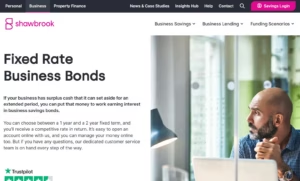
7. Shawbrook One-Year Fixed Rate Business Bond
Check the Shawbrook Business Savings Accounts Here
Best for Businesses Seeking a Competitive Guaranteed One-Year Rate
- Interest Rate: 4.81% AER fixed
- Minimum Deposit: £5,000
- Maximum Deposit: £2 million
- Term: One year
- Withdrawals: Not permitted before maturity
- Our Rating: 95% — Excellent
For businesses able to lock away money for 12 months, Shawbrook offers a particularly competitive fixed-rate proposition.
Its Issue 32 One-Year Fixed Rate Business Bond pays 4.81% AER, effective 9 October 2026.
The rate is fixed during the term, protecting the agreed return against subsequent reductions in variable savings rates.
How Much Could a Business Earn?
| Deposit | Interest After One Year | Maturity Balance |
| £5,000 | £240.50 | £5,240.50 |
| £20,000 | £962 | £20,962 |
| £50,000 | £2,405 | £52,405 |
| £100,000 | £4,810 | £104,810 |
These are illustrative gross figures assuming annual interest is retained until maturity, with no additional deposits or tax deductions.
What Is the Main Risk?
The greatest operational risk is liquidity rather than a change in the agreed rate.
The money cannot ordinarily be withdrawn before the term ends.
A business should never place its next Corporation Tax payment, payroll allocation or essential supplier funds into a fixed bond unless it has adequate accessible resources elsewhere.
Our verdict: 4.75/5 (95%)
A particularly strong choice for businesses with surplus reserves that can genuinely remain untouched for one year.
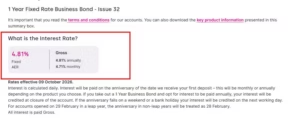
Shawbrook One-Year Fixed Rate Business Bond Issue 32 paying 4.81% AER from 9 October 2026.
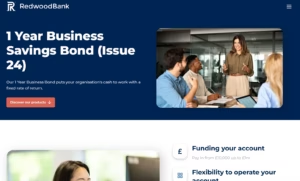
8. Redwood Bank One-Year Business Savings Bond
Check the Redwood Business Savings Accounts Here
Best Alternative for Fixed-Term Business Savings
- Interest Rate: 4.80% AER fixed
- Minimum Deposit: £10,000
- Maximum Deposit: £1 million
- Term: One year
- Interest: Monthly or annually
- Withdrawals: Not permitted before maturity
- Our Rating: 94% — Excellent
Redwood Bank is another competitive specialist business savings provider.
Its one-year bond offers a fixed 4.80% AER, close to Shawbrook’s advertised 4.81%.
The difference between the two rates is relatively small.
On £100,000 held for a full year, a difference of 0.01 percentage points is approximately £10 before tax.
That means businesses should also consider account-opening requirements, maturity instructions and administrative preferences.
Why Choose Redwood?
Redwood supports several organisational structures, including eligible sole traders, partnerships, limited companies, charities and associations.
Its maximum of four authorised users can also be useful where multiple people need account oversight.
The main limitation is the £10,000 minimum opening deposit and the inability to withdraw before maturity.
Our verdict: 4.7/5 (94%)
An excellent fixed-rate alternative, particularly for established organisations with predictable cash-flow requirements.
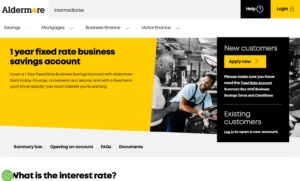
9. Aldermore One-Year Fixed Rate Business Savings Account
Check the Aldermore Business Savings Accounts Here
Best Fixed-Term Option With a £1,000 Minimum Deposit
- Interest Rate: 4.40% AER fixed
- Minimum Deposit: £1,000
- Term: One year
- Interest Payments: Monthly or annually
- Access: At maturity
- Our Rating: 90% — Very Good
Aldermore offers a practical alternative for eligible limited companies that want fixed-rate savings but do not have £5,000 or £10,000 available.
Its one-year fixed business account pays 4.40% AER.
The minimum deposit of £1,000 makes it more accessible than several specialist fixed-rate products.
Why Choose Aldermore?
Aldermore’s account may appeal to small limited companies gradually establishing a reserve fund.
It also allows a choice of interest-payment arrangements.
However, the product is subject to corporate eligibility and UK tax-residency requirements, and it is not a universal option for every sole trader or partnership.
Our verdict: 4.5/5 (90%)
A strong option where a low opening deposit matters more than obtaining the very highest fixed rate.
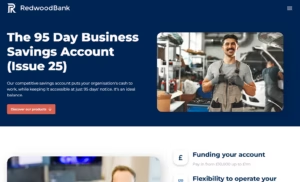
10. Redwood Bank 95-Day Business Savings Account
Check the Redwood’s 95-day Business Savings Accounts Here
Best for Businesses Planning Expenditure Three Months Ahead
- Interest Rate: 4.05% AER variable
- Notice Period: 95 days
- Minimum Deposit: £10,000
- Interest: Monthly or annually
- Our Rating: 91% — Excellent
Redwood’s 95-day account bridges the gap between easy-access savings and fully fixed deposits.
Businesses can continue earning interest while retaining the ability to withdraw after providing the required notice.
When Is a Notice Account Useful?
Consider an ecommerce company planning a £40,000 stock purchase in four months.
The business may not need that money immediately, but locking it away for an entire year would be inappropriate.
A 95-day notice account could provide a workable solution if notice is submitted at the correct time.
However, the rate remains variable, and the withdrawal process must be planned carefully.
Our verdict: 4.55/5 (91%)
A competitive account for structured cash-flow planning rather than emergency reserves.
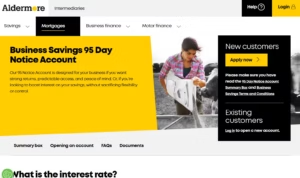
11. Aldermore 95-Day Notice Account
Check the Aldermore’s 95-day Business Savings Accounts Here
Best for Limited Companies Wanting Notice Savings From £1,000
- Interest Rate: 4.00% AER variable
- Minimum Deposit: £1,000
- Notice Period: 95 days
- Deposits: Additional deposits permitted
- Our Rating: 89% — Very Good
Aldermore’s 95-day notice account offers a competitive rate without requiring the large initial deposit demanded by some alternatives.
Its 4.00% AER variable rate makes it relevant to businesses with planned rather than immediate expenditure.
The account is particularly useful where a company wants to build reserves over time while maintaining a defined withdrawal process.
Our verdict: 4.45/5 (89%)
A practical notice savings option for eligible limited companies with relatively modest starting balances.
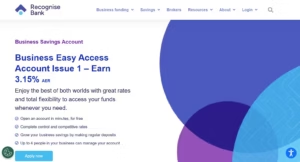
12. Recognise Bank Business Easy Access Account
Check the Recognise Business Savings Accounts Here
Best for Businesses Wanting Tiered Interest Rates
- Standard Easy-Access Rate: 3.15% AER variable
- Higher-Balance Rate: 3.55% AER variable
- Higher-Rate Minimum Deposit: £85,001
- Standard Minimum Deposit: £1,000
- Withdrawals: Easy access
- Our Rating: 89% — Very Good
Recognise Bank provides multiple easy-access savings options based on the amount deposited.
Its standard business easy-access account pays 3.15% AER, while a separate higher-balance issue pays 3.55% AER from £85,001.
Why Choose Recognise Bank?
The bank offers online account management and the ability to appoint multiple authorised users.
That may suit businesses where the director and finance manager both require oversight.
However, a business with only £20,000 should not assume that the higher rate applies to its deposit.
Our analysis therefore places Recognise slightly below the leading easy-access providers, despite its useful account-management features.
Our verdict: 4.45/5 (89%)
A reasonable alternative for established businesses, particularly those able to meet the higher minimum deposit.
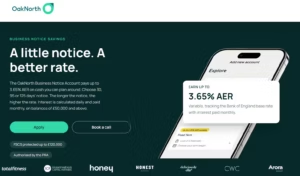
13. OakNorth Business Notice Savings Account
Check the OakNorth Business Savings Accounts Here
Best for Larger Companies Managing Predictable Cash Reserves
- Highest Advertised Notice Rate: 3.65% AER variable
- Notice Periods: 30, 95 or 125 days
- Interest-Earning Minimum Balance: £50,000
- Maximum Balance: £15 million
- Interest Payments: Monthly
- Our Rating: 84% — Good
OakNorth focuses on businesses with more substantial banking requirements.
Its notice accounts offer a choice of withdrawal periods, with rates that track the Bank of England base rate subject to a specified margin.
The published rates include 3.20% AER for 30 days, 3.60% AER for 95 days and 3.65% AER for 125 days on qualifying balances.
Why Choose OakNorth?
Its banking proposition includes payment controls, multiple users and integration with broader business banking operations.
However, the £50,000 interest-earning threshold is a significant restriction.
Balances below that level do not earn interest under the published notice-account terms.
Applicants also need an OakNorth Business Current Account.
Our verdict: 4.2/5 (84%)
Better suited to larger incorporated businesses than early-stage sole traders.
14. NatWest Business Reserve
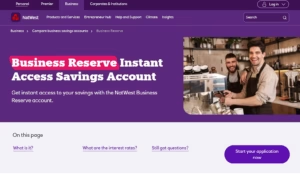
Check the NatWest Business Savings Accounts Here
Best for Existing NatWest Customers Prioritising Convenience
- Interest Rate: 0.85%–1.46% AER variable
- Typical Smaller Balance Rate: 0.85% AER
- Minimum Deposit: None
- Withdrawals: Instant access
- Interest Payments: Monthly
- Our Rating: 75% — Good for Existing Customers
NatWest provides a familiar high-street banking option for businesses wanting to hold reserves alongside an established banking relationship.
Its Business Reserve account offers interest rates based on account balance.
For balances below £1 million, the published rate is 0.85% AER. The 1.46% maximum requires substantially larger deposits.
Why Does NatWest Rank Lower?
The primary weakness is yield.
A company holding £100,000 at 0.85% AER would earn approximately £850 over one year if the rate remained unchanged.
The same amount held at a constant 4.18% AER would generate approximately £4,180.
That represents an illustrative difference of £3,330 before tax.
Nevertheless, some businesses may prefer NatWest because of their existing banking arrangements, account management and broader financial services.
Our verdict: 3.75/5 (75%)
Convenient for existing customers, but less competitive when interest income is the primary objective.
15. Santander Business Everyday Saver

Check the Santander’s Business Savings Accounts Here
Best for Simple Savings Through an Existing High-Street Bank
- Interest Rate: 0.80% AER variable
- Minimum Deposit: £1
- Withdrawals: Instant access
- Interest Payments: Monthly
- Our Rating: 73% — Suitable for Existing Customers
Santander’s Business Everyday Saver is a straightforward option for organisations seeking flexible savings.
The account pays 0.80% AER variable and permits withdrawals through supported online, telephone and banking channels.
Its main advantage is simplicity.
However, our comparison suggests businesses primarily seeking interest income should evaluate specialist alternatives before settling for the standard rate.
Santander also offers a Business Reward Saver paying 1.00% AER when the relevant no-withdrawal condition is satisfied. A lower rate applies in withdrawal periods.
Our verdict: 3.65/5 (73%)
A functional high-street option, but not a leading account for maximising business savings interest.
Which Other Business Savings Accounts Are Worth Considering?
Several well-known providers did not make the main ranking but deserve consideration.
| Provider | Account | Published Rate | Main Consideration |
| Lloyds Bank | Business Instant Access | From 0.50% AER | Useful existing banking relationship, but lower returns on smaller balances |
| Barclays | Business Premium | Tiered rates | Check the current rate schedule and account requirements |
| HSBC | Business Money Manager | Tiered rates | Rate depends on balance and product conditions |
| Hampshire Trust Bank | Business Savings | Applications temporarily paused | Check whether applications have reopened |
Lloyds Bank’s published business instant-access range starts at 0.50% AER, with higher rates requiring considerably larger balances.
Businesses using business bank accounts for small businesses should compare savings rates separately from transaction charges, cash-deposit costs and lending facilities.
A business current account can be excellent for everyday operations while offering an uncompetitive return on surplus cash.
What Is the Difference Between Easy-Access and Fixed Business Savings?
The main difference is how quickly a business can access its cash.
| Feature | Easy Access | Notice Savings | Fixed-Rate Bond |
| Interest Rate | Variable | Usually variable | Fixed |
| Withdrawal | Immediate or next working day | Advance notice required | Usually at maturity |
| Suitable for VAT Reserve | Often | Only if dates align | Generally unsuitable |
| Suitable for Emergency Fund | Yes | No, unless supplemented | No |
| Suitable for Surplus Long-Term Cash | Yes | Yes | Yes |
| Rate Certainty | Limited | Limited | Strong during the fixed term |
For a typical SME, our preferred approach would be to allocate money according to the expected date of expenditure.
Essential working capital belongs in accessible accounts.
Money that is not required for several months may be considered for notice savings.
Only genuinely surplus funds should be considered for fixed-term products.
How Much Interest Can a Business Earn on £10,000 to £250,000?
The following calculations show how interest rates affect annual gross returns.
These examples assume the balance remains unchanged for one year, the stated annual rate is maintained or fixed as applicable, and the interest stays in the account.
| Savings Balance | 0.50% AER | 3.50% AER | 4.18% AER | 4.81% AER |
| £10,000 | £50 | £350 | £418 | £481 |
| £25,000 | £125 | £875 | £1,045 | £1,202.50 |
| £50,000 | £250 | £1,750 | £2,090 | £2,405 |
| £100,000 | £500 | £3,500 | £4,180 | £4,810 |
| £250,000 | £1,250 | £8,750 | £10,450 | £12,025 |
The table is an illustration, not a forecast. The 4.81% fixed rate would apply only where a qualifying fixed-rate product is opened and held for its term. Variable-rate results could be higher or lower.
Actual earnings also depend on interest-payment arrangements, changing balances, product limits and taxation.
Why Does a Small Interest Difference Matter?
Consider a company holding £100,000 of spare working capital.
At 0.50% AER, the illustrative annual interest is £500.
At 4.18% AER, the return is approximately £4,180.
The difference is £3,680 in gross annual interest if the rates remain unchanged.
For a smaller company, that extra income could contribute towards accounting software, business insurance, equipment maintenance or professional fees.
However, businesses should compare their total financial requirements rather than optimising interest in isolation.
An excessive transfer to savings can create cash-flow pressure if supplier invoices fall due before the money becomes available.
Are Business Savings Accounts Protected by the FSCS?
Yes, eligible UK business deposits held with participating authorised banks generally receive protection under the Financial Services Compensation Scheme.
The standard deposit protection limit increased to £120,000 from 1 December 2025.
This is especially important for companies holding larger working-capital reserves.
Check Official FSCS Business Deposit Protection
How Does FSCS Protection Work for Limited Companies?
A limited company is a separate legal entity from its directors and shareholders.
An eligible limited company’s deposits can receive up to £120,000 of protection with the relevant authorised banking institution.
The director’s personal qualifying deposits with the same institution may have a separate £120,000 allowance because the company and individual are different legal persons.
However, deposits across multiple accounts with the same authorised institution are aggregated.
Opening three different accounts at the same bank does not automatically create three separate £120,000 protection limits.
What About Sole Traders?
Sole traders are different because the individual and business are not separate legal persons.
Personal and sole-trader deposits held with the same authorised institution are generally aggregated for FSCS protection.
A sole trader with £80,000 in personal savings and £70,000 in a business savings account at the same authorised bank would therefore have £150,000 in total deposits, exceeding the standard £120,000 protection limit by £30,000.
Should Businesses Split Deposits Between Banks?
For eligible deposits exceeding £120,000, spreading funds between genuinely separate authorised institutions can reduce exposure to a single bank failure.
Before doing so, check whether different bank brands share the same banking licence.
An account’s maximum permitted balance is not the same thing as its FSCS protection limit.
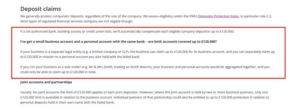
FSCS confirms that eligible company deposits are protected up to £120,000, with separate treatment for limited companies and sole traders.
Do Limited Companies Pay Tax on Business Savings Interest?
Yes. Interest earned by a UK limited company is normally included in its taxable profits for Corporation Tax purposes.
Business savings interest is usually paid gross, meaning the bank does not automatically deduct the company’s Corporation Tax liability.
For 2026/27, the standard UK Corporation Tax structure includes:
| Taxable Company Profits | Corporation Tax Treatment |
| £50,000 or less | 19% small profits rate, where eligible |
| £50,001–£250,000 | Marginal Relief may apply |
| Above £250,000 | 25% main rate |
These thresholds can be reduced for associated companies and short accounting periods, and some companies are subject to different rules.
How Does Corporation Tax Affect Savings Returns?
Suppose a company earns £4,000 in savings interest during its accounting period.
If that additional interest is effectively taxed at 19%, the additional Corporation Tax would be £760, leaving £3,240 after tax.
If the effective tax rate on the interest is 25%, the additional tax would be £1,000, leaving £3,000.
The actual calculation depends on the company’s wider taxable profits, accounting period and applicable rules.
Check Corporation Tax Rates on GOV.UK
A company does not receive the personal savings allowance available to qualifying individuals.
Sole traders, meanwhile, are subject to personal tax rules, and the treatment of their savings interest depends on their circumstances.
Keeping proper records is therefore essential.
Businesses comparing small business accounting software should check whether their chosen platform can record interest income, reconcile bank statements and distinguish taxable receipts from transfers between company accounts.
How Should Businesses Allocate Their Savings?
There is no universal percentage that every UK business should hold in cash.
The appropriate amount depends on operating expenses, customer-payment patterns, liabilities and the certainty of future cash inflows.
For example, consider a hypothetical company with £120,000 in available cash.
After preparing a cash-flow forecast, it determines that £80,000 can be reserved or committed without affecting its essential operating requirements.
It might structure that money as follows:
| Savings Allocation | Amount | Purpose |
| Easy-access savings | £35,000 | Tax provision and near-term liabilities |
| 95-day notice savings | £20,000 | Planned expenditure later in the year |
| One-year fixed savings | £25,000 | Genuinely surplus reserves |
| Total allocated | £80,000 |
The remaining £40,000 stays available for day-to-day operations.
This is an illustrative allocation, not a recommendation for every company.
The important principle is to match withdrawal availability with cash-flow requirements.
How Much Emergency Cash Should a Business Keep?
Many businesses use three to six months of essential operating expenses as a planning starting point, although the appropriate reserve may be lower or substantially higher.
A seasonal retailer, for example, may need a bigger buffer than an established professional-services company with predictable monthly retainers.
Cash-flow projections are therefore more useful than an arbitrary percentage of revenue.
A business preparing its financial strategy should also consider the relationship between liquidity, borrowing and expansion.
Using a business credit card or overdraft to pay an unexpected bill while substantial cash remains locked in a fixed bond could be expensive.
What Are the Biggest Mistakes When Choosing Business Savings Accounts?
Choosing the Highest Rate Without Checking Access
A 4.81% fixed rate is not necessarily better than a 4.18% easy-access rate if the company needs the money in six weeks.
Liquidity has a financial value even when it does not appear in the advertised interest percentage.
Ignoring Introductory Bonuses
A rate available for three or four months should not be treated as a permanent annual return.
Businesses should compare expected interest over their actual holding period, including the rate payable after the promotion ends.
Overlooking Minimum-Balance Rules
Some accounts pay a headline rate only above a specified threshold.
Falling below that threshold can reduce or eliminate interest.
Ignoring Banking Charges
An integrated savings product may require a paid account plan or a particular current-account balance.
The actual benefit is the interest earned after accounting for relevant charges, not the headline AER alone.
Confusing Banking Deposits With Investment Products
Some financial platforms offer interest-like returns through investment funds or money-market arrangements.
These are not necessarily conventional bank savings accounts, and the protection arrangements and capital risks can differ.
A business should verify the legal nature of the product before treating it as a bank deposit.
Failing to Review Existing Accounts
Variable savings rates change.
Businesses should periodically review the interest paid on existing savings, particularly when a promotional period ends or a bank introduces a new product issue.
The objective is not to chase every short-term rate movement. It is to avoid leaving substantial reserves unnecessarily in a poorly paying account.
How Can a Business Open a Savings Account in the UK?
Most specialist providers allow online applications, although eligibility and verification requirements differ.
Businesses should normally prepare their legal business name, registration information where applicable, address, owner or director identification, tax-residency details and information about their existing current account.
The application process usually involves selecting the savings product, completing identity and business checks, nominating an account for transfers and making the opening deposit.
Some banks require the nominated account to be held in exactly the same legal name as the savings account.
Direct payments from the savings account to suppliers or employees may not be permitted.
For businesses still completing their initial setup, the wider process of starting a small business in the UK should include establishing separate financial records and suitable banking arrangements before significant money begins moving through the company.
Which Business Savings Account Should You Choose?
Our final recommendations depend on the company’s financial position rather than rate alone.
| Business Requirement | Our Preferred Starting Option |
| Best all-round easy access | Shawbrook |
| Incorporated business with £10,000+ | Cynergy Bank |
| Sole trader with a small balance | Virgin Money |
| Established SME seeking integrated banking | Allica Bank |
| Digital-first small business | Tide or Monzo |
| Highest verified one-year fixed rate in our shortlist | Shawbrook |
| Alternative one-year fixed-rate bond | Redwood Bank |
| Fixed deposit starting from £1,000 | Aldermore |
| Three-month planned withdrawal | Redwood 95-Day |
| Larger company with structured notice deposits | OakNorth |
| Existing high-street banking relationship | NatWest or Santander |
One point stands out from the figures.
A business does not necessarily need to change its main current account to improve savings returns.
Many specialist providers allow deposits from and withdrawals to a separate nominated business bank account.
This allows a company to retain its preferred current account for customer payments, payroll and suppliers while using a specialist savings bank for surplus cash.
That separation can be more practical than moving every banking service to obtain a higher deposit rate.
Final Verdict
For UK businesses comparing savings accounts in October 2026, our strongest all-round selection is Shawbrook Easy Access Business Account at 4.18% AER variable.
Its accessible minimum deposit, competitive interest rate and withdrawal flexibility make it useful across a broad range of eligible business types.
Cynergy Bank is a strong alternative for qualifying companies with larger deposits, while Virgin Money provides a practical entry point for smaller businesses and sole traders.
Businesses with predictable surplus cash should also consider fixed-term products. Shawbrook’s 4.81% one-year bond and Redwood’s 4.80% alternative are particularly competitive among the accounts reviewed.
However, the correct approach is not simply to choose whichever bank pays the highest percentage.
A business should calculate how much cash it can safely set aside, identify when the funds will be needed and compare the expected return after tax, fees and withdrawal restrictions.
The best business savings account is the one that improves interest income without putting the company’s financial flexibility at risk.
Frequently Asked Questions
Which Bank Offers the Highest Business Savings Interest Rate in 2026?
Among the accounts compared, Shawbrook offers 4.81% AER on its one-year fixed business bond and 4.18% AER on its easy-access business account as of 9 October 2026.
Can a Limited Company Have More Than One Savings Account?
Yes. A limited company can generally hold multiple business savings accounts, subject to each provider’s eligibility rules and account limits.
Can Sole Traders Open Business Savings Accounts?
Yes. Providers including Shawbrook, Virgin Money and Redwood offer qualifying products to sole traders, although eligibility varies.
Are Business Savings Accounts Tax-Free?
No. Business savings interest is generally taxable. Limited companies normally include it in their Corporation Tax calculations, while sole traders are subject to relevant personal tax rules.
Are Business Savings Accounts Safe?
Eligible deposits with UK-authorised banks are generally protected by the FSCS up to £120,000 per eligible depositor per authorised institution. Balances above the limit may be exposed.
Can a Business Withdraw Money From a Fixed Savings Account?
Normally not before maturity. Businesses should check the specific product terms and avoid committing cash needed for essential expenses.
Is It Worth Opening a Business Savings Account?
It can be worthwhile when a business holds cash that is not immediately required. The benefit depends on its average savings balance, interest rate, accessibility requirements, charges and tax treatment.