

















Millions of older people are expected to receive help with heating costs this winter, but DWP excludes five specific groups from Winter Fuel Payments under the rules applying to winter 2026/27.
The headline is more complicated than it first appears. Some pensioners are completely excluded, some care-home residents can still qualify for a reduced payment, and people earning more than £35,000 are not automatically ineligible — they can receive the money first and then have it recovered by HMRC.
For winter 2026/27, people born on or before 27 June 1960 may qualify if they usually live in England, Wales or Northern Ireland. Payments range from £100 to £300, depending on age, household circumstances and living arrangements.
Readers looking specifically at the different payment levels can also see how DWP £200 pensioner eligibility works in 2026.
What Are the Five Groups DWP Excludes From Winter Fuel Payments?
Current government guidance identifies five main situations in which someone can miss out on Winter Fuel Payment.
| Group | Will They Receive Winter Fuel Payment? | Important Detail |
| Usually lives outside England, Wales or Northern Ireland | No | Residence rules apply even if the person receives a UK State Pension |
| Long-term hospital patient receiving free treatment | No | This is not triggered by an ordinary short hospital stay |
| Person whose immigration leave prevents access to public funds | No | Their granted leave must specifically restrict public-fund claims |
| Prisoner serving a sentence during the qualifying week | No | The person must be in prison throughout the qualifying week |
| Certain long-term care-home residents receiving specified benefits | No | Both the care-home and benefit conditions must apply |
The crucial point is that these exclusions contain conditions. A person should not assume that simply spending time in hospital or living in residential care automatically removes entitlement.
1. People Usually Living Outside England, Wales or Northern Ireland
A pensioner who normally lives outside England, Wales or Northern Ireland will generally not receive the DWP Winter Fuel Payment for 2026/27.
That rule can surprise people because receiving a UK State Pension overseas and receiving Winter Fuel Payment are separate questions. A State Pension can continue in many overseas circumstances, while the winter payment has its own residence requirements.
The distinction matters particularly for pensioners who have recently moved abroad or divide their time between Britain and another country.
2. Certain Long-Term Hospital Patients
The hospital exclusion is frequently oversimplified.
Being admitted to hospital during September does not by itself mean a pensioner loses Winter Fuel Payment.
For winter 2026/27, the government says a person will not be eligible where they were receiving free hospital treatment for the whole qualifying week — 21 to 27 September 2026 — and had been receiving that treatment for the preceding year.
The underlying regulations describe the rule as free in-patient treatment throughout the qualifying week following more than 52 weeks of such treatment immediately beforehand. It is therefore aimed at people receiving long-term state-supported inpatient care, rather than someone who happens to spend several days in hospital during September.
3. People Whose Immigration Status Bars Access to Public Funds
Another excluded group covers people who require permission to enter or remain in the UK and whose immigration leave specifies that they cannot claim public funds.
This is a specific immigration-status condition. It should not be interpreted as meaning that every person who was born abroad, holds foreign citizenship or later settled in Britain is automatically excluded.
What matters is the conditions attached to the individual’s permission to be in the UK.
4. Prisoners During the Qualifying Week
A person who is serving a court-imposed prison sentence throughout 21 to 27 September 2026 will not qualify.
Again, the qualifying week matters. DWP does not simply ask whether somebody spent any time in prison during 2026.
The legislation treats people serving a sentence throughout the qualifying period differently because their living costs are being supported through the prison system.
5. Certain People Living Permanently in Care Homes
The care-home rule deserves particular attention because headlines often reduce it to “care-home residents don’t get Winter Fuel Payment”. That is incorrect.
A care-home resident will be excluded under current 2026 guidance where both of these conditions apply:
- They receive Pension Credit, Universal Credit or income-related Employment and Support Allowance.
- They have lived in the care home for the whole period from 29 June 2026 or earlier.
Someone living in a care home who does not meet both conditions may still qualify.
Eligible care-home residents can receive a reduced amount of £100 if under 80 or £150 if aged 80 or over, based on the relevant birth-date rules.
Is There Actually Another Partner or Household Exclusion?
There is an important technical rule that most news reports do not explain.
The statutory regulations say an individual may not personally be entitled where they are living with a partner who receives one of the relevant means-tested benefits and the payment is instead being made to that partner on behalf of the couple.
That should not be presented as a sixth household losing Winter Fuel Payment.
It is primarily a rule designed to prevent duplicate household payments. Under the regulations, a couple receiving a qualifying means-tested benefit can receive £200 in one payment where both are under 80, or £300 where one or both are aged 80 or over.
This is one reason the phrase “five groups excluded” needs careful explanation: there is a difference between the household receiving nothing and one member not receiving a separate individual payment because their partner receives the household amount.
Does Earning More Than £35,000 Mean You Are Not Eligible?
No. This is one of the biggest sources of confusion surrounding the 2026 Winter Fuel Payment.
A pensioner whose individual total income is above £35,000 can still receive Winter Fuel Payment if they otherwise qualify. HMRC will then recover an amount equal to the payment.
Recovery can happen through:
- a change to the person’s PAYE tax code; or
- the Winter Fuel Payment charge included in Self Assessment.
The threshold is based on individual income rather than combined household income. A partner’s income does not count towards the other partner’s £35,000 test.
For example, if one partner has income of £38,000 and the other has income of £24,000, HMRC may recover the first person’s payment while allowing the second person to keep theirs.
The £35,000 figure should also not be confused with the Personal Allowance or ordinary UK income tax thresholds. It is a separate threshold created specifically for recovery of winter heating payments.
What if Income Is Exactly £35,000?
The tax charge applies where income exceeds £35,000.
Someone whose relevant total income is exactly £35,000 does not cross the threshold simply because they have reached that figure.
Why Might Someone Receive Only £100 or £150?
The common description that Winter Fuel Payment is simply “£200 or £300” misses several legitimate lower payment levels.
For 2026/27, payments can work broadly as follows:
| Circumstances | Amount |
| Living alone, younger qualifying age group | £200 |
| Living alone, older qualifying age group | £300 |
| Two younger eligible people living together without specified benefits | £100 each |
| Younger person living with an eligible person aged 80+ | £100 |
| Eligible person aged 80+ living with younger eligible person | £200 |
| Two eligible people aged 80+ living together | £150 each |
| Eligible care-home resident in younger group | £100 |
| Eligible care-home resident aged 80+ | £150 |
| Couple jointly claiming qualifying benefit, both younger group | £200 household payment |
| Couple jointly claiming qualifying benefit, one or both older group | £300 household payment |
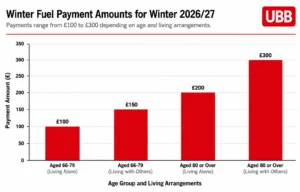
The younger group is generally someone born between 28 September 1946 and 27 June 1960. The higher rates apply to those born before 28 September 1946.
So a £100 payment is not necessarily evidence that DWP has made an error. It can simply mean the Winter Fuel Payment has been divided between eligible people sharing the same household.
What Is the Winter Fuel Payment Qualifying Week in 2026?
For winter 2026/27, the qualifying week is:
Monday 21 September to Sunday 27 September 2026.
Circumstances during this period can determine entitlement and payment amounts.
That makes the qualifying week particularly important for:
- household composition;
- prison status;
- long-term hospital treatment;
- relevant benefit entitlement;
- residential-care arrangements.
Age also matters. Instead of relying simply on the phrase “over 66”, people should use the official date-of-birth test. The broader timetable is explained in more detail in State Pension age rules for 2026.
Do England, Wales, Northern Ireland and Scotland Have the Same Scheme?
Not completely.
| Nation | Winter Support for Pensioners | 2026 Position |
| England | Winter Fuel Payment | DWP scheme |
| Wales | Winter Fuel Payment | DWP scheme |
| Northern Ireland | Winter Fuel Payment | Separate transferred administration, with broadly the same eligibility approach |
| Scotland | Pension Age Winter Heating Payment | Separate devolved Scottish payment |
Northern Ireland’s official guidance says eligible people can receive between £100 and £300 for winter 2026/27 and that its Winter Fuel Payment eligibility rules are aligned with those applying in England and Wales.
Scotland is different. Winter Fuel Payment has been replaced by Pension Age Winter Heating Payment, administered through Social Security Scotland.
For winter 2026, Scottish payments range from £105.55 to £316.70 depending on circumstances. Scottish pensioners with total individual income over £35,000 can also have the payment recovered through the tax system.
That means an article discussing “DWP Winter Fuel Payment exclusions” should not automatically apply the exact England and Wales rules to somebody living in Scotland.
Why Have Winter Fuel Payment Rules Changed So Much?
The confusion around the current system makes more sense when viewed as a short policy timeline.
Winter 2024/25
Winter Fuel Payment was heavily restricted. Eligibility was largely tied to receiving Pension Credit or another specified means-tested benefit.
2025
The policy changed again.
The government restored entitlement much more widely, while introducing a different method of targeting support: pensioners could receive the payment, but those with personal income above £35,000 would have its value recovered through the tax system.
The 2025 regulations therefore moved the system away from the much narrower Pension Credit-only model used the previous winter.
Winter 2026/27
The wider entitlement model continues, with the current qualifying week running from 21 to 27 September 2026.
Pensioners can receive between £100 and £300, while the £35,000 individual-income recovery system continues through HMRC.
That history explains why older online articles can now be misleading: they may describe rules that applied during only one winter.
Why Has the £35,000 Rule Been Criticised?
The Social Security Advisory Committee raised concerns about using taxable income above £35,000 as a strict dividing line.
One concern is that pensioners receiving Attendance Allowance, Personal Independence Payment, Disability Living Allowance or pension-age Housing Benefit do not automatically receive the same protection from recovery as people receiving Pension Credit and certain other specified benefits.
That can matter because disability, care requirements or poor-quality housing may create unusually high heating or living costs even where taxable income appears relatively high.
SSAC also questioned whether taxable income alone adequately reflects disposable resources. For example, a pensioner could have income slightly above £35,000 but face substantial care costs, while another person could receive significant non-taxable support that does not push them above the threshold.
The Committee recommended reconsidering whether additional benefits such as Attendance Allowance and pension-age Housing Benefit should receive greater protection.
The criticism does not mean the £35,000 rule has been cancelled. It remains part of the current recovery system.
Can Pensioners Opt Out of Winter Fuel Payment?
Yes.
Opting out may appeal particularly to somebody who knows their income will exceed £35,000 and does not want to receive a payment only for HMRC to recover it later.
For winter 2026/27, the current deadlines are:
- 6pm on 18 September 2026 when opting out by telephone.
- 11:59pm on 20 September 2026 when using the online options.
A person who opts out does not need to repeat the decision every year. Future Winter Fuel Payments will stop unless they opt back in.
Someone who later changes their mind can contact the Winter Fuel Payment Centre to opt back in. To receive the 2026/27 payment, the current deadline for doing so is 31 March 2027.
Does Everyone Need to Apply?
No. Most eligible people receive Winter Fuel Payment automatically.
Automatic payment commonly applies where DWP already has the necessary information because the person receives State Pension or benefits including Pension Credit, Attendance Allowance, PIP, Carer’s Allowance or Disability Living Allowance.
A claim may be required where somebody has not received Winter Fuel Payment previously or has deferred their State Pension since their last payment.
Claims for winter 2026/27 open on 21 September 2026.
When Will Winter Fuel Payments Be Paid in 2026?
Eligible pensioners should normally receive a letter during October or November 2026 confirming how much they will receive.
Most payments are expected during November or December 2026.
The money normally goes into the same bank or building-society account used for State Pension or other qualifying benefits.
People who believe they are eligible but have neither received a letter nor a payment by 27 January 2027 should investigate with the Winter Fuel Payment Centre.
Pensioners Should Be Alert to Winter Fuel Payment Scams
The large number of people receiving Winter Fuel Payment makes it an attractive subject for phishing scams.
Most eligible pensioners are paid automatically. A message claiming that a recipient urgently needs to “activate”, “release” or “verify” their Winter Fuel Payment by clicking a link and supplying bank details should therefore be treated cautiously.
Government guidance specifically warns about calls, emails and messages pretending to come from government services and requesting details such as bank information or passwords. Northern Ireland’s official guidance similarly warns that pensioners will not be sent a text or email asking them for bank details to receive the normal automatic payment.
There is a legitimate claims process for the minority of people who need to make a claim, but that is very different from an unsolicited message demanding financial information.
What Should Pensioners Check Before Assuming They Are Excluded?
A simple check can prevent many misunderstandings:
- Confirm the exact date of birth.
- Check where the person normally lives.
- Look at circumstances during 21 to 27 September 2026.
- If hospitalised, establish whether it is genuinely a long-term free inpatient stay.
- If living in residential care, check both the length of residence and benefit status.
- Check whether another eligible person lives in the household.
- Work out the individual’s own total income rather than combining it with a partner’s.
- Distinguish being ineligible from being eligible but having HMRC later recover the payment.
That last distinction is particularly important. Someone earning £36,000 is not in the same position as somebody who fails the residence or prison rule. The former can be entitled to Winter Fuel Payment but face an equivalent HMRC tax charge; the latter may have no entitlement in the first place.
Final Word
The headline that DWP excludes five specific groups from Winter Fuel Payments is correct for the main 2026 public eligibility categories, but those categories need much more explanation than most news reports provide.
A short stay in hospital does not automatically disqualify someone. Living in a care home does not necessarily remove entitlement. A partner may receive one household payment on behalf of a couple rather than both partners receiving separate amounts. And earning above £35,000 is principally an HMRC recovery issue, rather than the same type of eligibility exclusion.
For winter 2026/27, the key dates are 21 to 27 September 2026 for the qualifying week, with most eligible pensioners due to receive between £100 and £300 during November or December.
Frequently Asked Questions
What Are the Five Groups Excluded From Winter Fuel Payment in 2026?
They broadly cover people normally living outside England, Wales or Northern Ireland, certain long-term hospital patients, people whose immigration leave bars access to public funds, prisoners throughout the qualifying week, and certain long-term care-home residents receiving specified means-tested benefits.
Will I Lose Winter Fuel Payment if I Earn Over £35,000?
You may still receive the payment, but HMRC will normally recover an amount equal to it if your individual total income exceeds £35,000.
Does My Husband’s or Wife’s Income Count Towards My £35,000 Limit?
No. HMRC assesses the £35,000 threshold individually rather than combining both partners’ incomes.
Why Have I Received Only £100?
£100 can be the correct payment where more than one eligible pensioner lives in the household or where an eligible person under 80 lives permanently in residential care.
Can People in Care Homes Receive Winter Fuel Payment?
Yes. Living in a care home does not automatically remove entitlement. The exclusion applies where the specified benefit and long-term residence conditions are both satisfied.
Will a Short Hospital Stay Stop My Payment?
Normally no. The exclusion concerns long-term free inpatient treatment covering the qualifying week and the preceding extended period, rather than an ordinary short admission.
Is Winter Fuel Payment Taxable?
It is not simply treated like ordinary taxable pension income. However, a separate Winter Fuel Payment Charge equal to the payment applies where the relevant person’s income exceeds £35,000, subject to the applicable exemptions.
Does Winter Fuel Payment Affect Pension Credit or Other Benefits?
The Winter Fuel Payment itself does not reduce other benefits.
What if I Turn 66 During 2026?
Do not rely only on age 66 because State Pension age is changing. For Winter Fuel Payment 2026/27, the key published test is whether the person was born on or before 27 June 1960.
Do Scottish Pensioners Get the Same Dwp Winter Fuel Payment?
No. Scotland uses Pension Age Winter Heating Payment, administered through Social Security Scotland, with its own 2026 payment rates.