




















Choosing the best business insurance in the UK is not simply about finding the lowest monthly premium. The right policy must protect a business against the financial risks it faces, whether those involve customer injuries, professional negligence, employee accidents, cyberattacks or damage to commercial premises.
For 2026, our research compared 12 established UK business insurance providers and intermediaries, examining their published cover options, specialisms, purchasing methods, pricing information and suitability for different business structures.
From established insurers such as AXA, Hiscox and Aviva to comparison and broking services such as Simply Business and Superscript, the differences can be substantial.
Our analysis identifies the strengths, limitations and practical suitability of each option, helping sole traders, freelancers, startups and growing limited companies make better-informed insurance decisions.
Which Business Insurance Providers Are Best in the UK for 2026?
The following table compares 12 leading options based on our editorial assessment of their published products and services.
| Rank | Provider | Best For | Editorial Rating |
| 1 | Simply Business | Comparing multiple insurers | 93% |
| 2 | AXA Business Insurance | Small businesses and tradespeople | 91% |
| 3 | Hiscox | Consultants and professional services | 90% |
| 4 | Direct Line for Business | Flexible business insurance | 89% |
| 5 | Markel Direct | Freelancers and specialist professionals | 88% |
| 6 | Superscript | Startups and technology businesses | 87% |
| 7 | Aviva | Established businesses needing broker support | 86% |
| 8 | NFU Mutual | Retailers, trades and regional businesses | 85% |
| 9 | Zurich | Growing SMEs with complex risks | 84% |
| 10 | Allianz | Commercial and industrial businesses | 83% |
| 11 | Kingsbridge | Contractors and self-employed professionals | 82% |
| 12 | PolicyBee | Freelancers and microbusinesses | 81% |
How we assessed providers: Our editorial framework considers coverage breadth (30%), suitability for particular business needs (25%), ease of arranging insurance (15%), visibility of product and pricing information (15%) and access to customer or broker support (15%).
These are comparative editorial judgements based on published information, not the results of a statistically representative customer survey, live quote exercise or independent claims audit.
Ratings are not directly comparable to Feefo, Trustpilot or Defaqto scores. The best provider for an individual business may be lower in the overall ranking.
What Are the 12 Best Business Insurance Providers in the UK?
1. Simply Business – Best for Comparing Business Insurance Quotes
Check the Simply Business Insurance Here
Our Editorial Rating: 93%
Best for: Sole traders, startups, freelancers and small businesses that want to compare several insurers before purchasing.
Simply Business takes the top position in our comparison because it provides a convenient way for smaller UK businesses to investigate insurance options from multiple providers.
An important distinction is that Simply Business operates as an insurance broker rather than being the underwriter of every policy it sells.
Its insurance panel includes recognised providers such as AXA, Hiscox, Allianz, Zurich and other commercial insurance specialists, although the insurers available will depend on the business and the quotation.
This means an entrepreneur can provide information about their business and obtain relevant options without approaching every insurance company individually.
For founders who have recently worked through the process of starting a small business in the UK, comparing insurance alongside other operational commitments is a practical step towards establishing the business.
What Insurance Can Simply Business Arrange?
Available options can include:
- Public liability insurance
- Professional indemnity insurance
- Employers’ liability insurance
- Business buildings and contents insurance
- Tools and equipment insurance
- Business interruption insurance
- Personal accident insurance
- Specialist cover for selected trades and professions.
The main advantage is flexibility.
For example, a freelance designer may need professional indemnity and business equipment cover, while a building contractor may prioritise public liability, tools and employers’ liability protection.
Simply Business can help both types of customer explore different cover combinations.
How Much Does Simply Business Insurance Cost?
Simply Business advertises public liability insurance with an equivalent starting price of £5.40 per month for 10% of customers, subject to its stated conditions.
This is not a price guaranteed to every business. Individual premiums depend on occupation, turnover, employees, claims history and the amount of protection selected.
What Are the Main Advantages?
- Compares policies from several insurers.
- Provides insurance options for a wide variety of occupations.
- Offers online quotation and purchasing.
- Allows different covers to be combined.
- Provides access to UK-based support.
- Can deliver insurance documents electronically.
What Are the Drawbacks?
Simply Business does not compare every insurer in the UK. A cheaper or better-suited policy may be available outside its panel.
Also, the policy terms and claims handling arrangements depend on the insurer underwriting the selected cover.
Our Assessment
For small businesses that are unsure which insurer to approach, Simply Business is a strong starting point.
However, entrepreneurs should compare the actual policy documents and not assume that the cheapest quotation provides equivalent protection.
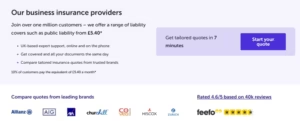
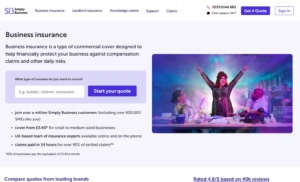
Simply Business business insurance comparison page showing the insurer panel, headline public liability pricing and quotation facility
2. AXA Business Insurance – Best for Small Businesses and Tradespeople
Check the AXA Business Insurance Here
Our Editorial Rating: 91%
Best for: Retailers, independent professionals, contractors, local service businesses and growing SMEs.
AXA is an established commercial insurer with products designed for a wide range of UK businesses.
Unlike an insurance comparison platform, AXA offers policies through its own insurance operations, allowing eligible businesses to arrange cover directly.
Our research found AXA particularly relevant to companies that want straightforward protection against common commercial risks without necessarily arranging a highly complex insurance programme.
Its product options are relevant to electricians, plumbers, independent retailers, consultants and other businesses that interact regularly with customers or clients.
What Insurance Does AXA Provide?
Depending on occupation and eligibility, AXA business products can include:
- Public liability insurance
- Employers’ liability insurance
- Professional indemnity insurance
- Business contents insurance
- Commercial property-related protection
- Tools and equipment protection
- Trade-specific insurance options.
One of AXA’s strengths is the ability to match cover to practical business risks.
For instance, a self-employed electrician entering customers’ properties faces a different exposure from a management consultant providing advice remotely.
Both may need liability insurance, but their policy wording, exclusions and suitable limits can differ significantly.
How Much Does AXA Business Insurance Cost?
AXA’s published figures for April to June 2026 show public liability insurance starting at £63 annually for 10% of customers.
Its monthly marketing price is from £6, subject to payment terms, eligibility and other conditions.
These figures should not be interpreted as a general premium for combined business insurance.
What are AXA’s Strengths?
- Established direct insurance provider.
- Cover designed around common SME risks.
- Public liability options with different cover limits.
- Online quotation for eligible occupations.
- Relevant products for both service and manual-trade businesses.
What Should Businesses Check?
The main consideration is whether the occupation and activities entered in the quotation accurately describe the work being undertaken.
A contractor carrying out specialist or hazardous work should not assume that a standard public liability policy covers every activity.
Businesses must also check equipment limits, subcontractor conditions and exclusions involving work on property in their care.
Our Assessment
AXA is particularly suitable for businesses seeking a recognisable insurer and an accessible direct purchasing process.
It is one of our strongest options for sole traders and established small companies with relatively conventional insurance requirements.
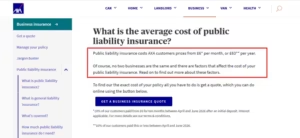
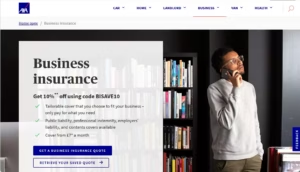
AXA’s public liability insurance cost page showing the £63 annual headline figure, the relevant April–June 2026 eligibility note and the explanation of pricing factors.
3. Hiscox – Best for Consultants and Professional Service Businesses
Check the Hiscox Business Insurance Here
Our Editorial Rating: 90%
Best for: Consultants, designers, marketing agencies, IT professionals and businesses providing specialist advice or services.
Hiscox is particularly relevant to businesses where professional advice, expertise and client deliverables create significant financial exposure.
Our analysis places Hiscox among the leading choices for professional service firms because its business insurance products and supporting resources address a broad range of service-based occupations.
A consultant, for example, may face a compensation claim if a client alleges that incorrect advice caused a substantial financial loss.
Public liability insurance would not ordinarily be designed to address that type of allegation. Professional indemnity insurance is the more relevant protection.
What Cover Can Hiscox Offer?
Depending on the business, Hiscox products can include:
- Professional indemnity insurance
- Public liability insurance
- Employers’ liability insurance
- Business equipment insurance
- Office insurance
- Cyber-related protection
- Other specialist business covers.
For businesses providing professional services, policy wording is particularly important.
Claims involving negligent advice, alleged errors, contractual obligations and intellectual property may be treated differently depending on the policy.
Why Does Hiscox Stand Out?
Hiscox offers a business insurance quotation process and supporting materials focused on entrepreneurs and professionals.
Its published information also highlights business support resources and flexible cover arrangements.
A marketing agency with several employees may require professional indemnity, cyber protection and employers’ liability cover.
A self-employed consultant may need a more limited package.
How Much Does Hiscox Insurance Cost?
Pricing is tailored to the business and the selected risks.
We would not assign one annual premium to Hiscox without obtaining a quotation for a clearly defined business scenario.
What Are the Potential Limitations?
- Specialist professional cover requires careful wording comparison.
- Premiums cannot be judged without like-for-like quotations.
- Certain professional or contractual exposures may require additional protection.
- Cyber cover should not be assumed to be included automatically.
Our Assessment
Hiscox deserves serious consideration from consultants, creative agencies and professional services businesses.
Its suitability is particularly strong where the financial consequences of a professional mistake could be far greater than the value of the original contract.
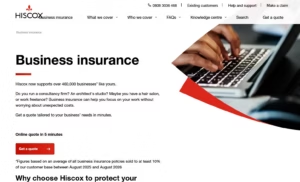
Hiscox official business insurance page showing its professional business cover offering and online quotation section.
4. Direct Line for Business – Best for Flexible Insurance Packages
Check the Direct Line Business Insurance Here
Our Editorial Rating: 89%
Best for: Small retailers, tradespeople, home-based businesses and owners seeking to customise their insurance.
Direct Line for Business offers a substantial range of commercial insurance options.
Its main appeal lies in allowing eligible businesses to select cover based on their activities rather than purchasing a fixed insurance package containing unnecessary protection.
This flexibility is particularly relevant to businesses whose operational risks evolve as they grow.
A home-based seller, for example, may initially need stock and product liability cover. After opening a retail premises and employing staff, the business may also need buildings, business interruption and employers’ liability protection.
What Does Direct Line for Business Cover?
Published options include:
- Public and product liability
- Professional indemnity
- Employers’ liability
- Buildings insurance
- Contents and stock
- Business interruption
- Theft of takings
- Cyber cover
- Legal expenses
- Personal accident
- Tools, plant and contract works for eligible trades.
The ability to select different sections makes it relevant to businesses that do not fit one simple insurance category.
What Does Its Pricing Offer Include?
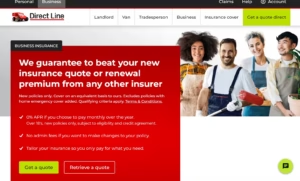
Direct Line for Business advertises a qualifying price-beat guarantee for certain new policies, provided the competing quotation offers equivalent protection and the other eligibility requirements are met.
Its public liability page also states that 70% of customers paid £5.60 per month or less online for qualifying new 12-month policies between June and August 2026.
The monthly payment offer is subject to eligibility and credit agreement conditions.
The promotional terms must be checked before relying on them, especially as they can change.
What Are the Main Strengths?
- Broad selection of insurance covers.
- Options for home-based and premises-based businesses.
- Specialist extensions for manual trades.
- Online access to policy documentation.
- No administration fees for qualifying policy changes.
- Price-beat offer for eligible policies.
What are the Limitations?
The price-beat guarantee is not unconditional and cannot substitute for comparing policy exclusions, excesses and cover limits.
A lower premium is only a meaningful saving when the policies protect against substantially equivalent risks.
Our Assessment
Direct Line for Business is a strong candidate for entrepreneurs seeking more control over their insurance package.
It is especially worth comparing with AXA and Simply Business for common small-business occupations.
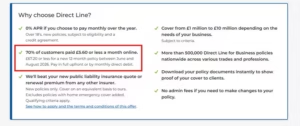
Direct Line for Business public liability insurance page showing the 70% customer pricing statistic and the price-beat terms.
5. Markel Direct – Best for Freelancers and Specialist Professionals
Check the Markel Direct Business Insurance Here
Our editorial rating: 88%
Best for: Freelancers, self-employed consultants, small professional firms, tradespeople and community organisations.
Markel Direct focuses on business insurance for smaller professional organisations and self-employed individuals.
Our assessment found it particularly relevant to businesses that need professional indemnity cover alongside liability protection.
This includes marketing consultants, accountants, designers, IT contractors and specialists whose work may create financial consequences for clients.
What Types of Business Insurance Does Markel Provide?
Its business products include:
- Professional indemnity
- Public liability
- Employers’ liability
- Business equipment cover
- Directors’ and officers’ insurance
- Cyber insurance
- Other specialist business protection.
Markel Direct also offers a legal advice helpline with eligible policies, which can provide additional support where business owners need guidance on a legal issue.
How Much Does Markel Business Insurance Cost?
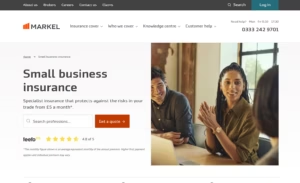
Markel advertises business insurance from £5 per month, using an example of £1 million public and products liability cover for a marketing consultant.
Its professional indemnity insurance page separately advertises a starting monthly figure of £8, subject to the relevant conditions.
These are product-specific illustrations rather than guaranteed prices for all applicants.
Why Might Markel Suit a Freelancer?
A freelance professional may have relatively limited physical business assets but face substantial contractual exposure.
For example, an independent website developer could be accused of delivering work that does not meet the agreed specification.
Professional indemnity may respond to certain allegations of professional negligence, subject to wording and exclusions.
However, it is important to distinguish professional negligence cover from a guarantee that every commercial dispute or contractual refund will be insured.
What Are the Drawbacks?
- The suitability of specialist cover depends on the profession.
- Limits, contractual liability and exclusions need detailed checking.
- Not every policy includes every advertised extension.
- A relatively inexpensive liability policy may not address professional negligence.
Our Assessment
Markel Direct is one of the options we would prioritise when comparing professional indemnity insurance for freelancers and specialist service providers.
Its sector focus makes it worth evaluating alongside Hiscox.
6. Superscript – Best for Startups and Digital Businesses
Check the Superscript Business Insurance Here
Our Editorial Rating: 87%
Best for: Technology startups, online businesses, digital agencies, ecommerce companies and growing SMEs.
Superscript offers commercial insurance through a combination of digital purchasing and specialist broking services.
Its proposition is particularly relevant to entrepreneurs who want to select different categories of cover as their businesses develop.
Unlike a single-insurer offering, its broking model can involve policies underwritten by different insurance providers.
What Insurance Does Superscript Arrange?
Its advertised options include:
- Public liability
- Employers’ liability
- Professional indemnity
- Business equipment and tools
- Buildings and contents
- Business interruption
- Cyber insurance
- Other specialist commercial products.
For a technology business, cyber protection can be particularly important.
An ecommerce company may process payment information, hold customer records, depend on online systems and experience severe trading disruption if its digital infrastructure fails.
However, standard cyber policies are not interchangeable.
A business should examine coverage for cyber incident response, data restoration, business interruption, liability claims and exclusions involving fraudulent payments.
What Makes Superscript Useful?
The digital quotation model can be convenient for growing organisations where operational requirements change.
For example, a new digital marketing agency may start with professional indemnity insurance.
After recruiting employees and expanding into additional services, its insurance requirements could include employers’ liability, cyber and additional management liability protection.
How Much Does Superscript Cost?
Premiums depend on the chosen coverage, the industry and the insurer offering the policy.
A tailored quotation is needed to establish the actual cost.
What Should Founders Consider?
Superscript may provide access to different insurers, but that does not mean every type of commercial risk can be insured instantly online.
Larger, highly specialised or unusual businesses may require broker involvement and additional underwriting information.
Our Assessment
Superscript is a useful option for digital-first companies seeking flexible insurance arrangements and access to specialist broking.
Startups expecting rapid operational changes may find the approach particularly relevant.
7. Aviva – Best for Established Businesses Seeking Broker-Led Cover
Check the Aviva Business Insurance Here
Our Editorial Rating: 86%
Best for: Established SMEs, employers, businesses with commercial premises and companies requiring several types of cover.
Aviva is a major UK insurance provider with a broad commercial insurance offering.
It is important, however, to understand how its business insurance is distributed.
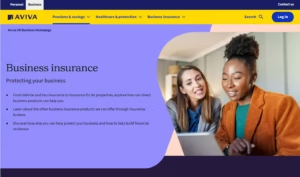
Aviva’s current published information explains that many of its commercial liability and property insurance products are arranged through insurance brokers rather than being directly available through its consumer-facing website.
This distinction matters because older comparison articles may suggest direct purchasing routes that are no longer available.
What Commercial Insurance Does Aviva Offer?
Through relevant distribution channels, its commercial options include:
- Public liability
- Employers’ liability
- Professional indemnity
- Buildings and contents
- Business equipment
- Business interruption
- Commercial motor insurance.
The particular products offered depend on the business and the broker.
Why Might an Established Business Choose Aviva?
Businesses with employees, premises, stock and multiple operational activities often need broader protection than a basic public liability policy.
An insurance broker can assess those different requirements and explore suitable commercial policies.
This can be particularly useful when a business has outgrown the relatively straightforward insurance arrangements used during its startup stage.
How Much Does Aviva Business Insurance Cost?
There is no single appropriate price for its commercial insurance range.
Companies should obtain a quotation through the relevant broker or direct product channel.
What Are Aviva’s Advantages?
- Broad commercial insurance capabilities.
- Options for companies with more complicated requirements.
- Availability through professional insurance brokers.
- Products covering several major commercial risks.
What Are the Drawbacks?
- Core liability products are no longer generally available for direct purchase from Aviva’s retail business insurance pages.
- Comparing products may require interaction with a broker.
- Pricing varies by insurer, business activities and coverage.
Our Assessment
Aviva is an important option for established SMEs, but it should not automatically be treated as a direct online alternative to AXA or Direct Line.
Businesses should confirm the correct purchasing channel before requesting cover.
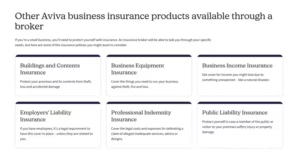
Aviva’s official business insurance page showing the section headed “Other Aviva business insurance products available through a broker”.
8. NFU Mutual – Best for Retailers and Businesses Wanting Personal Service
Check the NFU Mutual Business Insurance Here
Our Editorial Rating: 85%
Best for: Retailers, local businesses, tradespeople, manufacturers, offices and businesses seeking agency-based assistance.
NFU Mutual is widely associated with farming and rural businesses, but its commercial insurance range extends beyond agriculture.
Its published products cover a variety of sectors, including retail, professional services, hospitality, manufacturing and commercial property.
Our research found its regional agency network to be a distinguishing feature.
For business owners who prefer discussing their insurance requirements with a representative rather than relying exclusively on an online form, this may be an important consideration.
What Does Nfu Mutual Business Insurance Include?
Depending on the selected product, cover can include:
- Public liability
- Products liability
- Employers’ liability
- Commercial property
- Stock and contents
- Business interruption
- Goods in transit
- Commercial vehicles
- Specialist trade protection.
Its retailer insurance products include options designed around stock, premises and customer-facing business activities.
Why Is It Suitable for Retailers?
Retailers often carry risks that are not relevant to many digital service providers.
These may include physical stock damage, theft, customer injuries, seasonal inventory fluctuations and disruption following damage to premises.
NFU Mutual’s retailer insurance information describes specific protections for those risks.
For example, its published retailer product includes seasonal stock protection arrangements and business interruption features, subject to the applicable policy conditions.
What Are the Key Strengths?
- Broad commercial product range.
- Agency-based customer support.
- Industry-specific cover arrangements.
- Strong relevance to retailers and businesses with physical assets.
- Options for commercial property and specialist trades.
What Are the Limitations?
Business owners primarily seeking a quick digital comparison of multiple insurers may prefer a comparison broker.
The suitability and cost of NFU Mutual’s products also depend on discussing the specific business requirements.
Our Assessment
NFU Mutual is an attractive option for companies with premises, employees, stock or operational risks that benefit from a more individual insurance assessment.
It is particularly relevant to regional SMEs and businesses wanting ongoing personal support.
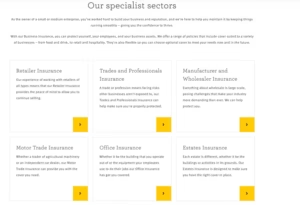
NFU Mutual’s official business insurance page showing its small-business products, specialist sectors and local agency service.
9. Zurich – Best for Growing SMEs with Complex Insurance Requirements
Check the Zurich Business Insurance Here
Our Editorial Rating: 84%
Best for: Established SMEs, manufacturers, wholesalers, retailers and companies with more substantial commercial exposures.
Zurich provides commercial insurance for a broad range of business sizes and sectors.
Its SME products include combined liability and commercial combined policies, making it relevant to businesses that need several insurance sections within a coordinated programme.
This can be particularly useful for an expanding business operating across multiple sites or handling different categories of commercial activity.
What Does Zurich Business Insurance Cover?
Its commercial offerings include:
- Public and products liability
- Employers’ liability
- Commercial property
- Business interruption
- Contractors’ combined insurance
- Commercial vehicle and fleet insurance
- Additional commercial risk solutions.
Zurich’s SME Commercial Combined product allows businesses to tailor a policy using multiple available sections.
It is designed to accommodate a range of UK businesses, including those in manufacturing, warehousing, retail and contracting.
Why Might a Growing Sme Choose Zurich?
A business with multiple activities may need to account for risks across premises, people, products and supply chains.
For example, a wholesaler supplying goods to several retailers could require products liability, stock insurance, goods-in-transit protection and business interruption cover.
A broker can assess whether a coordinated commercial insurance arrangement is appropriate.
How Are Policies Purchased?
Zurich’s commercial business insurance website directs customers towards insurance brokers for quotations.
What Are the Main Advantages?
- Broad commercial underwriting capabilities.
- Specialist products for growing businesses.
- Commercial combined insurance arrangements.
- Support for a variety of industries.
- Broker access to specialist underwriting teams.
What Are the Limitations?
- Products may be more complicated than a basic SME insurance package.
- Obtaining cover normally involves a broker.
- Businesses must review individual sections, limits and exclusions.
Our Assessment
Zurich deserves consideration for established businesses requiring more sophisticated commercial insurance arrangements.
It is especially relevant when a company has moved beyond the needs of a sole-trader liability policy.
10. Allianz – Best for Commercial and Industrial Businesses
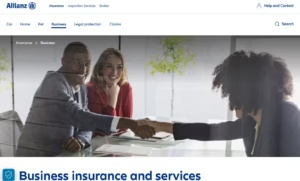
Check the Allianz Business Insurance Here
Our Editorial Rating: 83%
Best for: Manufacturers, contractors, established commercial businesses, property-intensive organisations and companies with vehicle fleets.
Allianz offers commercial insurance products designed around different categories of business risk.
Its UK commercial insurance portfolio includes liability, property, business interruption, motor, construction and specialist commercial covers.
A key consideration is that Allianz’s business insurance policies are purchased through insurance brokers.
This makes it different from direct insurers offering instant quotations for simple business types.
What Insurance Products Does Allianz Offer?
Its published commercial range includes:
- Buildings and contents
- Business interruption
- Commercial liability
- Commercial motor
- Cargo insurance
- Construction insurance
- Specialist commercial risk protection.
For certain businesses, the ability to coordinate different policies through a commercial broker can be more valuable than a simple online price comparison.
Why Is Allianz Relevant to Larger Operational Businesses?
A manufacturer may face risks involving expensive machinery, production disruption, employee accidents, property damage and liability arising from finished products.
A standard public liability policy will not address every one of those exposures.
Appropriate commercial insurance may require a combination of property, liability and business interruption protection.
Allianz also provides business risk guidance and engineering-related services.
What Are the Advantages?
- Broad commercial insurance range.
- Relevant products for operationally complex businesses.
- Broker-led assessment of insurance requirements.
- Support for commercial motor and construction risks.
- Business risk management resources.
What Should Companies Consider?
A business must work through an appropriate intermediary to arrange cover.
It should also make sure that the broker fully understands the organisation’s activities, premises and operational dependencies.
Our Assessment
Allianz is particularly relevant to established businesses where commercial property, liability and operational continuity are major financial considerations.
It is not necessarily the most convenient first option for a sole trader seeking a basic public liability quotation.
11. Kingsbridge – Best for Contractors and Freelancers
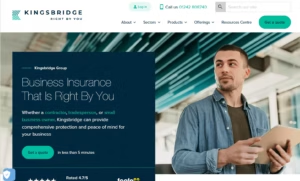
Check the Kingsbridge Business Insurance Here
Our Editorial Rating: 82%
Best for: IT contractors, engineering specialists, consultants, construction contractors and independent professionals.
Kingsbridge focuses on insurance and related services for contractors, freelancers and self-employed professionals.
Its specialist approach is particularly relevant to workers who provide services to business clients under project-based contracts.
For these professionals, insurance requirements can be influenced by contractual terms, working arrangements and the nature of the services delivered.
What Cover Can Kingsbridge Arrange?
Its offerings include:
- Professional indemnity
- Public liability
- Employers’ liability
- Contractor insurance
- Directors’ and officers’ cover
- Legal expenses
- IR35-related insurance products.
Kingsbridge also provides services connected to contractor arrangements and IR35.
However, IR35 protection must not be confused with an automatic guarantee that HMRC will accept a contractor’s tax status.
Any tax investigation or legal expenses cover is subject to its specific insured events, conditions, limits and exclusions.
Why Is Kingsbridge Suitable for Contractors?
Some client contracts require contractors to hold particular types of insurance before starting a project.
For example, an IT contractor providing services to a financial institution may be asked to demonstrate professional indemnity insurance and other relevant protection.
Kingsbridge’s contractor-focused offering can help eligible applicants explore arrangements that address these contractual requirements.
What Are the Strengths?
- Specialist contractor and freelancer focus.
- Combined insurance options.
- Relevant professional indemnity protection.
- Contract-related support services.
- Additional IR35-related products.
What Are the Limitations?
- IR35 insurance does not remove the need to comply with tax legislation.
- The exact contractor insurance package must be reviewed.
- Not every business is a natural fit for contractor-focused products.
Our Assessment
Kingsbridge is worth considering for independent contractors and specialist professionals, especially when clients impose insurance conditions.
The main value lies in its contractor-focused services rather than being a universal insurance option for every UK business.
12. PolicyBee – Best for Freelancers and Microbusinesses
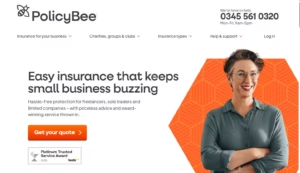
Check the PolicyBee Business Insurance Here
Our Editorial Rating: 81%
Best for: Freelancers, independent consultants, creative professionals, sole traders and smaller limited companies.
PolicyBee is a specialist business insurance broker with an emphasis on making cover accessible to smaller organisations.
Its proposition combines online purchasing with access to insurance professionals.
Unlike an insurer that underwrites its own policy, PolicyBee arranges protection through relevant insurance providers.
What Insurance Can Policybee Arrange?
Its published insurance categories include:
- Professional indemnity
- Public liability
- Employers’ liability
- Cyber insurance
- Additional small-business protection.
For small professional businesses, this combination can address several common commercial exposures without requiring a large corporate insurance arrangement.
Why Is It Suitable for Microbusinesses?
Many freelancers face risks associated with professional services and client relationships rather than factories, stock or heavy equipment.
For example, a freelance graphic designer may need professional indemnity cover for allegations arising from professional work, alongside appropriate business equipment protection.
PolicyBee is positioned towards these smaller businesses and their insurance requirements.
What Are the Advantages?
- Focus on freelancers and small businesses.
- Specialist broking support.
- Online purchasing options.
- Public and professional liability products.
- Access to advice from insurance professionals.
What Are the Limitations?
- The available underwriters and quotations vary.
- Not every specialist commercial exposure will necessarily be covered.
- The business must inspect the actual insurer’s policy wording.
Our Assessment
PolicyBee is a useful alternative to larger comparison platforms for microbusinesses wanting insurance arrangements with specialist broker assistance.
It is particularly relevant to independent professional service providers.
How Much Does Business Insurance Cost in the UK in 2026?
Business insurance premiums vary considerably because different industries present different insurance risks.
A self-employed consultant working from home may only need a limited combination of professional indemnity and public liability protection.
A construction firm employing several workers, operating machinery and undertaking high-value projects will face different insurance requirements.
Our analysis found that advertised entry-level premiums can be useful for identifying possible low-cost options, but they cannot be treated as quotes for a complete business insurance package.
Published Business Insurance Price Examples
| Provider | Advertised Example | Important Condition |
| Simply Business | Equivalent of £5.40/month | Public liability; 10% of customers |
| AXA | £63/year | Public liability; 10% of customers, April–June 2026 |
| Direct Line for Business | £5.60/month or less | Public liability; 70% of qualifying new online customers, June–August 2026 |
| Markel Direct | From £5/month | Example public liability policy for a marketing consultant |
| Hiscox | Quote required | Based on business and chosen cover |
| Superscript | Quote required | Depends on insurer and policy |
| Aviva | Quote required | Many commercial products broker-arranged |
| NFU Mutual | Quote required | Based on business needs |
| Zurich | Broker quotation | Commercial policy requirements vary |
| Allianz | Broker quotation | Available through brokers |
| Kingsbridge | Quote required | Depends on contractor’s activities |
| PolicyBee | Quote required | Depends on the selected policy |
Important: These advertisements relate to different customer groups, products, payment structures and eligibility periods. They are not equivalent-policy quotations or a direct price ranking.
What Factors Affect Business Insurance Premiums?
Insurers commonly consider:
- Industry: Higher-risk physical activities may create greater liability exposure.
- Turnover: Revenue can help indicate the scale of commercial operations.
- Employees: Workforce size and activities affect employers’ liability risk.
- Claims history: Previous claims may influence underwriting.
- Location: Premises, flood exposure and security can affect property premiums.
- Cover limits: Higher insurance limits may increase the premium.
- Excess: The amount the business contributes to certain claims affects the cost.
- Business activities: Specialist operations, overseas work or subcontracting may require additional assessment.
Businesses should calculate insurance costs alongside other recurring commitments when preparing their business financial plans, rather than treating insurance as an expense to consider only after operations begin.
What Types of Business Insurance Do UK Companies Need?
The best policy depends on the risks the company needs to insure.
Different insurance products address different categories of financial loss.
| Insurance Type | Main Purpose | Typical Users |
| Public liability | Third-party injury or property damage claims | Shops, tradespeople, service firms |
| Professional indemnity | Claims arising from negligent professional services or advice | Consultants, agencies, professionals |
| Employers’ liability | Employee work-related injury or illness claims | Most businesses employing staff |
| Product liability | Injury or damage caused by products | Retailers, manufacturers, importers |
| Buildings and contents | Covered damage to premises or equipment | Offices, shops, warehouses |
| Business interruption | Certain trading losses following insured events | Premises-based businesses |
| Cyber insurance | Selected cyber incidents and related losses | Digital businesses and data holders |
| Directors’ and officers’ | Specified claims against management | Limited companies and organisations |
| Tools and equipment | Covered theft or damage to business tools | Tradespeople and contractors |
| Goods in transit | Covered damage or loss during transport | Retailers, suppliers, distributors |
Public Liability Insurance
Public liability insurance protects businesses against certain claims from members of the public for injury or property damage arising from business activities.
For example, a customer who slips because of an unsafe condition in a shop may bring a compensation claim.
Public liability insurance can cover eligible defence costs and compensation, subject to the policy.
It is generally not a universal legal requirement in the UK, although clients, venues, landlords or professional organisations may require it contractually.
Professional Indemnity Insurance
Professional indemnity insurance protects against certain claims involving negligent advice, errors, omissions or failures in professional services.
It is relevant to consultants, architects, accountants, designers, IT professionals and other service businesses.
Some regulated professions are required by their regulators or professional bodies to maintain particular levels of professional indemnity cover.
Employers’ Liability Insurance
Most businesses employing staff in Great Britain are legally required to have employers’ liability insurance with at least £5 million of cover from an authorised insurer.
Certain exemptions apply.
Failure to hold the required cover can lead to penalties of £2,500 per day.
Employers must also make the insurance certificate accessible to employees. Failure to comply with certificate requirements can result in further penalties.
The official guidance is available at https://www.gov.uk/employers-liability-insurance.
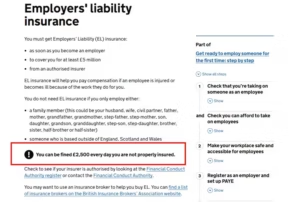
GOV.UK’s Employers’ Liability Insurance page showing the £5 million legal minimum, applicable exemptions and £2,500 daily penalty.
Cyber Insurance
Cyber insurance can provide protection against specified costs arising from cyber incidents.
Depending on the policy, these may include forensic investigation, system restoration, cyber-related liability and loss of income resulting from covered incidents.
However, businesses should not assume that every form of online fraud is automatically included.
Social engineering, voluntary payment transfers, security failures and certain cyberattacks may be subject to specific exclusions or sub-limits.
Business Interruption Insurance
Business interruption insurance helps address certain lost income or additional operating expenses following an insured event.
For example, a restaurant suffering substantial fire damage might be unable to trade while its premises are repaired.
A suitable property damage business interruption policy may respond to the resulting financial loss.
However, conventional business interruption insurance often requires an insured physical damage event to trigger cover.
Cyber incidents, supplier failures and other disruptions may need specific extensions or separate policies.
Which Business Insurance Is Best for Different Industries?
Different sectors need different combinations of cover.
A company should prioritise the risks most capable of disrupting its operations or creating substantial legal exposure.
| Business Type | Priority Insurance | Providers Worth Comparing |
| Freelance consultant | Professional indemnity, public liability | Hiscox, Markel, PolicyBee |
| IT contractor | Professional indemnity, cyber, contractual cover | Kingsbridge, Hiscox, Superscript |
| Small retailer | Public/product liability, stock, business interruption | AXA, NFU Mutual, Direct Line |
| Construction business | Public liability, tools, contract works, employers’ liability | AXA, Direct Line, Zurich |
| Digital marketing agency | Professional indemnity, cyber, employers’ liability | Hiscox, Markel, Superscript |
| Ecommerce seller | Product liability, stock, cyber, goods in transit | Superscript, NFU Mutual, Simply Business |
| Manufacturer | Product liability, commercial property, business interruption | Allianz, Zurich, NFU Mutual |
| Home-based business | Relevant liability, equipment and stock cover | Direct Line, Simply Business, AXA |
| Established SME | Combined liability, property, business interruption | Aviva, Zurich, Allianz |
These are shortlisting suggestions, not assurances that a particular provider will accept every occupation or insure every risk.
Best Insurance for Sole Traders
Sole traders should assess whether a claim could create personal financial exposure.
Unlike a limited company, a sole trader is not a separate legal entity from its owner.
Consequently, liabilities arising from business activities may directly affect the individual’s finances.
Public liability and professional indemnity insurance are often worth considering, depending on the occupation.
Best Insurance for Limited Companies
A limited company may need a wider insurance package as it recruits employees, acquires equipment or signs more substantial contracts.
Directors should also consider whether management liability or directors’ and officers’ insurance is appropriate.
While limited liability can protect shareholders in many circumstances, it does not prevent every potential claim against a director personally.
Business owners reviewing their company registration and legal structure should consider how insurance requirements differ between sole traders and incorporated businesses.
Best Insurance for Startups
Startups often operate with limited cash reserves, making large unexpected losses particularly damaging.
Founders should identify their principal exposures before choosing insurance.
A technology startup may prioritise professional indemnity and cyber cover. A food business may instead need product liability, premises and employers’ liability insurance.
The objective should be to buy adequate protection without paying for unrelated risks.
What Are the Hidden Insurance Conditions Businesses Should Check?
One of the biggest weaknesses in simple business insurance comparisons is the limited discussion of what policies exclude.
The headline coverage amount is important, but it is not sufficient to establish whether a policy will pay a claim.
Claims-Made Professional Indemnity Cover
Professional indemnity insurance is commonly written on a claims-made basis.
This generally means the relevant claim must be made during the applicable insurance period, subject to the policy’s notification, retroactive-date and other conditions.
Suppose a consultant completes a project in 2025.
The customer only discovers an alleged error and makes a claim in 2027.
If the consultant allowed professional indemnity cover to lapse before the claim arose, an old policy may not respond.
Businesses should therefore review continuity of cover, retroactive dates and run-off insurance requirements before changing insurer or closing operations.
Underinsurance and the Average Clause
Businesses may underestimate the value of stock, buildings, equipment or the income they would lose after a major incident.
Some property policies contain average clauses that can reduce claim payments when the sum insured is inadequate.
For example, if a business insures assets for only half their appropriate value, an applicable average clause might reduce a claim payment proportionately, even where the loss itself is below the stated sum insured.
Not every policy applies average in the same way, so the exact wording matters.
Contractual Liability Exclusions
A business may promise a client wider compensation rights than would otherwise arise under ordinary law.
Insurance policies do not necessarily cover every additional contractual obligation.
Businesses signing high-value contracts should check whether their insurance meets those obligations before accepting the agreement.
Territorial and Jurisdictional Limits
Companies working with overseas clients must check where their policy applies and which legal jurisdictions are included.
Cover valid for UK activities may not automatically extend to work performed abroad or claims brought in another country.
Cyber and Fraud Exclusions
A cyber insurance policy may provide data restoration or incident response cover but exclude some voluntary financial transfers induced by fraud.
Businesses should check social engineering, ransomware, business email compromise and payment fraud provisions separately.
Business Interruption Indemnity Periods
The indemnity period is the maximum period for which the policy can cover qualifying business interruption losses, subject to its terms.
Businesses should consider how long it would realistically take to replace equipment, rebuild premises or restore supply chains following a severe loss.
An inadequate indemnity period can leave a company financially exposed even if its property damage claim is paid.
How Can Businesses Compare Insurance Policies Properly?
An effective comparison should go beyond price and advertised coverage.
Our recommended approach is to obtain multiple quotations using identical business details and then compare the policy terms.
Example of a Like-for-Like Insurance Comparison
The following is a hypothetical example, not a quotation from any provider.
Assume a small consultancy requests professional indemnity protection.
| Feature | Illustrative Policy A | Illustrative Policy B |
| Annual premium | £180 | £240 |
| Professional indemnity limit | £100,000 | £1 million |
| Excess | £500 | £250 |
| Cyber protection | Not included | Optional |
| Legal defence costs | Subject to wording | Subject to wording |
| Overseas work | Restricted | Wider terms, subject to wording |
| Contractual requirements | May be insufficient | May offer suitable limits |
Policy A is cheaper by £60 annually, but that saving may be insignificant if a client’s contract requires £1 million of professional indemnity cover.
The comparison illustrates why the cheapest insurance is not necessarily the most cost-effective option.
What Should Businesses Ask Before Buying?
Before accepting a quotation, business owners should confirm:
- Does the policy accurately describe every business activity?
- Are all relevant employees and subcontractors properly accounted for?
- What are the limits for individual claims and total claims?
- Which exclusions could affect the most likely losses?
- How much excess would the business pay?
- Are legal defence costs included within or in addition to the limit?
- Does the policy cover work at customers’ premises?
- Are overseas clients and operations included?
- What circumstances must be reported to the insurer?
- What happens if the business changes activities or turnover during the policy year?
- Is the policy written on a claims-made or occurrence basis?
- How are claims handled and who is responsible for managing them?
The answers should be supported by the quotation, policy schedule, wording and endorsements.
How Can Small Businesses Reduce Insurance Costs?
Reducing insurance costs can be sensible, provided the savings do not create significant gaps in protection.
Several practical approaches are worth considering.
Compare providers at renewal. Premiums can change as insurers adjust their pricing and risk appetite. Comparing appropriate quotations may reveal better value.
Choose realistic cover limits. The business should match cover limits to contractual obligations and potential financial exposures.
Consider the voluntary excess. A higher excess can sometimes reduce premiums, but the business must be able to afford its contribution if a claim occurs.
Remove irrelevant optional cover. There is limited value in insuring equipment or activities a business does not have, provided removing the cover does not create a genuine exposure.
Improve risk management. Good premises security, health and safety procedures, staff training and cyber security may help a business manage claims risk.
Review payment terms. Annual payment may be cheaper than paying monthly where instalment interest or fees apply, although some providers advertise interest-free instalment arrangements.
Maintain accurate financial information. Up-to-date turnover, equipment valuations and stock records can support more accurate insurance assessments.
Using reliable small business accounting software can help businesses track the financial information needed for renewals and insurance declarations.
The goal should be to optimise the premium relative to the financial protection provided, not simply to minimise spending.
Is Business Insurance Tax-Deductible in the UK?
Business insurance premiums may generally qualify as allowable business expenses where they are incurred wholly and exclusively for business purposes, subject to the relevant tax rules.
For example, appropriate public liability or professional indemnity insurance purchased for business activities will commonly be treated as a business expense.
However, tax treatment depends on the type of insurance, the business structure and the purpose of the policy.
Personal cover and some business protection arrangements may be treated differently.
Does VAT Apply to Business Insurance?
Most UK insurance premiums are exempt from VAT.
Instead, many general insurance products are subject to Insurance Premium Tax.
The standard IPT rate in October 2026 is 12%.
This means business owners should not automatically treat the IPT included in an insurance premium as recoverable input VAT.
The government explains the applicable rules at https://www.gov.uk/tax-on-shopping/insurance-premium-tax.
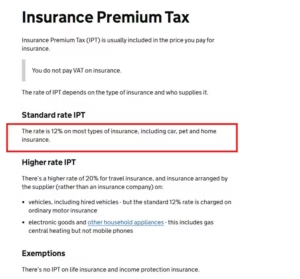
GOV.UK Insurance Premium Tax page showing the standard 12% rate and the statement that VAT is not charged on insurance.
How Do Businesses Check Whether an Insurance Provider Is Regulated?
Before purchasing insurance, business owners should confirm that the insurer or intermediary is appropriately authorised.
The Financial Conduct Authority provides a Firm Checker and a Financial Services Register.
These services allow users to examine information about regulated organisations and their permissions.
For example, a business using an insurance broker should check that the correct legal entity has the necessary permission or operates under an appropriate authorised arrangement.
The trading name displayed on a website may differ from the regulated company’s formal name.
Business owners should therefore examine the legal entity and regulatory details rather than relying on a familiar brand alone.
The FCA guidance is available at https://www.fca.org.uk/consumers/how-check-firm-individual-authorised.
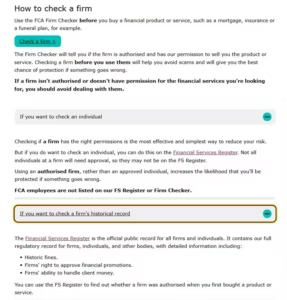
FCA’s official “How to check a firm or individual is authorised” page showing the Firm Checker instructions and how to verify insurance permissions.
Which Business Insurance Provider Offers the Best Overall Value?
Our comparison identifies different strengths across the UK insurance market.
For businesses wanting several insurance quotations, Simply Business is our leading comparison option.
For small businesses and tradespeople seeking direct cover, AXA and Direct Line for Business are strong candidates.
For consultants and professional service companies, Hiscox and Markel Direct deserve particular attention.
For startups with developing commercial risks, Superscript offers a flexible broking approach.
Established organisations with more complex operational exposures may benefit from working with a broker to assess commercial insurance from Aviva, Zurich or Allianz.
Meanwhile, NFU Mutual is especially worth considering for retailers and businesses wanting agency support, while Kingsbridge and PolicyBee address more specialised contractor and freelancer requirements.
The most important principle is that business insurance should be evaluated against the financial consequences of an uninsured claim.
A policy that costs more but provides appropriate indemnity limits, fewer relevant gaps and suitable business interruption protection may deliver considerably better value than a low-cost product offering inadequate cover.
The final decision should be based on quotations for the same business profile, full policy documents and a clear understanding of the exposures being insured.
Frequently Asked Questions About Business Insurance
1. What is the best business insurance company in the UK?
There is no single best insurer for every business. AXA, Hiscox and Direct Line are strong options for different SME needs, while Simply Business is useful for comparing policies from multiple insurers.
2. How much does small business insurance cost per month?
Some providers advertise basic public liability cover from approximately £5–£6 per month for eligible customers. Broader packages can cost substantially more depending on the business.
3. Is business insurance compulsory in the UK?
Most businesses are not legally required to hold every type of commercial insurance. However, employers’ liability insurance is compulsory for most employers, and certain regulated professions have specific insurance obligations.
4. Does a limited company need business insurance?
A limited company may need employers’ liability, professional indemnity, public liability or other cover depending on its employees, industry, contracts and activities.
5. What is the cheapest business insurance for sole traders?
The cheapest suitable option varies by occupation, claims history and cover requirements. Comparing equivalent quotes from AXA, Direct Line, Markel and other relevant providers is a practical approach.
6. Can a business operate without public liability insurance?
In many cases, yes, because public liability insurance is not universally required by law. However, clients, landlords, industry bodies or contracts may require it.
7. Can business insurance cover cyberattacks?
Yes, specialist cyber insurance can cover certain cyber-related costs, claims and disruption. The precise protection depends on policy terms, limits and exclusions.