




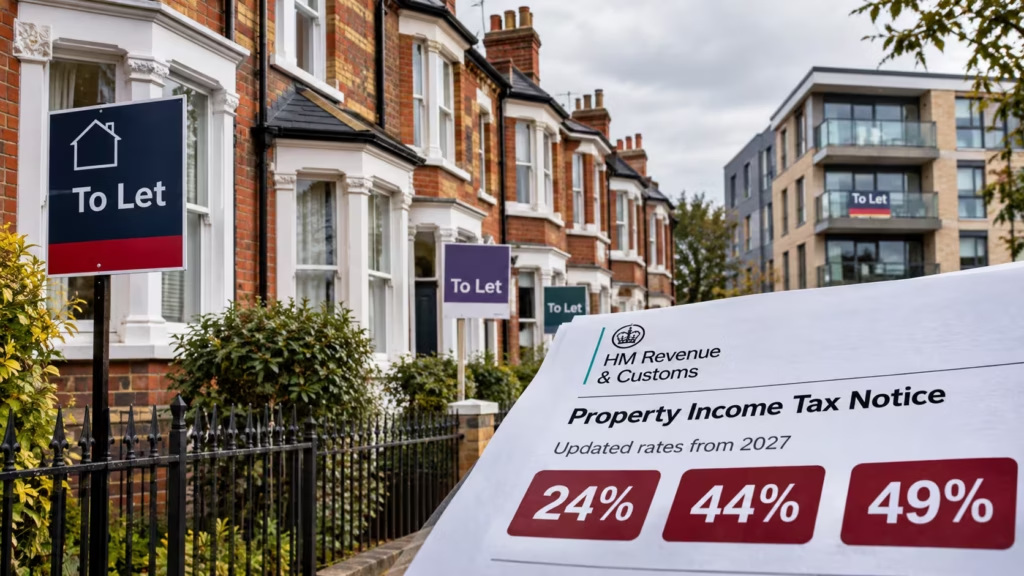















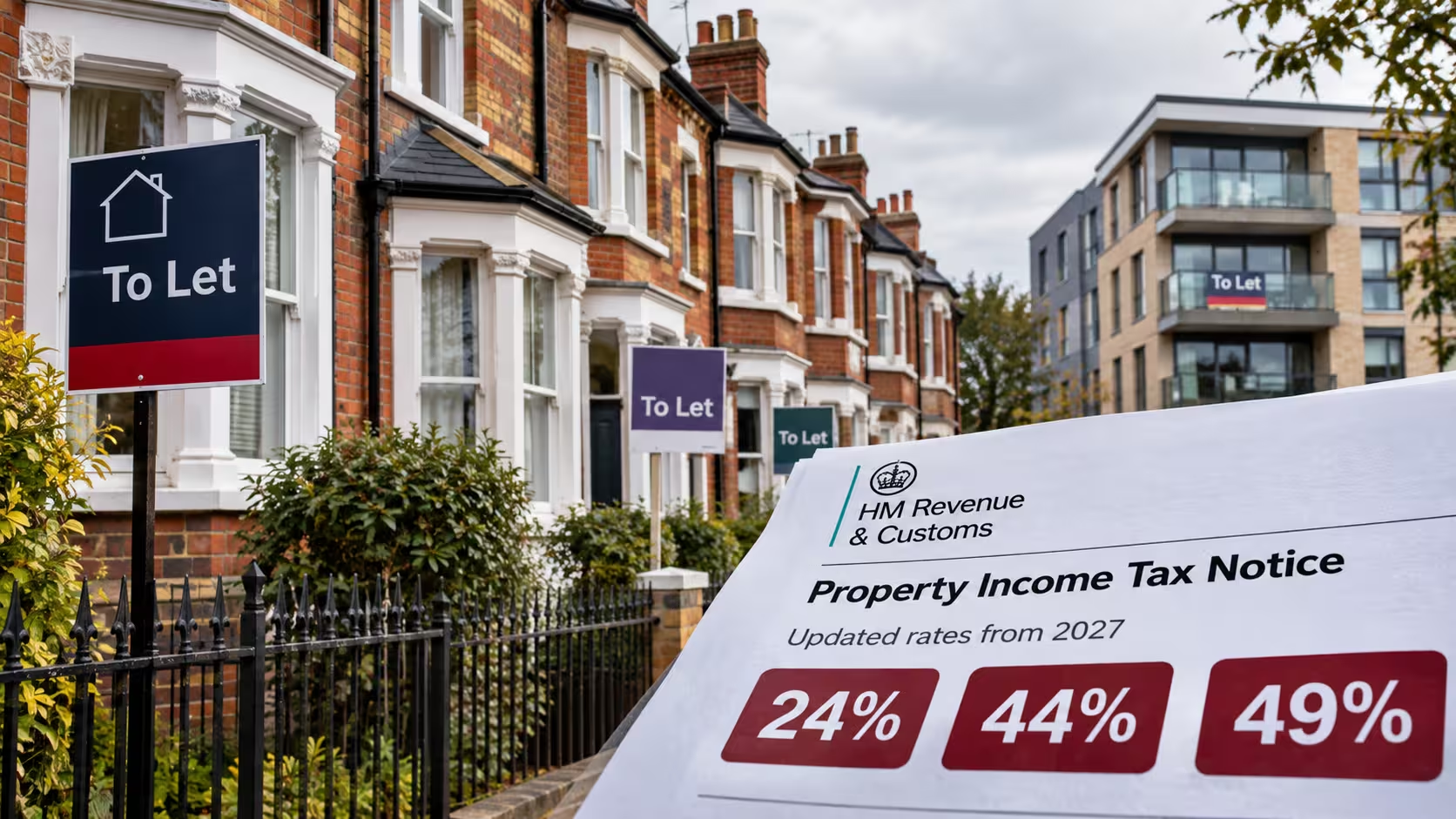
The portfolio landlord tax increase UK property investors face in 2027 is becoming one of the most significant financial changes for buy-to-let businesses.
Following the Autumn Budget announced on 28 October 2026, landlords holding residential rental properties personally could face Income Tax rates of 24%, 44% or 49% on taxable property profits from 6 April 2027.
These rates are four percentage points higher than the standard Income Tax rates applying to property income in 2026/27. They also exceed the 22%, 42% and 47% rates originally announced in the 2025 Budget.
For a landlord with £30,000 of taxable rental profit, a four-percentage-point increase could mean £1,200 more tax annually where the entire profit falls within the same tax band and no finance-cost relief or other tax adjustments affect the calculation.
For larger portfolios, the financial impact can be considerably greater, particularly where landlords are already managing higher mortgage costs, maintenance expenses, insurance premiums and changing tenancy regulations.
Our analysis examines how the latest tax announcements could influence portfolio profitability, ownership structures, rental yields and investment decisions through 2027 and beyond.
What Is the Portfolio Landlord Tax Increase in the UK for 2027?
The government plans to introduce separate Income Tax rates for property income from 6 April 2027.
The 2025 Budget originally set these rates two percentage points above the main Income Tax rates. However, the Autumn Budget 2026 announced another two-percentage-point increase.
As a result, the planned total increase compared with 2026/27 is four percentage points.
| Tax band | 2026/27 property income | Original 2027 proposal | Updated 2027/28 rate |
| Basic rate | 20% | 22% | 24% |
| Higher rate | 40% | 42% | 44% |
| Additional rate | 45% | 47% | 49% |
| Increase against 2026/27 | — | +2 percentage points | +4 percentage points |
The latest rates apply to property income in England, Wales and Northern Ireland under the announced framework. Scotland’s position must be considered separately because of its devolved Income Tax arrangements.
As of November 2026, the additional increase announced in October is intended to be legislated through Finance Bill 2026–27.
Importantly, these rates apply to taxable rental profits, not automatically to every pound of gross rent received.
A landlord collecting £60,000 annually but incurring £15,000 of allowable operating expenses would normally begin with £45,000 of property profit before considering any other relevant reliefs or adjustments.
Our assessment is that investors should immediately review both their expected rental profits and their ownership arrangements. A portfolio containing five properties does not automatically face a different statutory property-income rate from a portfolio containing one property.
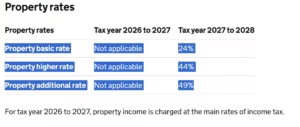
Official 2026/27 and 2027/28 property Income Tax comparison confirming the new 24%, 44% and 49% rates.
Who Is Considered a Portfolio Landlord in the UK?
A portfolio landlord generally refers to an investor who owns several residential properties for rental purposes.
In mortgage underwriting, the term often refers to landlords with four or more mortgaged buy-to-let properties. However, there is no universal rule stating that a landlord becomes subject to a separate Income Tax regime simply because they own four properties.
For Income Tax purposes, an individual’s UK rental properties will generally form part of the same UK property business, with their profits and losses calculated together under the applicable rules.
For example, consider a landlord who owns five residential properties.
| Property | Annual rent | Allowable operating expenses | Profit before finance-cost treatment |
| Property A | £12,000 | £2,000 | £10,000 |
| Property B | £15,000 | £3,000 | £12,000 |
| Property C | £13,200 | £2,200 | £11,000 |
| Property D | £18,000 | £4,000 | £14,000 |
| Property E | £16,800 | £3,000 | £13,800 |
| Total | £75,000 | £14,200 | £60,800 |
In this example, the property business generates £60,800 before residential finance-cost restrictions and other tax adjustments.
The landlord does not normally receive a new Personal Allowance for each rental property. The income must be considered alongside the landlord’s other taxable income when calculating the appropriate tax bands.
This distinction is particularly important for landlords who also receive salaries, pension income, self-employment income or other investment income.
Our review of how much someone can earn before paying tax explains how taxable income interacts with the Personal Allowance and wider Income Tax thresholds.
How Much More Tax Will Portfolio Landlords Pay in 2027?
The simplest starting point is to compare the tax due on the same amount of taxable rental profit under the 2026/27 and proposed 2027/28 rates.
The following calculations assume the entire rental profit falls within a single tax band, with no mortgage finance-cost credit, allowance changes or other complications.
| Annual taxable rental profit | Tax at 20% | Tax at 24% | Additional annual tax |
| £5,000 | £1,000 | £1,200 | £200 |
| £10,000 | £2,000 | £2,400 | £400 |
| £20,000 | £4,000 | £4,800 | £800 |
| £30,000 | £6,000 | £7,200 | £1,200 |
| £40,000 | £8,000 | £9,600 | £1,600 |
These are simplified marginal-rate illustrations, not complete tax returns. In practice, a landlord’s income may span several bands.
The same four-percentage-point difference applies when comparing the corresponding higher and additional property tax rates.
How Significant Is the Percentage Increase?
Although the statutory rates rise by four percentage points, the percentage increase in the tax rate itself differs by band.
| Taxpayer category | Previous rate | New rate | Relative increase in rate |
| Basic-rate landlord | 20% | 24% | 20% |
| Higher-rate landlord | 40% | 44% | 10% |
| Additional-rate landlord | 45% | 49% | 8.9% |
A basic-rate landlord therefore faces a 20% relative increase in the applicable tax rate on profit taxed wholly at that rate.
That does not mean every basic-rate landlord’s final tax bill will automatically rise by 20%. Allowances, interest relief and other income can change the outcome.
The most useful calculation is the change in actual annual tax payable after all available reliefs.
What Does HMRC Estimate the Increase Will Cost?
HMRC’s October 2026 tax impact assessment estimates that approximately 5% of taxpayers will experience an average annual increase of £225 during 2027/28 from the additional property-rate measure.
The assessment also projects that around 2.4 million landlords will be affected by 2031/32.
These are population-wide estimates, not a forecast for every individual landlord.
HMRC estimates that the additional October 2026 property tax measure will generate £35 million in 2027/28, rising to £575 million in 2028/29 before changing in subsequent years.
For portfolio owners with substantial rental profits, the individual financial impact could be far above the estimated average.
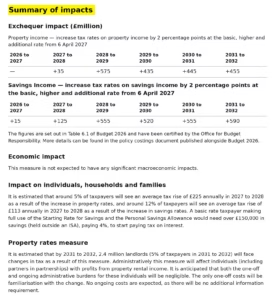
HMRC’s assessment of the additional 2026 Budget property tax measure, including projected revenue and the number of affected landlords.
How Will the New Tax Rates Affect a Four-Property Buy-to-Let Portfolio?
For landlords with mortgage borrowing, the calculation becomes more complex because residential mortgage interest is generally subject to a tax-reduction system rather than being deducted directly from taxable rental profits.
Consider a hypothetical investor with four buy-to-let properties.
| Portfolio financial detail | Annual amount |
| Rental income | £45,600 |
| Allowable operating expenses | £9,600 |
| Property profit before finance-cost relief | £36,000 |
| Eligible mortgage interest | £18,000 |
| Cash profit before Income Tax | £18,000 |
Assume this landlord also receives a £55,000 salary and that the entire £36,000 property profit falls within the higher-rate band. The example excludes other income, additional reliefs and special adjustments, and assumes the full residential finance-cost reduction is available.
2026/27 Calculation
- Property Income Tax at 40%: £14,400
- Finance-cost tax reduction at 20% of £18,000: £3,600
- Net property-related Income Tax: £10,800
- Cash remaining from the portfolio after this tax: £7,200
2027/28 Calculation
- Property Income Tax at 44%: £15,840
- Finance-cost tax reduction at 24% of £18,000: £4,320
- Net property-related Income Tax: £11,520
- Cash remaining from the portfolio after this tax: £6,480
| Financial result | 2026/27 | 2027/28 |
| Cash profit before Income Tax | £18,000 | £18,000 |
| Net property-related Income Tax | £10,800 | £11,520 |
| Cash after Income Tax | £7,200 | £6,480 |
| Share of pre-tax cash retained | 40% | 36% |
In this illustration, annual Income Tax increases by £720 rather than £1,440 because the tax reduction on eligible mortgage interest also increases.
This is a crucial detail that simple headline comparisons can overlook.
However, the cash available to the landlord still falls by 10%, assuming the underlying rental figures remain unchanged.
For investors relying on rental income to fund living costs, mortgage repayments or portfolio expansion, a reduction of this size can influence wider financial decisions.
Will Mortgage Interest Tax Relief Change for Landlords in 2027?
Yes. The new property basic rate also affects the tax reduction available for qualifying residential finance costs.
Individual landlords generally cannot deduct residential mortgage interest from rental income when calculating taxable property profit.
Instead, they receive a tax reduction calculated using the applicable basic rate, subject to statutory restrictions.
The finance-cost tax reduction is scheduled to follow the separate property basic rate from April 2027.
| Mortgage-interest treatment | 2026/27 | 2027/28 |
| General property basic rate | 20% | 24% |
| Potential finance-cost tax reduction rate | 20% | 24% |
| Residential interest generally deducted directly from individual property profit? | No | No |
For example, £12,000 of eligible mortgage interest could generate a tax reduction of £2,400 under a 20% rate or £2,880 under a 24% rate, assuming the full amount qualifies.
That is an additional £480 of potential relief.
However, the tax reduction is subject to limits involving eligible finance costs, property business profits and relevant adjusted income. Unused relief can sometimes be carried forward.
Mortgage capital repayments are also different from mortgage interest. Repaying loan principal reduces a landlord’s cash balance but is not ordinarily an allowable revenue expense against rental profits.
Our assessment is that higher-rate landlords with significant borrowing should model their full post-tax cash position before deciding whether to sell or refinance.
A mortgage calculator can help assess repayment changes and interest-rate sensitivity, although the resulting figures need a separate landlord-specific tax calculation.
Should Portfolio Landlords Use a Limited Company Before 2027?
Limited-company ownership may be worth considering, but it is not automatically the best choice for every landlord.
The 24%, 44% and 49% property Income Tax rates primarily affect individuals and relevant unincorporated arrangements. A company is generally subject to Corporation Tax on its taxable profits instead.
Under the rates published for the 2027/28 financial year, Corporation Tax remains:
| Company taxable profits | Corporation Tax treatment |
| £50,000 or less | 19% small-profits rate, where eligible |
| £50,001 to £250,000 | Marginal Relief may apply |
| Above £250,000 | 25% main rate |
The limits can be reduced where associated companies or short accounting periods are involved.
A company carrying on a qualifying property business can also generally deduct eligible loan interest under the company tax rules.
However, there are several disadvantages.
What Are the Risks of Transferring Existing Properties?
A landlord transferring personally owned rental properties into a limited company may face:
- Capital Gains Tax on a disposal treated at market value.
- Stamp Duty Land Tax or the appropriate devolved transaction tax.
- Mortgage refinancing and early repayment charges.
- Conveyancing, valuation and professional fees.
- Additional tax when profits are subsequently withdrawn.
- Company accounts, Corporation Tax returns and ongoing administrative costs.
Incorporation Relief may be available in qualifying circumstances, but ordinary investment ownership does not automatically satisfy its requirements.
For example, transferring a property with a substantial unrealised gain may create an immediate tax cost even where the owner controls the receiving company.
Our analysis of the HMRC landlord tax loophole crackdown explains why some complex LLP and corporate-member arrangements are particularly risky.
Landlords exploring a conventional corporate structure can also review the practical steps involved in registering a limited company and selecting appropriate business bank accounts for keeping company transactions separate.
Is Company Ownership More Tax-Efficient?
It depends heavily on what happens to the rental profit.
A company retaining earnings to fund future property purchases may produce a different tax outcome from a company distributing nearly all available profit to its shareholders.
For example, assume a company has £40,000 of taxable profit and qualifies for the 19% small-profits Corporation Tax rate.
Its Corporation Tax would be £7,600, leaving £32,400 in the company.
However, that £32,400 is company money, not automatically the shareholder’s tax-free personal income. Dividends or salaries can create additional personal tax liabilities.
The 2026/27 and announced 2027/28 dividend rates include 10.75% at the ordinary rate, 35.75% at the upper rate and 39.35% at the additional rate, above the applicable dividend allowance.
The correct comparison therefore includes both company-level and shareholder-level taxation.
For existing portfolios, the transaction cost of transferring ownership may outweigh many years of expected annual tax savings.
Will the 2027 Tax Increase Make Portfolio Landlords Sell Their Properties?
Some landlords may reconsider whether individual properties continue to meet their investment objectives.
The National Residential Landlords Association has strongly criticised the higher rates.
In commentary published on 5 November 2026, its Chief Executive Ben Beadle described the successive increases as:
“This double whammy is both unjust and extremely shortsighted.”
The association argues that additional taxation could reduce rental supply and contribute to higher rents as some landlords withdraw from the market.
However, landlords cannot automatically recover increased tax costs through higher rents. Rental levels depend on local demand, affordability, competition and applicable tenancy regulations.
There is also a significant difference between a landlord selling one weak-performing property and a landlord leaving the rental market completely.
A portfolio investor may instead choose to sell a property with unusually high maintenance costs, persistent vacancies or weak net yields.
What Do Professional Investment Analysts Say?
Charlie Newsome, Senior Investment Director at Rathbones, commented in the firm’s November 2026 analysis:
“The landlord squeeze is tightening from all directions and, for some, the sums simply no longer stack up.”
Rathbones’ illustrative calculations suggest that the combined four-percentage-point rate increase could add approximately £1,122 to the first-year tax burden associated with a property receiving average London rent.
Its modelling projects approximately £12,288 over ten years and almost £36,000 over 25 years under specified assumptions, including annual rental growth of 2%.
These are simplified projections rather than individual tax-return estimates, and they do not necessarily reflect deductible expenses, tax allowances or mortgage finance-cost relief.
The broader lesson is that even a relatively small annual tax increase can accumulate over a long investment period.
How Will the New Tax Rates Affect Portfolio Rental Yields?
A landlord’s gross rental yield does not automatically change because Income Tax rates increase.
Gross yield is calculated by dividing annual rental income by the property’s value.
For example, a property worth £250,000 producing annual rent of £15,000 has a gross yield of 6%.
However, the landlord’s after-tax return can decline because a larger proportion of taxable profit is paid to HMRC.
Consider an illustrative mortgage-free investment generating £12,000 of taxable profit, wholly within the higher-rate band.
| Metric | 2026/27 | 2027/28 |
| Taxable property profit | £12,000 | £12,000 |
| Property Income Tax | £4,800 | £5,280 |
| After-tax profit | £7,200 | £6,720 |
| After-tax return on £250,000 property value | 2.88% | 2.69% |
The after-tax return declines by approximately 0.19 percentage points.
Although this change may appear modest, portfolio landlords need to consider it alongside vacancies, repairs, financing costs and property-price movements.
Our view is that investors should place more emphasis on sustainable after-tax cash generation than headline gross rental yield.
A property producing a 7% gross yield could still represent a weaker investment than one producing 5.5% if its borrowing costs, operating expenses and tax exposure are substantially higher.
What Other Property Taxes Should Landlords Watch in 2027?
The rental Income Tax increase is not the only financial issue affecting property owners.
However, it is important not to describe every existing property tax as a new 2027 measure.
| Tax or policy | Position relevant to 2027 | Main concern |
| Property Income Tax | New 24%, 44% and 49% rates planned from 6 April 2027 | Higher tax on personal rental profits |
| Capital Gains Tax | General rates of 18% and 24% for individuals | Tax when selling investment properties |
| Stamp Duty Land Tax | Additional-property rates continue in England and Northern Ireland | Higher acquisition or transfer costs |
| Corporation Tax | 19% to 25% framework, depending on circumstances | Tax on company profits |
| Making Tax Digital | Threshold extends to qualifying income over £30,000 from April 2027 | Digital records and quarterly reporting |
| High Value Council Tax Surcharge | Starts April 2028, not 2027 | Additional annual costs for qualifying high-value homes in England |
Capital Gains Tax When Selling Properties?
Portfolio landlords should calculate the potential Capital Gains Tax consequences before selling.
For 2027/28, the published general individual CGT rates are 18% and 24%, depending on the applicable income and gains.
The annual exempt amount remains £3,000.
A landlord disposing of an investment property may also need to consider qualifying acquisition costs, improvement expenditure, selling expenses, previous occupation and available reliefs.
Where a taxable UK residential property disposal must be reported, the normal reporting and payment deadline is within 60 days of completion.
Stamp Duty on Additional Properties
In England and Northern Ireland, purchases of additional residential property generally attract rates five percentage points above the ordinary residential SDLT bands.
For example, the published higher-rate bands include 5% on the first £125,000 and 7% on the portion between £125,001 and £250,000.
Scotland and Wales have separate property transaction tax systems.
For portfolio investors, SDLT is especially important when calculating the cost of buying additional properties or transferring assets between ownership structures.
High-Value Property Surcharge
The High Value Council Tax Surcharge is another measure property investors should monitor.
It is scheduled to begin in England in April 2028 and will apply to qualifying residential properties valued at £2 million or more.
The announced annual bands range from £2,500 to £7,500, subject to the relevant exemptions, discounts and deferral provisions.
This is separate from the 2027 property Income Tax increase and should not be presented as an additional charge beginning in April 2027.
Landlords holding second homes should also review the existing second-home Council Tax rules, particularly where properties are vacant or used for a mixture of personal occupation and letting.
How Will Making Tax Digital Affect Portfolio Landlords in April 2027?
Making Tax Digital for Income Tax represents another important change to landlord administration.
The first mandatory phase began in April 2026 for qualifying individuals with more than £50,000 of qualifying income based on the relevant earlier tax year.
From 6 April 2027, the threshold extends to individuals with more than £30,000 of qualifying income based on their 2025/26 tax return.
| Qualifying gross income | Relevant tax year used for assessment | Mandatory start |
| More than £50,000 | 2024/25 | 6 April 2026 |
| More than £30,000 | 2025/26 | 6 April 2027 |
| More than £20,000 | 2026/27 | 6 April 2028 |
Qualifying income generally refers to relevant gross income from property and self-employment before deducting expenses.
For example, a landlord with £36,000 in qualifying gross rental income and £15,000 in deductible expenses might have only £21,000 of rental profit.
Nevertheless, the £36,000 gross income figure could bring that landlord within the April 2027 MTD threshold, subject to the other rules and exemptions.
Landlords required to use the system will generally need compatible software, digital records and quarterly updates, followed by their annual tax return.
The 2026 Budget also confirmed that taxpayers required to join MTD in April 2027 will not receive late-submission penalty points for their first four quarterly updates for 2027/28.
This easement does not remove the obligation to send the updates or submit the annual return.

HMRC’s Making Tax Digital timetable showing the April 2026, April 2027 and April 2028 qualifying-income thresholds.
What Legal Ways Can Portfolio Landlords Reduce Their Tax Bills?
Although the higher rates make property investment less tax-efficient for some individuals, legitimate reliefs and commercial planning remain available.
The first priority should be calculating the correct taxable profit rather than assuming tax is charged on total rent received.
Claim Eligible Operating Expenses
Common qualifying property expenses can include:
- Letting-agent and property-management fees.
- Landlord insurance premiums.
- Qualifying repairs and maintenance.
- Accountancy and certain professional fees.
- Advertising and tenant-finding costs.
- Service charges and ground rent where allowable.
- Qualifying replacement domestic items.
Not every property-related payment is deductible.
Capital improvements are generally treated differently from routine repairs, while residential mortgage finance costs are subject to their own tax-reduction rules for individual landlords.
The legal ways to reduce tax on rental income should be considered alongside the investor’s ownership arrangements and available property losses.
Review Genuine Joint Ownership Arrangements
Married couples and civil partners who jointly own a rental property are normally taxed on a 50/50 income split.
Where beneficial ownership is genuinely unequal, a different treatment may be possible if the relevant rules are satisfied, including a valid Form 17 declaration where required.
Simply transferring the rent into another person’s bank account does not establish a different beneficial ownership position.
Any ownership change should be reviewed for mortgage, legal and wider tax consequences.
Preserve Property Losses
Qualifying property-business losses can generally be carried forward against future profits of the same property business.
For example, where an eligible £6,000 carried-forward loss is available against £20,000 of later property profit, the taxable amount may reduce to £14,000.
The specific loss rules must be satisfied, and losses from one type of property business cannot always be used against another.
For established portfolios, maintaining accurate records of previous losses can prevent unnecessary tax payments.
Avoid Questionable Tax-Avoidance Schemes
HMRC warned in April 2026 about certain hybrid property business arrangements involving LLPs, limited companies and mortgage-related transactions.
The arrangements have been marketed as a way to bypass residential finance-cost restrictions or transfer profits into corporate structures.
HMRC’s position is that the targeted arrangements do not deliver the advertised tax advantages.
Landlords considering these arrangements should obtain independent professional advice rather than relying solely on a promoter’s projected savings.
What Is Our 2027 Portfolio Landlord Risk Assessment?
We assessed the principal financial exposures that property investors should review before the higher rates begin.
The following percentages are editorial planning scores, not a survey of landlords or independently measured probabilities. They represent our qualitative assessment of potential financial pressure, with higher percentages indicating greater concern.
| Portfolio characteristic | Illustrative tax and cash-flow pressure rating | Main reason |
| Debt-free, profitable personal portfolio | 45% | Higher Income Tax, but no mortgage cash-flow pressure |
| Moderately leveraged personal portfolio | 65% | Higher tax alongside borrowing costs |
| Highly leveraged personal portfolio | 90% | Limited cash-flow buffer and refinancing exposure |
| Existing company-owned portfolio | 40% | Different tax treatment, but Corporation Tax and extraction costs remain |
| Portfolio approaching major refinancing | 85% | Mortgage affordability and future interest costs can change materially |
These assessments reflect five considerations: taxable profit exposure, leverage, cash-flow reserves, ability to absorb vacancies and repairs, and flexibility to respond to changing costs.
They are intended as a comparison framework rather than personalised financial advice.
Our principal finding is that the largest portfolio is not automatically the most exposed.
A landlord with eight low-debt properties and consistent occupancy may be financially stronger than a landlord with three heavily mortgaged properties, even where the smaller portfolio generates a higher headline rental yield.
What Should Portfolio Landlords Do Before April 2027?
Portfolio owners should use the remaining months of 2026 and early 2027 to prepare a property-by-property financial forecast.
A useful review includes calculating expected taxable profit using the new rates, checking eligible mortgage interest relief, comparing personal and corporate ownership costs, identifying refinancing deadlines and confirming Making Tax Digital obligations.
Landlords should also consider whether their property business can absorb a vacancy, a major repair or higher financing costs without depending on immediate rental increases.
In England, rental planning also needs to reflect the tenancy reforms introduced under the Renters’ Rights Act from May 2026, including the revised framework for private tenancies and rent increases.
The most important commercial decision is whether each property continues to generate a sustainable return after tax, borrowing costs and realistic operating expenses.
Property investors should not transfer assets into companies, restructure joint ownership or dispose of valuable properties solely because the headline tax rates are rising.
Each option can create additional liabilities.
Our analysis suggests that disciplined cash-flow forecasting, legitimate expense management and portfolio-level tax planning are likely to be more useful than reacting to the Budget with an immediate change of ownership structure.
Conclusion
The portfolio landlord tax increase planned for April 2027 represents a significant change in how personal rental profits will be taxed across England, Wales and Northern Ireland.
Following the 2026 Budget, the announced property rates of 24%, 44% and 49% are four percentage points above the equivalent 2026/27 rates.
However, the actual cost depends on far more than the headline percentages. Mortgage finance-cost relief, taxable profit, other income, ownership structure and portfolio leverage can materially affect the final liability.
For landlords planning to retain or expand their portfolios, after-tax profitability, cash-flow resilience and accurate reporting should take priority over gross yield alone.
Disclaimer: This article provides general UK tax and investment information, updated to the announcements available on 6 November 2026. The additional 2026 Budget property rates remain subject to the legislative process. It does not constitute personalised tax, legal or financial advice.
Frequently Asked Questions
Will UK landlords pay 24% tax from April 2027?
The announced property basic rate is 24% from 6 April 2027 in England, Wales and Northern Ireland. The actual liability depends on taxable profit, allowances, other income and available reliefs.
Will higher-rate landlords pay 44% on rental income?
Yes, under the announced 2027/28 property rates, taxable rental income falling within the higher-rate band will be charged at 44%. The additional property rate will be 49%.
Is there a separate tax for landlords owning four or more properties?
No separate general Income Tax rate applies simply because someone owns four properties. The number four is more commonly associated with portfolio landlord mortgage underwriting.
Will limited-company landlords pay the new 49% property tax?
Company property profits are generally subject to Corporation Tax rather than the individual property Income Tax rates. Additional personal tax may arise when shareholders extract company profits.
Does the new tax apply to rental income before expenses?
Income Tax is generally charged on taxable rental profit after allowable expenses or relevant allowances, subject to special rules such as residential finance-cost restrictions. Gross rent remains important for some reporting thresholds.
Is mortgage interest tax relief increasing to 24%?
The residential finance-cost tax reduction is scheduled to follow the property basic rate, which is planned to become 24% in April 2027. The amount of relief remains subject to the statutory restrictions.
Will all portfolio landlords have to use Making Tax Digital in 2027?
No. The April 2027 phase generally covers qualifying individuals with more than £30,000 of relevant gross income under the applicable previous-year test. Other exemptions and requirements can apply.
Should landlords sell their properties before the tax increase?
Not automatically. Selling could trigger Capital Gains Tax and transaction costs. Landlords should compare the value of retaining an asset with its expected future after-tax income and the net proceeds available from a sale