

















The Second Home Council Tax Loophole has attracted much more attention since councils in England gained the power to impose an additional Council Tax premium on second homes.
For many property owners, this is no small increase. Since April 2025, an English council can impose a premium of up to 100% on a qualifying second home. In practical terms, a property that would normally have a £2,500 annual Council Tax bill could potentially cost £5,000.
That has inevitably led homeowners, landlords and property investors to ask whether there is a legal way around the additional charge.
The important answer in 2026 is that there is no universal loophole that automatically wipes out Council Tax.
There are, however, legitimate circumstances in which the premium does not apply. A genuine holiday-letting business may also move from Council Tax to business rates, while properties being genuinely marketed for sale or rent can receive temporary protection from the premium.
The rules are more restrictive than simply changing the description of a property, and councils can ask owners to prove that the circumstances claimed are genuine.
For property investors, the decision therefore needs to be treated as a commercial and tax-planning question rather than simply a Council Tax trick.
What Is the Second Home Council Tax Loophole?
The term Second Home Council Tax Loophole is normally used to describe legitimate ways in which a property can stop attracting the second-home premium.
Three routes receive the most attention:
| Possible route | Effect on second-home premium | Key limitation |
| Genuine holiday-letting business | May move from Council Tax to business rates | Strict letting tests apply |
| Property genuinely marketed for sale | Premium exception for up to 12 months | Standard Council Tax can remain payable |
| Property genuinely marketed for long-term letting | Premium exception for up to 12 months | Active marketing must be demonstrated |
| Long-term tenant moves in | Normally ceases to be a second home | Must genuinely be the tenant’s main residence |
| Owner genuinely makes it main residence | Second-home status may end | Councils look at actual circumstances |
| Statutory exception applies | Premium may not apply | Conditions differ by exception |
The distinction between avoiding the premium legally and artificially changing a property’s status is crucial.
Calling a second home a business, putting it on Airbnb for a few weekends or changing correspondence to another address will not automatically change its Council Tax treatment.
How Much Council Tax Can You Pay on a Second Home in 2026?
In England, a second home is broadly a substantially furnished dwelling that is not anybody’s sole or main residence.
Councils have had the power since 1 April 2025 to apply a premium of up to 100%.
That effectively allows a council to double the normal bill.
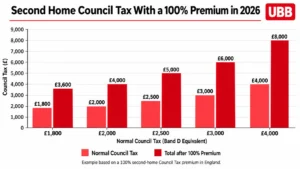
For example:
| Normal annual Council Tax | 100% second-home premium | Potential total |
| £1,800 | £1,800 | £3,600 |
| £2,000 | £2,000 | £4,000 |
| £2,500 | £2,500 | £5,000 |
| £3,000 | £3,000 | £6,000 |
| £4,000 | £4,000 | £8,000 |
Not every council has to impose the premium. English councils have discretion over whether to use it and can determine the rate up to the statutory maximum.
Property owners should therefore establish the policy operated by the council where the property is situated rather than assuming every English second home receives the same bill.
Second-home taxation should also be distinguished from the wider Council Tax reforms affecting England, as the premium operates under its own statutory framework.
Can Putting a Second Home Up for Sale Avoid the Premium?
This is one of the most important parts of the Second Home Council Tax Loophole search in 2026.
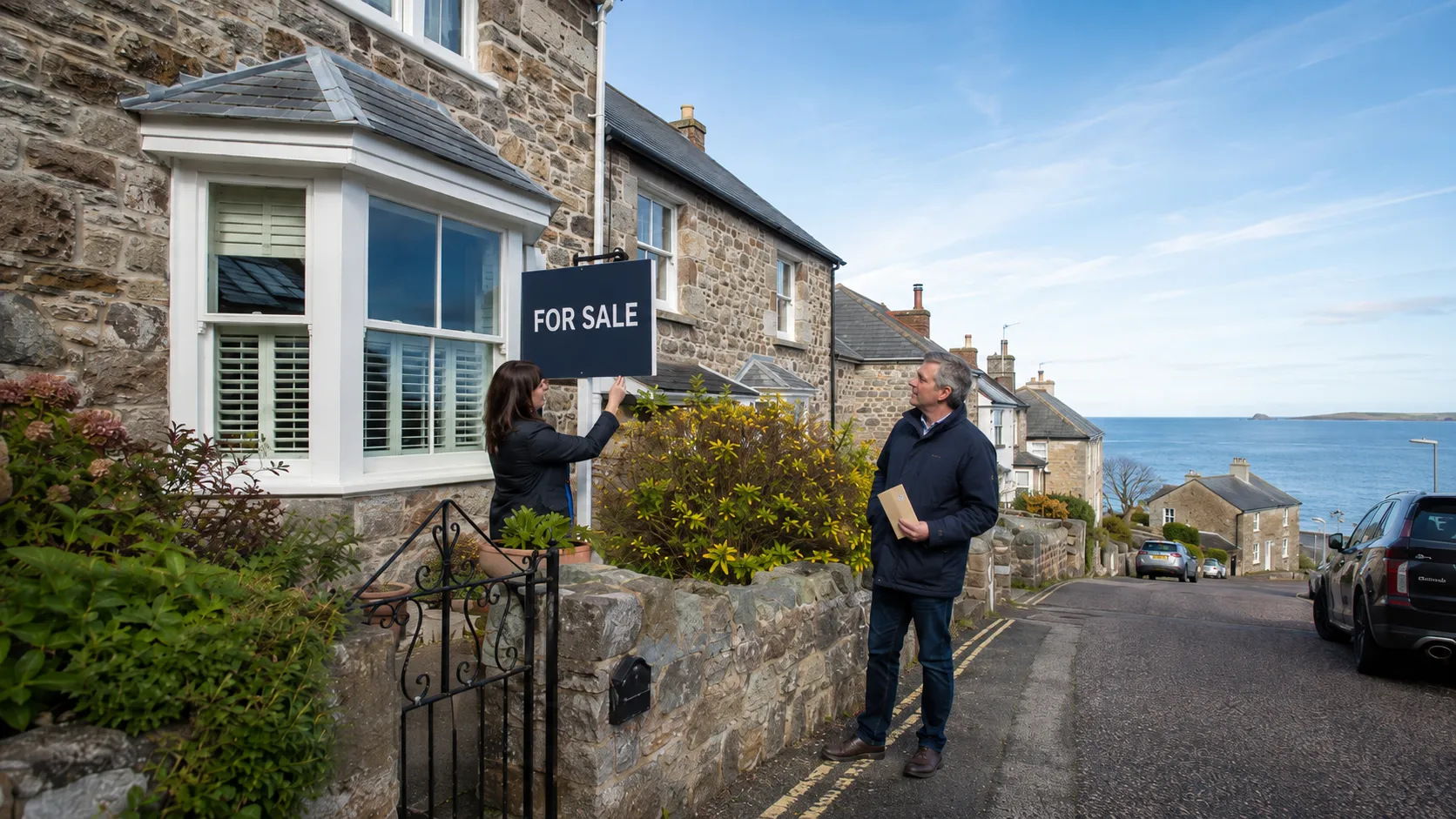
A dwelling that is genuinely and actively marketed for sale can qualify for an exception from the premium for up to 12 months.
But there are several catches.
The exception removes the additional premium. It does not necessarily eliminate the underlying standard Council Tax bill.
More importantly, the 12-month period relates to the period during which the property has been marketed. It does not necessarily give an owner a fresh 12 months simply because their council later introduced a second-home premium.
Imagine a property was first put on the market on 1 January 2026 and the relevant Council Tax premium began on 1 April 2026.
The owner should not automatically assume the marketing exception lasts until 31 March 2027. The earlier marketing period can be relevant when calculating the 12-month limit.
That makes accurate records particularly important.
What Counts as Genuinely Marketing a Second Home for Sale?
Putting up a token online advert is unlikely to be enough if everything else suggests there is no genuine intention to sell.
When assessing whether a dwelling is actively marketed, a council can consider factors such as whether it is publicly advertised, whether the asking price is realistic, whether there are artificial restrictions preventing a sale, whether the property has an appropriate EPC and whether the owner is taking reasonable steps to secure a buyer.
That means deliberately advertising a £300,000 property for £900,000 simply to claim that it is “for sale” could cause difficulties.
A genuine seller should retain evidence such as an estate-agent agreement, property listing, asking-price history, correspondence about viewings and records of offers.
The commercial lesson is straightforward: the 12-month exception is designed to help owners genuinely trying to return housing to normal residential occupation. It is not designed to create an indefinite tax holiday.
Can You Keep Relisting the Property Every 12 Months?
Normally, an owner cannot simply remove the property from sale and relist it to generate another 12-month exception.
The sale exception is generally available only once to the same owner for the same dwelling.
If the property is later sold, a new owner can potentially qualify independently where the relevant conditions are satisfied.
The rules for properties marketed for letting have some differences. A further exception may potentially become available after the dwelling has genuinely been let for a sufficiently continuous period.
This distinction is worth including because simply “relisting every year” is sometimes presented online as a Council Tax loophole when the rules are considerably tighter.
Can Turning a Second Home Into a Holiday Let Avoid Council Tax?
Potentially, but only if it becomes a genuine commercial self-catering business satisfying the business-rates conditions.
For a property in England, the current tests generally require it to:
| Requirement | England |
| Commercial short letting | Normally 28 nights or less per letting |
| Available in previous 12 months | At least 140 nights |
| Actually commercially let | At least 70 nights |
| Intended availability for next 12 months | At least 140 nights |
Where these requirements are satisfied, the property can be valued for non-domestic business rates instead of remaining within the ordinary Council Tax system.
The important phrase is actually let.
Older versions of the so-called holiday-let loophole attracted criticism because owners could potentially advertise properties without generating substantial genuine bookings. The rules have since been tightened so that evidence of actual letting is required.
A property advertised on Airbnb but used primarily as a private family holiday home will not automatically qualify.
Could a Holiday Let Pay No Business Rates?
It is possible in some circumstances.
Small Business Rate Relief can potentially reduce the bill substantially where the qualifying conditions are met.
For a business occupying only one qualifying property in England:
| Rateable value | Potential Small Business Rate Relief |
| £12,000 or below | Up to 100% |
| £12,001–£15,000 | Relief tapers gradually |
| £15,000 or above | Standard SBRR normally unavailable |
Consequently, a genuine holiday property with a sufficiently low rateable value could potentially move out of Council Tax and then receive substantial or even 100% Small Business Rate Relief.
This is the arrangement people are often describing when they use the expression second home Council Tax loophole.
But there is an important commercial distinction.
The property has to be operated as a genuine accommodation business. That can create management costs, insurance requirements, cleaning expenses, booking-platform fees, maintenance costs, utilities, tax on property income and wider regulatory obligations.
A £3,000 Council Tax saving therefore does not automatically mean converting a private second home into holiday accommodation creates a £3,000 improvement in profit.
Did the Furnished Holiday Let Tax Rules End?
Yes, and this is where many older articles become misleading.
The special Furnished Holiday Lettings tax regime was abolished from April 2025.
That removed a number of historic tax advantages previously available to qualifying furnished holiday-let businesses.
However, abolishing the FHL tax regime did not abolish the separate rules determining whether self-catering accommodation is assessed for business rates.
These are two different systems.
A property can therefore meet the current business-rates test for self-catering accommodation even though the old Furnished Holiday Lettings income and capital-gains tax regime no longer exists.
For property owners, this means converting a second home into a holiday business should never be assessed purely on its Council Tax treatment.
Income Tax, mortgage finance, operating costs and future disposal taxes need to be considered alongside business rates.
That is particularly important as HMRC is taking an increasingly close look at some property structures marketed as tax-saving arrangements, as covered in the recent HMRC landlord tax loophole crackdown.
Can You Avoid the Premium by Renting the Property Long Term?
A genuine long-term residential tenancy provides a very different situation from a privately used second home.
If another person occupies the property as their sole or main home, it would generally no longer satisfy the definition used for the second-home premium.
Council Tax liability will then depend on the normal rules for the tenancy and property.
This can make long-term letting one of the most commercially straightforward options for an owner who no longer wants to absorb the cost of maintaining a lightly used second property.
However, it converts the asset into a residential rental investment.
Before doing so, an owner should consider achievable rent, letting and management fees, mortgage conditions, landlord insurance, repair obligations, regulatory compliance and taxation of rental profits.
A £4,000 annual Council Tax saving can look attractive, but it should be compared against the overall return and obligations created by becoming a landlord.
Can You Simply Declare the Second Home as Your Main Residence?
Only where that reflects reality.
A person’s sole or main residence is determined from the actual circumstances rather than simply the address they choose to write on a form.
Changing a driving-licence address, registering to vote elsewhere or redirecting post can form part of the evidence, but no single administrative change necessarily proves that a property has genuinely become someone’s main home.
Councils investigating the issue can consider the broader pattern of occupation.
A homeowner who continues living and working at one property for most of the year while visiting a coastal cottage occasionally cannot safely assume that calling the cottage their “main residence” removes the premium.
The strongest position is always one that reflects how the properties are genuinely being used.
What Second Homes Are Excluded From the Premium?
England has several prescribed exceptions.
The relevant categories can include armed-forces circumstances, qualifying annexes, properties actively marketed for sale, properties actively marketed for letting, certain probate situations, job-related accommodation, occupied caravan pitches or boat moorings and certain seasonal properties subject to planning or occupancy restrictions.
A simplified overview is:
| Situation | Possible treatment |
| Armed-forces accommodation | Premium exception may apply |
| Annex forming part of main residence | Premium exception may apply |
| Actively marketed for sale | Up to 12 months |
| Actively marketed for let | Up to 12 months |
| Certain probate cases | Temporary protection available |
| Job-related dwelling | Exception can apply |
| Qualifying caravan pitch or boat mooring | Exception can apply |
| Seasonal/planning-restricted property | Exception can apply |
These generally concern the premium, not necessarily the standard Council Tax charge.
That distinction matters. An owner who qualifies for an exception should not automatically assume that the whole Council Tax bill disappears.
How Does Probate Affect a Second Home?
Inherited property creates another area of confusion.
There are existing Council Tax rules for properties left empty after a death, and there is also a premium exception associated with probate.
Following a grant of probate or letters of administration, a qualifying property may receive protection against the premium for up to 12 months, subject to the relevant circumstances.
This gives executors and beneficiaries time to determine whether the property should be sold, let or retained.
Anyone dealing with a valuable inherited property should consider the Council Tax position alongside the wider estate implications. The UK Business.Blog’s explanation of inheritance tax when the second parent dies covers another part of that financial picture.
Can You Avoid the Premium by Removing the Furniture?
This strategy needs particular caution.
An English second home is generally substantially furnished and has no resident. Some owners may therefore assume that removing the furniture means it can no longer be treated as a second home.
That does not mean the Council Tax liability disappears.
An unoccupied and substantially unfurnished dwelling can instead fall within the rules for long-term empty homes.
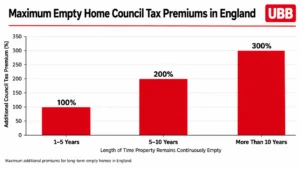
In England, councils can impose progressively higher empty-home premiums depending on how long the dwelling has remained empty.
The statutory maximum can reach:
| Period continuously empty | Maximum additional premium |
| 1–5 years | 100% |
| 5–10 years | 200% |
| More than 10 years | 300% |
Simply moving furniture out of a property is therefore not a reliable tax-saving strategy and can eventually produce a much larger liability.
This is an important difference between a genuine change in property use and an artificial attempt to alter its classification.
Does Putting the Property in a Limited Company Avoid the Premium?
Company ownership does not itself transform a residential dwelling into commercial premises.
If the property remains substantially furnished, is not someone’s main residence and otherwise satisfies the local definition of a second home, transferring ownership into a company does not automatically remove the Council Tax issue.
A company structure also raises potentially much larger questions involving financing, Stamp Duty Land Tax, Capital Gains Tax, Corporation Tax and the extraction of profits.
Property owners should therefore be particularly sceptical of arrangements marketed as an effortless way to eliminate several property taxes simultaneously.
The legal owner of the property and the actual use of the property are separate issues.
Can Councils Check Whether Someone Is Really Living There?
Yes. Councils do not necessarily have to accept an owner’s description of the property without evidence.
Where the question is whether a dwelling has genuinely become somebody’s main residence, councils can seek information that helps establish the real position.
Depending on the circumstances, evidence may include utility usage, electoral information, financial records, correspondence addresses and other indicators of where a person normally lives.
Likewise, an owner claiming the marketing exception may be expected to demonstrate genuine marketing activity.
This is why a sustainable approach should always be based on the property’s real use.
Can You Appeal a Second Home Council Tax Premium?
Yes, there can be routes to challenge a premium where an owner believes it has been applied incorrectly.
The first step is normally to raise the matter directly with the local council and provide evidence explaining why the premium should not apply.
For example, an owner might demonstrate that the dwelling falls within a prescribed exception, has genuinely become someone’s main residence or has been incorrectly classified.
If the dispute cannot be resolved with the council, a further appeal may potentially be made to the appropriate Valuation Tribunal.
For businesses and professional property owners, keeping a clear evidence file from the beginning is considerably easier than attempting to recreate one months later.
Is the Second Home Council Tax Loophole the Same Across the UK?
No. This is one of the biggest weaknesses in generic articles discussing a “UK second home tax loophole”.
Property taxation is devolved.
England
Councils can charge an additional second-home premium of up to 100%, effectively producing a bill of up to twice the normal Council Tax charge where the full premium applies.
The 140-night availability and 70-night actual-letting tests are important when considering business rates for qualifying self-catering accommodation.
Wales
Wales has considerably tougher rules in several respects.
Welsh local authorities can set second-home Council Tax premiums of up to 300% of the standard rate.
For self-catering accommodation, the normal business-rates thresholds are also substantially higher than in England. A property generally needs to have been available for at least 252 nights and actually let for at least 182 nights.
From April 2026, additional provisions can help certain Welsh businesses calculate the actual letting requirement using average occupancy over longer periods in qualifying circumstances.
Scotland
Scottish rules have also changed.
From 1 April 2026, the previous national cap on second-home premiums was removed. Local authorities have greater flexibility to set their own premium, while a 100% premium remains the national default position.
This means Scottish owners need to check the policy of the particular local authority rather than relying on older articles stating that the maximum is always 100%.
Northern Ireland
Northern Ireland does not operate Council Tax. Domestic properties are instead subject to the domestic rates system.
For that reason, advice about a UK-wide “Council Tax loophole” should never be applied uniformly across all four nations.
Which Option Makes Most Business Sense for a Second-Home Owner?
For an investor or business owner, the most important question is not simply:
“How can I avoid the second-home premium?”
The better question is:
“Which use of this property creates the best risk-adjusted return after tax and operating costs?”
Consider an owner facing £5,000 a year of Council Tax after a premium.
They may have several options:
| Strategy | Potential advantage | Commercial drawback |
| Keep as private second home | Maximum personal use | Potential double Council Tax |
| Holiday letting | Revenue plus possible business-rates treatment | Operating costs and occupancy risk |
| Long-term residential letting | Stable rental income | Landlord obligations and reduced personal use |
| Sell | Removes ongoing property costs | Disposal taxes and loss of future appreciation |
| Make genuine main residence | Premium can cease | Requires genuine change in living arrangements |
A holiday-let conversion can appear attractive if business rates fall to zero through Small Business Rate Relief.
But suppose the property requires £6,000 a year in cleaning, management, insurance, utilities and booking costs simply to operate commercially.
The apparent Council Tax saving needs to be compared against those costs and the rental revenue generated.
That is why the business-rates route should be viewed as a business model, not merely a tax loophole.
Could the Second Home Council Tax Loophole Be Tightened Further?
Property owners should not assume the current framework will remain unchanged indefinitely.
The movement of second homes into business rates has already attracted political and industry scrutiny, particularly in tourism-heavy areas where councils depend heavily on both Council Tax revenue and the visitor economy.
Current rules already require genuine commercial letting rather than merely an intention to let.
Further reform remains possible as governments and councils attempt to balance housing supply, tourism, local economic activity and public finances.
Investors therefore need to avoid purchasing a property based entirely on the assumption that today’s Council Tax or business-rates treatment will remain available for the full ownership period.
What Should Second-Home Owners Do in 2026?
Owners facing a premium should first establish exactly how their local authority has classified the property.
They should then determine whether any statutory or locally discretionary exception genuinely applies.
If the property is being sold or let, evidence of active marketing should be retained from the first day rather than waiting for a Council Tax dispute.
Anyone considering moving a second home into the business-rates system should model the whole operation: expected occupancy, nightly rates, rateable value, relief eligibility, insurance, management costs, mortgage conditions and property-income taxation.
Where the numbers do not support genuine commercial letting, converting the property simply to reduce Council Tax may create more complexity than it solves.
Is There Really a Second Home Council Tax Loophole?
There is no single automatic Second Home Council Tax Loophole that allows every owner to stop paying Council Tax.
There are instead several legitimate rules that can change the amount payable.
A genuine commercial holiday let may qualify for business rates. A dwelling actively marketed for sale or letting can potentially receive temporary relief from the premium. Certain properties receive statutory exceptions, while a genuine long-term tenancy or genuine change of main residence can change the property’s status altogether.
What does not work reliably is creating the appearance of a change while continuing to use the property as a normal private second home.
For landlords and property investors, the most sustainable strategy is to decide what the property is genuinely going to be used for and then structure its finances around that use.
Final Thoughts
The Second Home Council Tax Loophole in 2026 is better understood as a collection of legitimate exceptions and alternative property classifications rather than a secret method of avoiding tax.
For English property owners, the most significant options are the 12-month exceptions for genuine sale or letting, qualifying prescribed exceptions, long-term occupation and commercial self-catering use that genuinely meets the business-rates tests.
However, each option has consequences beyond Council Tax.
Holiday letting creates a business with operating costs and taxable property income. Long-term letting creates landlord responsibilities. Selling may trigger disposal taxes. Removing furniture can move a property towards the empty-home premium regime rather than eliminating Council Tax.
For business owners and investors, the strongest approach is therefore to assess the property as an investment in full rather than making a major decision solely to save one annual tax bill.
Note: This article provides general information and does not constitute legal, financial or tax advice. Council Tax and business-rates treatment depends on the property, local authority and individual circumstances.
FAQs
Can You Legally Avoid Council Tax on a Second Home?
Sometimes the premium can be avoided, but that does not necessarily mean all Council Tax disappears. Genuine holiday accommodation may qualify for business rates, while statutory exceptions and other changes in property use can alter liability.
Can I Put My Second Home on Airbnb to Avoid Council Tax?
Simply listing it on Airbnb is not enough. In England, qualifying self-catering accommodation normally needs to have been commercially available for at least 140 nights and actually commercially let for at least 70 nights during the relevant 12-month period.
How Long Can I Avoid the Premium While Selling My Second Home?
A qualifying property genuinely and actively marketed for sale can receive an exception from the premium for up to 12 months. Time spent marketing before the premium began can be relevant to the 12-month period.
Can I Relist My Second Home After 12 Months for Another Exemption?
The same owner cannot normally repeatedly use the sale exception for the same dwelling simply by relisting it. A later new owner can potentially qualify separately.
Do Holiday Lets Still Qualify for Business Rates After the Fhl Rules Ended?
Yes, where the separate business-rates conditions are met. The abolition of the Furnished Holiday Lettings tax regime in April 2025 did not abolish business-rates classification for qualifying self-catering accommodation.
Can Small Business Rate Relief Make the Bill Zero?
Potentially. In England, an eligible business occupying one property with a rateable value of £12,000 or less can potentially receive 100% Small Business Rate Relief. Different rules can apply where several properties are occupied.
Can I Remove the Furniture to Avoid the Second-home Premium?
Removing furniture does not make the property tax-free. An unoccupied and substantially unfurnished property can become subject to the separate empty-home Council Tax rules and potentially higher premiums over time.
Can a Limited Company Own the Property and Avoid the Premium?
Company ownership alone does not automatically prevent the second-home premium. The property’s actual occupation and classification remain important.
Can I Challenge My Council’s Decision?
An owner who believes the premium has been applied incorrectly should normally challenge the decision with the council first and provide supporting evidence. A further Valuation Tribunal appeal may be possible if the matter remains unresolved.
Is the Second-home Premium the Same Everywhere in Britain?
No. England, Wales and Scotland operate different Council Tax frameworks, while Northern Ireland uses domestic rates. Local authority decisions can also produce substantial differences within each nation.