





















The FunnyFuzzy Tech UK pet supplies closure has raised serious questions about online retail accountability, financial transparency and consumer protection in Britain.
Funnyfuzzy Tech UK Co., Ltd was wound up by the High Court on 22 September 2026 after an Insolvency Service investigation uncovered more than £6.3 million in incoming payments that were inconsistent with the company’s dormant-account filings.
The case is particularly concerning because an earlier UK company operating through the same pet supplies website had already been shut down in 2024.
Our review of the official investigation, Companies House records and publicly available customer feedback shows that this is more than a conventional business closure.
It raises wider issues about identifying the company behind an online store, recovering payments for unfulfilled orders and recognising financial warning signs before making a purchase.
Why Was FunnyFuzzy Tech UK Shut Down?
Funnyfuzzy Tech UK Co., Ltd was wound up in the public interest following an investigation into its business activities, financial disclosures and treatment of customers.
According to the Insolvency Service’s announcement published on 25 September 2026, investigators identified significant inconsistencies between the company’s reported financial position and payments received through its operations.
The company had filed dormant accounts despite investigators identifying more than £6.3 million in incoming payments between August 2023 and January 2026.
Investigators also reported that the company did not provide the business records requested and declined to engage with the investigation on the basis that it operated outside the UK.
However, the business had been selling products to British customers and using a UK-based contractor to handle returns.
The principal concerns involved:
- Financial reporting that did not reflect the payment activity identified by investigators.
- Failure to provide requested records or cooperate with the investigation.
- Customer complaints about missing or substantially delayed orders.
- Allegations concerning poor-quality pet products and unresolved refunds.
- Changes to the company names and addresses displayed on the website.
The High Court subsequently wound up the business under Section 124A of the Insolvency Act 1986.
This is an important legal distinction. A public-interest winding-up order does not require proof that a company has simply run out of money.
It can be sought where the authorities consider that closing the company is necessary to protect the public interest.
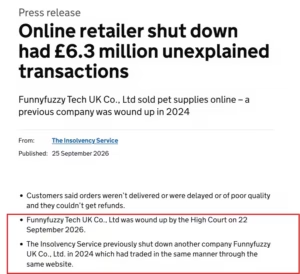
Insolvency Service announcement dated 25 September 2026 confirming the High Court closure of Funnyfuzzy Tech UK Co., Ltd and the investigation into more than £6.3 million in payments.
What Happened to the £6.3 Million in FunnyFuzzy Transactions?
The £6.3 million figure is one of the most significant financial findings in the investigation, but it needs careful interpretation.
Investigators identified more than £6.3 million in incoming payments over approximately two and a half years.
During that period, the company’s financial filings presented it as dormant.
A dormant company is generally one that has no significant accounting transactions during the relevant accounting period. Filing dormant accounts when substantial commercial activity is taking place creates obvious concerns about financial transparency.
However, £6.3 million in incoming payments does not automatically mean £6.3 million in profit, missing money or established consumer losses.
Incoming payments can represent gross receipts before expenses, refunds, supplier costs, transaction fees and other business liabilities.
Without reliable accounting records, the authorities cannot simply determine the business’s true profitability from the incoming-payment figure alone.
Why Does the Financial Discrepancy Matter?
For business owners, proper accounting is essential because it establishes whether revenue, expenses, liabilities and tax obligations have been recorded accurately.
The situation becomes particularly serious when a company handles consumer payments while providing financial statements that appear inconsistent with its commercial activity.
Our financial assessment identifies three separate concerns.
First, inaccurate or incomplete financial records make it difficult for regulators and creditors to understand the business’s financial position.
Second, a lack of transparency creates uncertainty over where payments were received and which legal entity was responsible for fulfilling orders.
Third, customers face additional difficulties when trying to recover money from a business whose financial arrangements are unclear.
The FunnyFuzzy investigation illustrates why accurate accounting is not simply an administrative requirement. It is a core element of commercial accountability.
Was Another FunnyFuzzy Company Closed in 2024?
Yes. The September 2026 closure was not the first winding-up order involving a UK company trading under the FunnyFuzzy name.
Companies House records confirm that Funnyfuzzy UK Co., Ltd, registered under company number 13336978, entered compulsory liquidation on 19 November 2024.
The later business, Funnyfuzzy Tech UK Co., Ltd, was incorporated on 25 July 2023 under company number 15028095 and was wound up on 22 September 2026.
| Company | Registration number | Winding-up date |
| Funnyfuzzy UK Co., Ltd | 13336978 | 19 November 2024 |
| Funnyfuzzy Tech UK Co., Ltd | 15028095 | 22 September 2026 |
The Insolvency Service reported that the earlier company had operated through the same website and attracted similar concerns regarding the quality of goods, deliveries and refunds.
This repeated pattern is particularly important from a regulatory perspective.
A winding-up order against one company does not automatically establish that every similarly named company, website or overseas business is subject to the same court order.
For customers, the key question is which legal entity was responsible for their particular purchase.
For entrepreneurs, the case demonstrates why understanding how UK business registration works is essential when evaluating corporate structures and verifying a trading company’s legal identity.
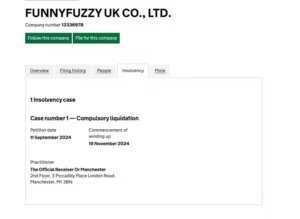 Companies House records for Funnyfuzzy UK Co., Ltd, company number 13336978, showing its liquidation status and insolvency history.
What Do Companies House Records Reveal About Funnyfuzzy Tech UK?
Companies House identifies Funnyfuzzy Tech UK Co., Ltd as a private limited company incorporated on 25 July 2023.
Its registered office was listed as 41 Devonshire Street, Ground Floor Office 1, London, W1G 7AJ.
However, Insolvency Service investigators reported finding no evidence that the company operated from that address.
The company record now shows its status as liquidation.
A review of the company’s filing history also identifies dormant accounts submitted for the financial years ending 31 July 2024 and 31 July 2025.
This creates an important distinction between legal registration and actual business activity.
Being listed at Companies House does not automatically prove that a company has a genuine operational presence at its registered address or that its commercial practices meet regulatory requirements.
Companies House itself warns that it does not verify the accuracy of every piece of information submitted to the register.
In the case of FunnyFuzzy, the company’s public filings must therefore be considered alongside the Insolvency Service’s investigative findings.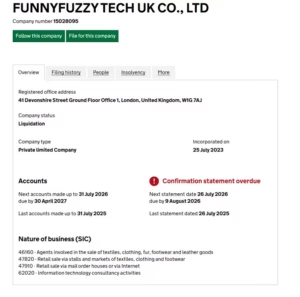 Companies House overview for Funnyfuzzy Tech UK Co., Ltd, company number 15028095, displaying its registered details and liquidation status.
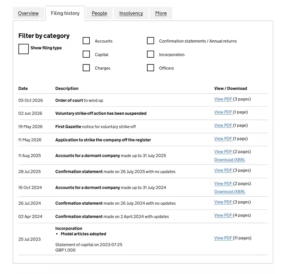 Companies House filing history showing dormant-account submissions for the financial years ending 31 July 2024 and 31 July 2025.
Is FunnyFuzzy.co.uk Still Operating After the Closure?
The company’s liquidation and the operating status of the FunnyFuzzy website are not necessarily the same thing.
The Insolvency Service identified Funnyfuzzy Tech UK Co., Ltd as the company that had traded through funnyfuzzy.co.uk.
However, the government also reported that the latest version of the website was linked to Funnyfuzzy HK Tech Limited, a Hong Kong-registered company.
The website’s published contact information has also identified that Hong Kong entity as its corporate operator.
This creates an important consumer-protection question: does a customer entering an order through the website know which company is legally responsible for the transaction?
A website can remain accessible even when a previously associated UK company has entered liquidation.
Indeed, reporting published after the September 2026 court order indicated that the website still appeared to be accepting orders at that time.
That does not establish that the website is currently fulfilling purchases, that it is legally operated by the liquidated company, or that every transaction is subject to the UK winding-up proceedings.
We would distinguish three separate matters:
- The UK company’s legal status: Funnyfuzzy Tech UK Co., Ltd has been wound up and is in compulsory liquidation.
- The website’s availability: Accessible web pages or a functioning shopping cart do not prove that a previously associated company remains operational.
- The current seller’s identity: Customers should establish the contracting entity named in the checkout terms, order confirmation and payment records.
This distinction matters because a consumer’s legal rights and recovery options may depend on the identity and jurisdiction of the actual seller.
What Do Real FunnyFuzzy Customer Reviews Reveal?
Public customer feedback provides additional context to the concerns identified by investigators.
Our review of the independent Trustpilot profile for funnyfuzzy.co.uk, checked on 20 October 2026, found an overall score of approximately 2.3 out of 5, based on more than 10,000 reviews.
The percentage distribution was as follows:
| Customer rating | Percentage of reviews |
| 5 stars | 29% |
| 4 stars | 8% |
| 3 stars | 7% |
| 2 stars | 7% |
| 1 star | 49% |
These figures show that approximately 56% of reviews were rated one or two stars, compared with 37% rated four or five stars.
The remaining 7% were three-star reviews.
These percentages describe the published review population rather than a scientifically representative sample of all customers. Individual complaints also remain customer accounts unless independently verified.
Nevertheless, the pattern is consistent with several concerns identified in the Insolvency Service investigation.
Delivery Delays and Missing Orders
One recurring theme involves customers reporting unusually long delivery periods.
In a publicly available October 2026 review, Rachel Griffiths described receiving an earlier sofa-cover order that she had been satisfied with, despite delays.
However, she subsequently reported that a replacement order placed in September had still not arrived after approximately seven weeks.
That example illustrates an important distinction: positive experiences with earlier purchases do not eliminate the risk of delivery problems with later orders.
Other public reviews describe customers waiting for dog beds, car seats and sofa covers without receiving satisfactory delivery updates.
Refund Difficulties
Another prominent concern involves unsuccessful attempts to obtain refunds.
Some reviewers describe repeated email exchanges, delayed refund processing and responses that did not resolve their underlying complaint.
The Insolvency Service separately confirmed that customers had complained to official bodies about missing refunds and poor customer service.
However, not every customer described the same outcome.
Some public reviewers reported receiving their products and being satisfied with the quality, even when delivery took longer than expected.
This mixed picture helps explain why a single positive review or attractive product listing is insufficient to assess a retailer’s overall reliability.
Why Independent Ratings Matter?
A September 2026 BusinessCloud report noted that the retail website appeared to display its own customer score of 4.86 out of 5 at the time.
That figure was considerably higher than the independent Trustpilot score subsequently reviewed.
These are different rating systems and may use different customer populations, dates and calculation methods.
The difference is not, by itself, proof that either rating was fabricated.
It does, however, reinforce the importance of comparing review sources and examining recent customer experiences rather than relying on a single headline score.
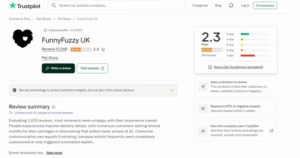
FunnyFuzzy UK’s independent Trustpilot profile showing its overall rating, total review count and percentage breakdown of one-star to five-star reviews as checked on 20 October 2026.
What Did the Insolvency Service Say About the Closure?
The official response underlines the seriousness of the government’s concerns.
Mark George, Chief Investigator at the Insolvency Service, commented on the difficulties created when the ownership of an online retail website changes.
In the government’s September 2026 announcement, he stated:
“Transfer of ownership of a website can cause difficulties in getting the website closed down”
The quotation highlights an important problem for regulators and customers.
A court order can bring a particular company into liquidation, but the underlying website, branding or commercial infrastructure may involve other legal entities.
From a business-governance perspective, this means authorities must examine not only the registered company but also the individuals, payment arrangements and trading structures behind an online operation.
Customers, meanwhile, need clear information about whom they are actually buying from.
Can Customers Get a Refund After the FunnyFuzzy Closure?
Customers who have paid for goods that never arrived should investigate their refund options as soon as possible.
The appropriate route depends on the original payment method, the company responsible for the sale and the timing of the transaction.
1. Preserve the Order and Payment Evidence
Customers should retain their order confirmations, receipts, bank statements, tracking information and correspondence with the seller.
They should also preserve screenshots showing the product description and any promised delivery date.
These documents can become important evidence in a payment dispute or creditor claim.
2. Contact the Card Provider
For purchases made using a debit card, customers may be able to request a chargeback if goods were not delivered or the retailer failed to provide an appropriate refund.
Chargeback can also be available for some credit-card transactions.
Claims are commonly subject to a 120-day timeframe, although the applicable starting date and detailed rules depend on the circumstances and card scheme.
Customers should therefore contact their bank promptly rather than assuming that the deadline has already passed.
3. Consider Section 75 Protection
Customers who used a qualifying credit card may have additional protection under Section 75 of the Consumer Credit Act 1974.
This generally applies where the cash price of the purchased item, or qualifying set of items, was more than £100 and no more than £30,000.
For example, a customer who paid £180 for a dog bed using a qualifying credit card may be able to make a Section 75 claim if the product never arrived.
A customer who purchased a £65 item using a debit card would not have Section 75 protection, but might be eligible for chargeback.
The exact arrangements matter, particularly where third-party payment services have been used.
4. Check PayPal or Other Payment Protection
Where customers paid through PayPal or another payment intermediary, the provider’s buyer-protection process may offer another route.
Customers should check the transaction details, eligibility requirements and dispute deadlines with the provider directly.
These protection arrangements are not identical to Section 75 and should not be treated as interchangeable.
5. Contact the Official Receiver
If a customer is owed money by the liquidated UK company, they may be able to register a claim in the liquidation.
The Insolvency Service has directed enquiries concerning FunnyFuzzy to the Official Receiver’s Public Interest Unit.
Official Receiver contact details:
Email: piu.or@insolvency.gov.uk
Reference: LQD08007147
Customers should explain the transaction date, amount paid, undelivered goods and the name of the company shown on their order or payment documents.
They should not assume that a successful claim will result in full repayment.
In compulsory liquidation, available funds are distributed according to legal priorities. Unsecured creditors may receive only part of what they are owed, or nothing if there are insufficient recoverable assets.
Customers who suspect they have been victims of fraud can also report their concerns through Report Fraud, the service that replaced Action Fraud in December 2025.
What Does the FunnyFuzzy Closure Mean for the UK Pet Supplies Market?
The FunnyFuzzy case should not be interpreted as evidence that the wider UK pet supplies industry faces the same problems.
Pet products remain a substantial consumer retail category, supported by recurring household demand for food, bedding, accessories and animal-care products.
However, online retail businesses can expose customers to additional risks when delivery arrangements, corporate identities and refund responsibilities are difficult to establish.
The case demonstrates three particularly important commercial lessons.
Transparent Corporate Identity Builds Consumer Confidence
A retailer’s website should make it straightforward for customers to identify the seller and understand the terms of the transaction.
Company registration details, contact information, delivery policies and customer-service arrangements should be consistent and accessible.
When the identity of the responsible company changes repeatedly, consumers may struggle to establish who must fulfil an order or issue a refund.
Financial Compliance Is More Than a Filing Obligation
Accurate financial records allow a business to account for income, expenses, customer liabilities and tax obligations.
The discrepancy between FunnyFuzzy’s dormant-account filings and the payment activity identified by investigators illustrates how significant these issues can become.
It also demonstrates why incorporation alone should not be interpreted as proof of commercial reliability.
Customer Service Failures Can Become Regulatory Risks
Delayed deliveries and unresolved refund complaints are not always evidence of deliberate misconduct.
Individual service failures occur across legitimate retail businesses.
However, repeated complaints accompanied by serious accounting and governance concerns can attract regulatory scrutiny.
The FunnyFuzzy investigation shows how operational complaints can become part of a much larger assessment of a company’s conduct.
What Can UK Businesses Learn From This Closure?
For founders and e-commerce operators, the central lesson is that growth must be supported by credible accounting, traceable operations and clear consumer obligations.
High order volumes or strong advertising performance do not establish that a company is financially well-managed.
A retailer must also demonstrate that it can deliver products, handle complaints, account for payments and respond to legitimate regulatory enquiries.
The same distinction is important when analysing UK retail closures and their wider commercial implications. A company entering liquidation, a retailer restructuring its operations and an individual shop closing are not legally or financially identical events.
Our analysis suggests that smaller online businesses should give particular attention to payment reconciliation, management accounts, supplier oversight and customer communications.
Outsourcing product fulfilment does not remove the need to understand who is responsible for deliveries and what happens when orders cannot be completed.
Equally, using an overseas fulfilment partner does not automatically mean that a business is acting improperly. The key issue is whether the company operates transparently and complies with the obligations relevant to its trading arrangements.
The FunnyFuzzy case demonstrates the financial and reputational risks that arise when those basic controls cannot be established.
How Can Customers Check an Online Pet Store Before Ordering?
Consumers can reduce their exposure to unfamiliar retailers by completing several straightforward checks.
- Check the legal business name. A website’s trading name may differ from the company responsible for payment and delivery. Customers should examine the legal information and order terms.
- Verify the company record. Where a retailer claims to operate through a UK limited company, its registration number and legal status can be checked through Companies House.
- Examine recent customer feedback. Reviews from the previous few weeks or months may be more useful than an overall rating accumulated over several years.
- Compare delivery promises with customer experiences. Repeated reports of long delays or missing tracking information deserve attention.
- Use a payment method with appropriate protection. Card payments can provide valuable recovery options when a transaction goes wrong.
- Keep a record of the original offer. Saving product listings, delivery estimates and order confirmations can help resolve later disputes.
No single check guarantees a successful purchase. However, combining these steps provides a stronger assessment than relying on branding, discounts or a prominent customer-rating badge.
Final Assessment
The FunnyFuzzy Tech UK pet supplies closure is a significant example of how financial-reporting concerns, repeated customer complaints and uncertainty over corporate identity can intersect in online retail.
The High Court’s September 2026 order followed an investigation identifying more than £6.3 million in incoming payments despite dormant-account filings. The earlier closure of another FunnyFuzzy UK company makes the sequence of events particularly important.
Our review of the public evidence also highlights a broader lesson for customers and businesses: an attractive retail website, a registered company name and positive product reviews are not substitutes for financial transparency, clear contractual responsibility and dependable customer service.
For affected customers, the immediate priority is to establish the seller responsible for their transaction and pursue the appropriate payment-recovery route without unnecessary delay.
Frequently Asked Questions
Is Funnyfuzzy Tech UK Co., Ltd permanently closed?
The company was wound up by the High Court on 22 September 2026 and is in compulsory liquidation. This does not automatically determine the status of every other business using the FunnyFuzzy name.
Why was FunnyFuzzy shut down?
The Insolvency Service identified major concerns involving financial filings, customer complaints, company information and failure to cooperate with investigators.
How much money was involved in the investigation?
Investigators identified more than £6.3 million in incoming payments between August 2023 and January 2026. This should not be confused with established profit or proven financial losses.
Is the FunnyFuzzy website still safe to use?
The UK company’s liquidation raises significant concerns, but the website’s current operating arrangements must be assessed separately. Customers should establish the legal seller before making any new payment.
Can customers claim money back for undelivered orders?
Potentially. Chargeback, Section 75, payment-provider buyer protection and creditor claims may be relevant, depending on the transaction and the seller involved.
Did FunnyFuzzy have another company closed in 2024?
Yes. Funnyfuzzy UK Co., Ltd, company number 13336978, was wound up on 19 November 2024.
What should a customer do if FunnyFuzzy ignores refund requests?
Customers should preserve their evidence, contact their payment provider promptly and investigate whether the Official Receiver can assist with a claim against the liquidated company.