




















Finding the Martin Lewis best savings account in 2026 involves more than choosing the bank advertising the highest interest rate.
With some UK savings accounts paying 5% AER, regular savers offering up to 8% and selected fixed-rate products exceeding 5%, savers have several competitive options. However, account limits, introductory bonuses, withdrawal restrictions and tax implications can substantially change the actual return.
We analysed the latest published UK savings rates, account conditions, interest calculations and tax rules to compare the options that matter most to households, professionals, freelancers and entrepreneurs.
Our assessment also considers a distinction frequently overlooked in savings comparisons: an account offering the highest percentage may not generate the greatest financial benefit for someone holding £20,000, £50,000 or more.
The objective is to identify savings accounts offering a practical combination of competitive interest, accessibility, tax efficiency and security, while distinguishing Martin Lewis’s published guidance from our independent editorial evaluations.
Interest rates reviewed: 15 October 2026. Rates, promotions and account availability may change.
What Is Martin Lewis’s Best Savings Account in 2026?
There is no single savings account that Martin Lewis recommends for every saver. The most appropriate account depends on the amount available, whether the money is needed immediately, the person’s tax position and how long the funds can remain untouched.
His MoneySavingExpert guidance currently highlights Cahoot for smaller easy-access balances, Tembo for accessible savings, Trading 212 for a competitive cash ISA and fixed-term products from providers including OakNorth and Oxbury.
For monthly savings, Santander and First Direct offer some of the strongest advertised regular-saver rates.
Top 12 Savings Accounts Compared
| Savings provider | Interest rate (AER) | Best suited to | Our rating |
| Cahoot Sunny Day Saver | 5.00% variable | Savings up to £3,000 | 96% |
| Trading 212 Cash ISA | 4.80% variable, including introductory bonus | Tax-free savings | 95% |
| OakNorth 1-Year Fixed | 5.12% fixed | One-year lump sums | 94% |
| Tembo Homesaver | 4.55% variable, including bonus | Easy-access savings up to £20,000 | 93% |
| Oxbury 2-Year Fixed | 5.21% fixed | Medium-term savings | 93% |
| Cahoot Simple Saver | 4.52% variable | Larger accessible balances | 92% |
| First Direct Regular Saver | 7.00% fixed | Monthly savings | 92% |
| Santander Regular Saver | 8.00% variable | Smaller monthly contributions | 91% |
| Chip Cash ISA | 4.66% variable, including bonus | Cash ISA transfers | 90% |
| Zopa Limited Access | 4.56% variable, including bonus | Occasional withdrawals | 89% |
| Chase Saver | 4.50% variable, including bonus | App-based banking | 88% |
| Co-operative Bank Regular Saver | 7.00% variable | Consistent monthly saving | 88% |
Rates are published offers rather than guaranteed returns for every applicant. Promotional terms, existing-customer eligibility and balance restrictions apply.
How Did We Calculate Our Percentage Ratings?
We assessed the products using five editorial criteria.
| Assessment factor | Weight |
| Interest-rate competitiveness | 35% |
| Withdrawal flexibility | 25% |
| Eligibility and account restrictions | 15% |
| Deposit protection and transparency | 15% |
| Practical suitability and account management | 10% |
| Total | 100% |
Our percentage scores are editorial judgements based on published product characteristics. They are not customer-satisfaction statistics, independently audited results or evidence of accounts being personally tested.
We have also evaluated each product for its intended purpose. A fixed-rate bond may score highly for guaranteed returns even though it is unsuitable for emergency savings.
1. Cahoot Sunny Day Saver – Best for Smaller Easy-Access Savings
Cahoot, part of Santander UK, offers a Sunny Day Saver paying 5.00% AER variable on balances up to £3,000.
It is among the strongest options for people holding relatively modest savings who want an attractive rate without tying money up in a conventional fixed bond.
Key account details:
- Interest rate: 5.00% AER variable
- Minimum deposit: £1
- Maximum balance: £3,000
- Account term: One year
- Withdrawals: Easy access
- Interest payments: Monthly or annually
- FSCS protection: Eligible deposits protected under Santander UK’s banking authorisation
Why Does Cahoot Rank First?
The main advantage is its combination of a competitive rate and accessible funds.
Someone maintaining a £3,000 balance at 5% AER for a full year could earn approximately £150 before tax, assuming the rate remains unchanged.
This account is particularly suitable for building an emergency fund or holding money for upcoming household expenses.
However, the maximum balance prevents it from being a complete solution for larger savers.
A person holding £20,000 cannot earn 5% on the entire amount through this account.
Our verdict: An excellent starting point for smaller savings balances, but it works best alongside another account once the £3,000 limit has been reached.
2. Trading 212 Cash ISA – Best for Tax-Free Savings

Trading 212 is widely known as an investment platform, but its Cash ISA has become a competitive option for savers seeking tax-free interest.
The advertised rate available to eligible new customers is 4.80% AER, consisting of a variable underlying rate and a 12-month introductory bonus.
Key account details:
- Interest rate: 4.80% AER for eligible new money
- Underlying rate: 3.60% variable
- Introductory bonus: 1.20 percentage points for 12 months
- Minimum deposit: £1
- Current annual ISA allowance: £20,000
- Withdrawals: Flexible cash ISA
- Account management: Online and mobile app
Why Is Trading 212 Attractive to Higher-Rate Taxpayers?
Cash ISA interest is exempt from UK Income Tax.
Consider an individual holding £20,000.
| Savings account | Gross annual interest | Potential net interest |
| Ordinary savings at 5.00% | £1,000 | £1,000 for a basic-rate taxpayer with their full PSA available |
| Ordinary savings at 5.00% | £1,000 | £800 for a higher-rate taxpayer with their full £500 PSA available |
| Cash ISA at 4.80% | £960 | £960 tax-free |
The difference becomes particularly important for higher-rate taxpayers or people already earning substantial interest elsewhere.
However, Trading 212’s promotional 4.80% rate does not necessarily apply to existing ISA transfers. The provider’s terms distinguish qualifying new deposits from transferred funds.
The ISA also involves a platform structure in which cash is held with partner banks. Savers should check which banking groups hold their money because FSCS limits can apply across combined deposits.
Our verdict: One of the strongest options for savers who value tax-free interest, although the bonus expiry and transfer rules must be checked carefully.
3. OakNorth Bank – Best One-Year Fixed Savings Account
OakNorth Bank offers a competitive one-year fixed-rate savings product, with a recently published rate of 5.12% AER.
This option is designed for people who have money they do not expect to need during the coming 12 months.
Key Account Details:
- Interest rate: 5.12% AER fixed
- Fixed period: One year
- Access: Normally restricted until maturity
- Product category: Personal fixed-rate savings
- FSCS protection: Eligible deposits protected
Unlike variable-rate accounts, a fixed savings bond provides certainty about the interest rate throughout the agreed period.
For someone saving £20,000, a 5.12% AER represents an illustrative £1,024 over one year before any applicable tax.
That certainty can be valuable when future changes to Bank of England interest rates are difficult to predict.
However, the commercial disadvantage is reduced liquidity.
Money committed to a fixed savings account should not be needed for rent, mortgage payments, urgent household expenditure or planned business obligations.
Our verdict: A competitive choice for savers who can confidently commit their money for one year, but unsuitable as their only emergency reserve.
4. Tembo Homesaver – Best for Everyday Accessible Savings
Tembo Homesaver offers 4.55% AER variable, including an introductory bonus.
The account is designed for people who want a competitive return while retaining access to their money.
Key account details:
- Interest rate: 4.55% AER variable, including bonus
- Minimum deposit: £10
- Maximum balance: £20,000
- Account management: Mobile app
- Withdrawals: Available, subject to account conditions
- Promotional period: 12 months
An important detail is how Tembo’s introductory bonus works.
The bonus element is payable after a qualifying period. Savers who withdraw most of their funds before the anniversary may need to retain the required minimum balance and keep the account open to preserve eligibility.
A £10,000 balance would generate approximately £455 over a year at an unchanged 4.55% AER, assuming all conditions are satisfied.
Our verdict: Competitive for digital savers holding up to £20,000, although the timing and structure of the introductory bonus deserve attention.
5. Oxbury Bank – Best Two-Year Fixed Savings Account

Oxbury Bank has featured among the competitive two-year fixed-rate savings providers, with a published rate of approximately 5.21% AER.
This product is suitable for savers who prefer predictable returns over the next two years.
Why Consider a Two-Year Fixed Account?
A two-year bond locks in the contractual interest rate, providing protection against reductions in available variable savings rates during the term.
For illustration, £20,000 earning an effective annual return of 5.21% for two years would grow to approximately £22,138 if interest compounds annually at that rate.
That represents around £2,138 in cumulative interest before tax.
The actual payment and compounding treatment depends on the product’s terms.
However, a fixed bond may become less competitive if market rates rise substantially after opening.
Our verdict: Particularly attractive for medium-term savings where predictable income is more important than immediate access.
6. Cahoot Simple Saver – Best for Larger Easy-Access Balances
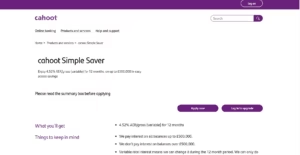
Cahoot’s Simple Saver offers a published variable rate of 4.52% AER.
Unlike the Sunny Day Saver, it has a substantially higher maximum balance, making it more relevant to savers with larger amounts of money.
Key account details:
- Interest rate: 4.52% AER variable
- Minimum deposit: £1
- Maximum balance: £500,000
- Withdrawals: Easy access
- Interest payments: Monthly or annually
- Banking group: Santander UK
A saver holding £50,000 could generate approximately £2,260 in annual interest at 4.52%, assuming an unchanged rate and balance.
However, earning this level of interest may create a tax liability depending on the individual’s other income and allowances.
The FSCS protection limit should also be considered when holding larger balances across Cahoot and other Santander-linked savings products.
Our verdict: Suitable for larger savings balances and people preferring an established banking group, although tax efficiency becomes increasingly important.
7. First Direct Regular Saver – Best for Consistent Monthly Contributions
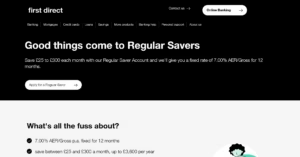
First Direct offers a Regular Saver paying 7.00% AER fixed for one year.
It is particularly relevant to employees, freelancers and professionals who prefer to build savings through monthly contributions rather than deposit a large lump sum.
Key Features
- Interest rate: 7.00% AER fixed
- Maximum monthly contribution: £300
- Minimum monthly contribution: £25
- Term: 12 months
- Eligibility: Existing First Direct current account customers
- Withdrawals: Restricted, with reduced interest on early closure
Depositing £300 each month could generate approximately £135 in interest over the year, using the provider’s published illustration.
This is considerably lower than multiplying the full £3,600 annual contributions by 7%, because the full balance is not present for the entire year.
Our verdict: One of the strongest regular savings accounts for disciplined monthly savers, although it is not designed for substantial lump sums.
8. Santander Regular Saver – Best Headline Monthly Savings Rate
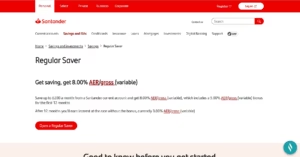
Santander’s Regular Saver offers an advertised 8.00% AER variable rate for eligible existing customers.
It is one of the highest headline rates in the regular savings market.
Key account details:
- Interest rate: 8.00% AER variable for the promotional period
- Maximum monthly contribution: £200
- Term: 12 months
- Current account requirement: Yes
- Withdrawal flexibility: Subject to account terms
- Illustrative maximum annual interest: Approximately £104
The 8% rate is attractive, but the £200 monthly contribution limit prevents savers from using it as a high-interest account for large deposits.
A person with £30,000 cannot simply move their entire savings balance into this account to earn 8%.
The rate also contains an introductory bonus component, meaning the return can fall significantly after the promotional period.
Our verdict: A strong supplementary account for people already banking with Santander, but not necessarily the most profitable regular saver in absolute pounds.
9. Chip Cash ISA – Best for Transferring Existing ISA Savings

Chip’s Cash ISA offers a competitive introductory rate of approximately 4.66% AER for qualifying customers.
Its main advantage is that the advertised bonus can apply to qualifying transferred ISA funds as well as new contributions.
This distinguishes it from products whose best introductory rates are reserved for newly deposited money.
Key details:
- Interest rate: Approximately 4.66% AER variable, including bonus
- Account type: Flexible cash ISA
- Opening balance: From £1
- Interest: Calculated daily, normally credited monthly
- ISA transfers: Supported subject to eligibility
- Account management: Mobile app
There is an important consideration involving accrued interest when transferring or closing the account.
Under the published terms, customers may lose interest already accrued but not yet credited.
For larger balances, even a short period of lost interest can matter.
Our verdict: Worth evaluating for existing ISA holders seeking higher returns, provided the transfer process and potential loss of accrued interest are understood.
10. Zopa Limited Access Saver – Best for Occasional Withdrawals
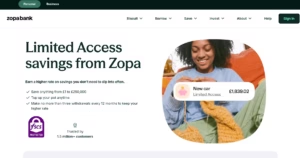
Zopa offers a Limited Access savings pot with a competitive introductory rate of approximately 4.56% AER.
However, the headline rate should not be confused with completely unrestricted easy access.
Under the published account conditions, making more than three withdrawals within the relevant annual period can reduce the interest rate to 2%.
This means a saver using the account for frequent purchases, bills or repeated emergency withdrawals may receive a substantially lower return than expected.
Our verdict: Useful for money that should remain accessible but is unlikely to be withdrawn frequently.
11. Chase Saver – Best for Mobile Banking Convenience

Chase, part of JPMorgan Chase, offers eligible new customers a promotional saver rate of approximately 4.50% AER.
The deal combines an underlying variable rate with a temporary introductory bonus.
Key account details:
- Advertised rate: 4.50% AER for eligible new customers
- Account type: Variable-rate savings
- Promotional period: 12 months
- Current account requirement: Yes
- Management: Mobile app
- Joint accounts: Not available for this saver
Chase may appeal to savers who prefer to manage daily spending and savings through the same digital banking relationship.
However, the extra current-account requirement and eventual bonus expiry must be included in any comparison.
Our verdict: A practical app-based option, particularly for existing Chase users, but not the highest-paying savings account for every balance.
12. Co-operative Bank Regular Saver – Best Alternative Monthly Saver
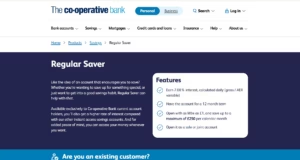
The Co-operative Bank offers a Regular Saver paying 7.00% AER variable for eligible customers.
The product allows qualifying monthly deposits of up to £250.
A saver making the maximum permitted monthly contributions could earn approximately £113 over the year, assuming the advertised rate remains unchanged.
The variable rate means that the return is not guaranteed throughout the full term.
For eligible savers who value monthly saving and withdrawal flexibility, it remains a competitive alternative to First Direct and Santander.
Our verdict: A useful additional regular savings account, especially for customers who meet the existing banking requirements.
Which Savings Account Pays the Most Interest on £1,000, £5,000, £10,000 or £20,000?
The best savings account changes depending on the starting balance.
We compared illustrative annual returns across several published rates.
| Savings balance | At 4.55% AER | At 4.80% AER | At 5.12% AER |
| £1,000 | £45.50 | £48 | £51.20 |
| £3,000 | £136.50 | £144 | £153.60 |
| £5,000 | £227.50 | £240 | £256 |
| £10,000 | £455 | £480 | £512 |
| £20,000 | £910 | £960 | £1,024 |
Figures assume a full year at the stated effective annual rate, with an unchanged balance and no withdrawals. They are before tax and exclude eligibility restrictions. Not all accounts accept every illustrated balance.
Our Assessment for Different Savings Balances
For £1,000 to £3,000: Cahoot’s Sunny Day Saver is particularly competitive because its 5% rate applies to qualifying balances within the account limit.
For £5,000 to £10,000: A combination of a smaller high-rate account and a competitive easy-access account may produce a better result than keeping everything in one lower-paying account.
For £20,000: A cash ISA becomes especially relevant for savers at risk of exceeding the Personal Savings Allowance. A fixed bond may earn more before tax, but prevents easy withdrawals.
For £50,000 or more: Tax, account-provider banking licences, FSCS protection and the balance available for emergencies become increasingly important.
The practical lesson is that an additional 0.25 percentage points of interest may be worth relatively little on a small balance but a meaningful amount over several years on a larger balance.
Is It Better to Open One Savings Account or Split Money Between Several?
Our analysis favours splitting savings when doing so improves returns without creating excessive administrative complexity.
Consider a person holding £20,000 in available cash.
They could place:
- £3,000 in Cahoot Sunny Day Saver at an illustrative 5%.
- £17,000 in another suitable easy-access account at an illustrative 4.55%.
Assuming both rates remain unchanged, the first account would generate £150 in a year and the second approximately £773.50.
Combined interest would be £923.50 before tax.
Putting the entire £20,000 into an account paying 4.55% would generate £910.
The difference is only £13.50 over a year.
For some people, opening and monitoring an additional account to earn that amount is worthwhile. Others may reasonably prefer a simpler arrangement.
The point is not to maximise the number of bank accounts. It is to optimise the return after accounting for time, restrictions and taxes.
Savers can also estimate the longer-term effect of different interest rates using a compound interest calculator, particularly when adding monthly contributions.
Should Savers Choose a Cash ISA or an Ordinary Savings Account in 2026?
The distinction between cash ISAs and conventional savings accounts is one of the most important financial decisions for higher earners.
A cash ISA protects interest from Income Tax, while ordinary savings interest may be taxable once the relevant allowances have been used.
Personal Savings Allowance for 2026/27
| Income Tax position | Annual Personal Savings Allowance |
| Basic-rate taxpayer | £1,000 |
| Higher-rate taxpayer | £500 |
| Additional-rate taxpayer | £0 |
Some lower-income savers may also qualify for the starting rate for savings, which can provide up to £5,000 of additional 0%-taxed savings income, depending on their other income.
How Much Can Someone Save Before Paying Tax on Interest?
At an assumed 5% annual interest rate:
- A basic-rate taxpayer with their full £1,000 allowance available could hold approximately £20,000 before reaching that interest threshold.
- A higher-rate taxpayer with their full £500 allowance available could reach the threshold with approximately £10,000.
- An additional-rate taxpayer does not receive a Personal Savings Allowance.
These are simplified examples. Interest from other taxable accounts also counts, and interest can affect tax-band calculations.
For a higher-rate taxpayer, a slightly lower cash ISA rate may therefore deliver a greater after-tax return than a higher-rate ordinary savings account.
What Will Change for Cash ISAs and Savings Tax in April 2027?
The government’s planned reforms are particularly important for people considering tax-efficient savings.
For the current 2026/27 tax year, the overall adult ISA subscription allowance remains £20,000.
From 6 April 2027, the announced changes will reduce the annual cash ISA subscription limit to £12,000 for savers under 65, while preserving the overall £20,000 ISA allowance.
Those aged 65 or over will retain the ability to subscribe up to £20,000 to cash ISAs, subject to the relevant rules.
The changes concern new annual contributions, rather than a requirement to withdraw existing qualifying ISA savings above £12,000.
There are also planned changes to Income Tax rates on taxable savings income from 2027/28.
| Tax band | 2026/27 savings tax rate | 2027/28 savings tax rate |
| Basic | 20% | 22% |
| Higher | 40% | 42% |
| Additional | 45% | 47% |
The Personal Savings Allowance is scheduled to remain unchanged.
Our assessment is that cash ISAs may become more financially significant for higher-rate taxpayers, particularly those already earning more than £500 annually in taxable savings interest.
However, there is no automatic benefit from transferring money into an ISA if the ordinary savings return would remain untaxed and the alternative account offers a meaningfully better rate.
Each decision should be based on expected interest, eligibility, available ISA subscription allowance and the saver’s wider financial position.
What Does Martin Lewis Recommend Before Opening a Savings Account?
Martin Lewis has consistently encouraged people to consider broader financial priorities before committing money to savings products.
In his published savings guidance, he describes saving as “investing’s poorer cousin” when discussing money that can remain untouched for extended periods.
That does not mean savings accounts are unnecessary.
It means the correct financial decision depends on what the money is intended to achieve.
1. Build Emergency Savings
A readily accessible emergency fund is important for unexpected expenses, income interruptions and household financial stability.
A common planning benchmark is three to six months of essential expenditure, although self-employed workers or people with unpredictable income may reasonably need more.
2. Consider Expensive Borrowing
Putting money into a 5% savings account while paying much higher interest on an overdraft or credit card may be financially inefficient.
For example, someone with £2,000 of revolving card debt charged at 25% annual interest could incur roughly £500 of annual interest if the balance remained outstanding.
Keeping the same £2,000 in savings at 5% would produce only about £100 before tax.
That represents a substantial difference, though borrowers still need sufficient accessible funds for emergencies and essential bills.
The broader problem is particularly relevant to consumers who overlook the borrowing costs associated with everyday banking. Martin Lewis’s debit card warning highlights how an overdrawn current account can effectively become an expensive debt facility.
3. Compare Saving With Mortgage Overpayments
Someone paying a relatively high mortgage interest rate may be able to reduce future borrowing costs by making overpayments.
However, the decision depends on mortgage terms, early repayment charges, available cash reserves and the after-tax return on savings.
Mortgage overpayments also reduce liquidity because funds cannot usually be withdrawn again as easily as money in an accessible savings account.
4. Consider Long-Term Investment Objectives
Money needed in the next few years is often better held in suitable cash savings than exposed to stock market volatility.
For goals more than five years away, diversified investing may be worth considering, but it introduces capital risk and does not guarantee higher returns.
Are Savings Accounts Safe if a Bank Collapses?
UK savers benefit from the Financial Services Compensation Scheme, which protects eligible deposits if an authorised bank, building society or credit union fails.
From 1 December 2025, the standard deposit protection limit increased to £120,000 per eligible person, per authorised firm.
This replaced the previous £85,000 limit.
An important distinction is that protection is linked to banking authorisation rather than simply the number of savings accounts held.
Two brands operating under the same banking licence may share a compensation limit.
Example of Shared Banking Protection
If someone holds £80,000 with one banking brand and £70,000 with another brand sharing the same authorisation, the combined £150,000 could exceed the standard £120,000 protection limit by £30,000.
The exact position depends on the banking licences and account structures involved.
The FSCS also provides separate temporary high-balance protection of up to £1.4 million for qualifying life events, generally for up to six months.
These rules are especially important for people holding substantial cash after selling property, receiving an inheritance or completing a business transaction.
Which Savings Accounts Are Best for Entrepreneurs and Business Owners?
Business owners frequently face a different savings problem from salaried employees.
An entrepreneur may need accessible money to cover personal expenses during an unpredictable trading period, while also maintaining company cash reserves for tax, payroll, suppliers or investment.
These funds should not automatically be combined.
A sole trader’s personal finances and a limited company’s money have different legal and tax treatment.
Personal Savings Versus Company Savings
| Consideration | Personal savings | Limited company savings |
| Account holder | Individual | Company |
| Typical use | Emergency fund and personal goals | Working capital and business reserves |
| Cash ISA eligibility | Eligible individuals | Companies cannot hold personal cash ISAs |
| Interest taxation | Personal savings income rules | Generally included in company profits for Corporation Tax |
| Access needs | Household expenditure | Payroll, VAT, Corporation Tax and operations |
For entrepreneurs comparing accounts held by their companies, the best business savings accounts should be assessed separately from Martin Lewis’s personal savings selections.
A business may also need to compare a current account’s transaction features with the interest available on reserve funds.
Choosing between business bank accounts for small businesses can therefore be part of a wider cash-management decision.
Our Financial Assessment for Entrepreneurs
For a limited company, cash required for tax payments or operating expenses should not normally be committed to a fixed-term bond that matures after those liabilities fall due.
A separate, appropriately accessible business reserve may be more useful than a marginally higher interest rate with restrictive withdrawal conditions.
For a sole trader, personal tax allowances can be relevant to interest received on personally owned savings, although their trading income may affect the tax band applying to that interest.
The central principle is to compare the after-tax and liquidity-adjusted return, rather than selecting an account from a headline interest-rate table alone.
Is It Worth Keeping Savings With an Existing Bank?
Maintaining an established banking relationship may provide convenience, but it does not guarantee the highest interest rate.
Some banks offer loyalty bonuses, linked regular savers or membership payments.
For example, Nationwide’s Fairer Share arrangements have provided qualifying customers with payments based on eligible current-account and savings or mortgage relationships.
The Nationwide Fairer Share payment is an example of a benefit that cannot be assessed simply by comparing ordinary savings interest rates.
However, a previous membership payment should never be treated as a guaranteed future return.
Before staying with an existing provider, compare the net value of any genuine customer benefits against the additional interest available elsewhere.
What Are the Biggest Mistakes Savers Make When Choosing an Account?
Our comparison identifies several decisions that can reduce the financial benefits of a competitive savings rate.
Focusing only on the highest percentage: An 8% regular saver may earn less actual interest than a 5% lump-sum account because monthly contributions are restricted.
Ignoring introductory bonuses: Some headline rates include bonuses that disappear after 12 months.
Overlooking withdrawal conditions: Accounts described as accessible may still reduce their interest rate after repeated withdrawals.
Forgetting savings tax: A higher-rate taxpayer can receive a better net return from a cash ISA even when its advertised rate is lower.
Leaving an account unchanged after maturity: Fixed-term products may move into accounts paying considerably less when their original term ends.
Making an incorrect ISA transfer: Existing ISA savings should normally be moved through an authorised provider-to-provider ISA transfer process, rather than withdrawn and redeposited without checking the tax implications.
Assuming every brand receives separate FSCS protection: Shared banking authorisations can mean savings balances are combined for protection purposes.
Using personal accounts for company funds: Limited company reserves should remain appropriately separated from the director’s personal money.
Addressing these issues is often more beneficial than spending substantial time chasing a very small increase in the advertised rate.
How Can Savers Choose the Best Account in 2026?
A practical selection process begins with defining how the money will be used.
| Financial objective | Savings account type to consider |
| Emergency fund | Easy-access savings |
| Small balance under £3,000 | High-rate capped easy-access account |
| Saving £100–£300 monthly | Regular saver |
| Saving towards a purchase next year | Easy-access or suitable one-year fixed account |
| Higher-rate taxpayer with taxable interest | Cash ISA |
| Large sum not needed for two years | Two-year fixed bond |
| Retirement cash reserve | Suitable easy-access or fixed savings, depending on liquidity needs |
| Limited company tax reserve | Eligible business savings account |
Our preferred approach is to establish the emergency reserve first, understand the tax position and then allocate any genuinely surplus funds to products offering an appropriate balance between interest and access.
Savings rates should also be reviewed periodically, especially after introductory offers expire or fixed bonds mature.
Final Verdict: Which Savings Account Offers the Best Value in 2026?
Our analysis indicates that the Martin Lewis best savings account depends on the saver’s financial objectives rather than a single headline rate.
Cahoot’s Sunny Day Saver stands out for smaller balances at 5% AER, while Trading 212 provides an attractive tax-free option for eligible new cash ISA deposits. OakNorth and Oxbury offer competitive fixed-rate alternatives for people comfortable restricting access to their money.
First Direct and Santander remain particularly relevant for monthly savers, although their contribution limits prevent the advertised 7% and 8% rates from applying to substantial lump sums.
For higher earners and entrepreneurs, tax efficiency, cash-flow requirements and deposit protection can be more valuable than a marginal increase in interest.
The strongest savings strategy is therefore not necessarily to choose one bank. It is to match each portion of available money to its purpose, review the after-tax return and retain enough flexibility to meet unexpected financial commitments.
Editorial disclosure: This is an independent comparison of published savings-account information, not a statement that Martin Lewis endorses our rankings. The percentage scores reflect editorial assessments, not independently surveyed customer reviews. Rates and eligibility should be checked directly before applying. This article provides general financial information rather than personalised financial advice.
Frequently Asked Questions
1. Which bank does Martin Lewis recommend for savings?
Martin Lewis’s MoneySavingExpert comparisons highlight different providers depending on account type. Recent top selections include Cahoot, Tembo, Trading 212, OakNorth and Oxbury, rather than one universal recommendation.
2. What is the highest savings interest rate in the UK in 2026?
Selected regular savers currently advertise up to 8% AER, while competitive ordinary easy-access and fixed-term products offer rates around 5%. Balance limits and eligibility conditions matter.
3. Is a 5% savings account good in 2026?
A 5% AER rate is competitive for ordinary cash savings, particularly with reasonable access terms. Its actual value depends on tax, inflation, promotional conditions and account restrictions.
4. Can I earn 8% interest on £20,000?
Not usually through standard 8% regular savers, because they restrict monthly contributions. The advertised rate generally applies only to the money gradually deposited within those limits.
5. Is a cash ISA better than an ordinary savings account?
A cash ISA can be particularly valuable when taxable savings interest exceeds the Personal Savings Allowance. Otherwise, the higher after-tax return may come from an ordinary savings account.
6. How much savings interest is tax-free in 2026/27?
Basic-rate taxpayers normally receive a £1,000 Personal Savings Allowance, higher-rate taxpayers £500 and additional-rate taxpayers none. Lower-income individuals may qualify for additional relief.
7. Are Martin Lewis savings accounts protected by the FSCS?
Martin Lewis does not operate the savings accounts listed in his comparisons. Eligible deposits with authorised UK institutions generally benefit from FSCS protection of up to £120,000 per person, per authorised firm.