





















Choosing the best business credit cards in the UK is more complicated than comparing cashback percentages.
One card may offer 1% cashback with no annual fee but charge a relatively high interest rate if the balance is carried. Another may have a much lower purchase rate but require the company to hold its business bank account with the same provider.
Premium cards can offer airport lounges, Avios or travel insurance, yet those benefits are only worthwhile if the business actually uses them.
Business structure matters too. Some of the strongest cards are restricted to UK limited companies or LLPs, while others accept sole traders and partnerships. Foreign transaction fees, employee cards, accounting integrations, credit limits and personal guarantees can all materially change which card represents the best value.
For a London business, this becomes particularly practical.uk b
A Shoreditch marketing agency buying thousands of pounds of Google Ads and software each month has very different requirements from a Soho restaurant, a construction company running several vans, an ecommerce retailer buying stock or an international consultancy whose directors spend half the month travelling.
Our comparison therefore looks beyond headline rewards.
We have compared:
- Annual and account fees
- Representative aprs and purchase rates
- Interest-free periods
- Cashback and points
- Foreign transaction fees
- Introductory offers
- Potential credit limits
- Sole-trader eligibility
- Limited-company eligibility
- Requirements to hold a particular business bank account
- Employee-card arrangements
- Accounting and expense-management features
- Travel benefits
- Personal-guarantee considerations and
- The circumstances in which each card is likely to provide the greatest value.
Product information checked: 5 October 2026.
Rates, promotions, eligibility criteria and credit limits can change. A lender may also offer an individual business a different rate or limit according to its credit assessment.
What Is the Best Business Credit Card in the UK?
For many established UK limited companies, Capital on Tap Business Credit Card is our strongest all-round choice.
The standard card combines:
- No annual fee
- Unlimited 1% cashback
- No foreign-exchange fees on purchases
- Credit limits potentially reaching £250,000
- Free employee cards
- Reward conversion into avios or virgin points and
- No requirement to move the company’s main business bank account.
Capital on Tap advertises rates from 13.86% APR variable, although the actual rate offered depends on the individual business. It is not available to sole traders.
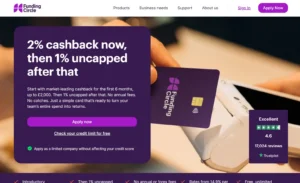
For businesses primarily interested in cashback, Funding Circle Cashback Business Credit Card is particularly competitive because eligible limited companies currently receive 2% cashback during the first six months, capped at £2,000 during that introductory period, followed by uncapped 1% cashback.
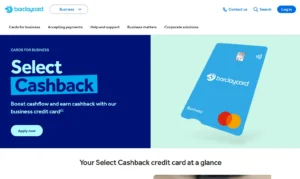
Sole traders have fewer options. Barclaycard Select Cashback is therefore important because it does not force applicants to move their main business banking relationship and pays 1% cashback when the applicable monthly-spend condition is satisfied.
There is no universal winner. The correct card changes according to whether the business pays in full, carries balances, spends overseas, buys fuel, wants Avios, gives cards to employees or primarily needs short-term borrowing.
Best Business Credit Cards UK: Top 20 at a Glance
| Rank | Business Card | Best For | Annual Fee | Main Reward/Benefit |
| 1 | Capital on Tap Business Credit Card | Best overall | £0 | Unlimited 1% cashback |
| 2 | Funding Circle Cashback Business Credit Card | Best introductory cashback | £0 | 2% for 6 months, then 1% |
| 3 | Barclaycard Select Cashback | Best for sole traders/open access | £0 | 1% cashback subject to monthly-spend condition |
| 4 | iwoca Credit Card | Best for newer limited companies | £0 | 1% cashback and no FX fee |
| 5 | Lloyds Bank Business Credit Card | Best lower-rate bank card | £32 per card after year one, subject to waiver | 0.5% general cashback and 1% fuel/EV cashback |
| 6 | Santander Business Cashback Credit Card | Best cashback high-street-bank card | £30 per account | Unlimited 1% cashback |
| 7 | Metro Bank Business Credit Card | Best simple no-fee bank card | £0 | 18.9% representative APR |
| 8 | NatWest Business Plus Credit Card | Best category cashback | £70 per card | Up to 3% cashback |
| 9 | Virgin Money Business Credit Card | Best Virgin Money customer option | £0 year one, then £28 per card | 1% cashback |
| 10 | HSBC Commercial Card | Best HSBC borrowing option | £32 per card | 15.9% purchase rate |
| 11 | NatWest Business Credit Card | Best standard NatWest option | £30 per card, potentially waived | Fuel and EV cashback |
| 12 | RBS Business Plus Credit Card | Best premium RBS option | £70 per card | Up to 3% cashback |
| 13 | RBS Business Credit Card | Best standard RBS option | £30 per card, potentially waived | 1% fuel/EV cashback |
| 14 | Barclaycard Premium Plus | Best for a planned large purchase | £150 | Six months at 0% on purchases |
| 15 | American Express Business Gold | Best flexible points card | £0 year one, then £195 | Membership Rewards |
| 16 | British Airways Accelerating Business Amex | Best for Avios | £250 | Avios on business spending |
| 17 | Amazon Business Prime American Express | Best for Amazon Business Prime | £50, potentially waived | Up to 2% Amazon Rewards |
| 18 | Amazon Business American Express | Best non-Prime Amazon option | £0 year one, then £50 | Up to 1.5% Amazon Rewards |
| 19 | Capital on Tap Pro | Best premium Visa rewards option | £299 | Travel perks and enhanced reward conversion |
| 20 | American Express Business Platinum | Best premium business travel card | £650 | Lounge access, travel benefits and Membership Rewards |
The ranking is not based solely on APR or cashback. It considers how useful each card is to a typical UK SME and how restrictive its eligibility conditions are.
How We Compared the Best Business Credit Cards?
A comparison of the leading Google results shows that business-card articles frequently suffer from several problems.
Some concentrate heavily on rewards but give little attention to the cost of carrying a balance. Others mix conventional revolving credit cards with charge cards, debit cards and expense-management products without clearly explaining the difference.
Eligibility is another common weakness.
A business owner can spend ten minutes comparing cashback rates only to discover that the card requires an existing bank account with the provider or does not accept their legal business structure.
Current comparison pages from Finder and BusinessExpert demonstrate just how much the market varies across APR, eligibility, fees and product type.
We have therefore added several areas that deserve more attention:
- Business structure. Can a sole trader apply, or is the card limited to companies?
- Bank-account lock-in. Must the business already bank with the provider?
- Net reward. What remains after annual fees?
- Foreign spending. Does a 2.95% or 2.99% FX fee wipe out the cashback?
- Borrowing cost. What happens when the statement cannot be cleared?
- Employee-card economics. Is the annual fee charged once per account or for every employee card?
- Reward caps. Is headline cashback actually unlimited?
- Accounting. Can spending feed automatically into bookkeeping systems?
- Personal guarantees. Does the director retain personal exposure?
- Product type. Is it really revolving credit?
Those differences can completely reverse which card represents the best value.
1. Capital on Tap Business Credit Card

Check the Capitalontap Credit Card Here
Best Overall Business Credit Card for UK Limited Companies
- Card type: Business credit card
- Annual fee: £0
- Rewards: Unlimited 1% cashback
- Credit limit: Potentially up to £250,000
- Interest: Rates advertised from 13.86% APR variable
- Interest-free period: Up to 42 days
- Foreign purchase fee: £0
- Sole traders: No
- Existing bank account with provider required: No
- Employee cards: Unlimited free employee cards
- Accounting: Integrations and transaction-management tools available
Capital on Tap remains one of the strongest starting points for an incorporated SME.
Its main advantage is that the proposition is easy to understand: businesses earn one point for every £1 spent, equivalent to 1% cashback, with no annual fee and no cashback ceiling.
Rewards can be redeemed in several ways, including against the card balance, as cash, for gift cards or through travel-reward conversions.
There are also no Capital on Tap foreign-exchange fees on card purchases, making it much more useful than a 1% cashback card charging close to 3% every time the company spends in another currency.
Who Can Apply?
Capital on Tap states that applicants should be an active director or a shareholder owning at least 25% of the company.
Eligible businesses include active UK limited companies, LLPs and PLCs.
Sole traders are excluded.
That is the biggest limitation of the product. A self-employed consultant operating without a company cannot simply choose Capital on Tap because it ranks highly.
Why It Ranks First?
Three characteristics are particularly valuable.
First, there is no requirement to move business banking.
That matters because several traditional banks only make their business credit cards available to their own current-account customers.
Second, there is no annual fee.
A business spending £50,000 of eligible expenditure through a 1% cashback card generates £500. With Capital on Tap, there is no annual membership charge to deduct from that figure.
Third, overseas purchases do not attract a Capital on Tap FX fee.
For a London digital agency paying US software providers, travelling to European conferences and buying international advertising, that can represent meaningful savings.
Employee Spending
Capital on Tap also provides free employee cards and allows businesses to use spending controls.
That makes the product relevant beyond a one-person company.
An agency could issue cards to its operations manager, sales director and marketing team without automatically creating another large annual card-membership bill.
Main Drawbacks
The card is much less appealing if the company regularly carries significant balances.
The lowest advertised rate should not be confused with the rate every applicant will receive. Credit pricing depends on the business and its application.
The company also needs to meet Capital on Tap’s eligibility criteria, and sole traders are excluded.
London Business Example
Consider a London consultancy spending:
- £3,000 a month on advertising and software
- £1,000 on travel
- £1,000 on accommodation, subscriptions and general expenses.
That produces £60,000 annual card expenditure.
At 1%, gross cashback would be approximately £600 per year.
If the same expenditure were placed on a card charging a 2.99% FX fee and £12,000 of it involved foreign currency, the company could potentially lose around £359 in FX charges alone.
Our verdict: 5/5
Capital on Tap is our best all-round option for many eligible UK limited companies that pay their balance responsibly.
2. Funding Circle Cashback Business Credit Card
Check the Funding Circle Credit Card Here
Best Business Credit Card for Introductory Cashback
- Annual fee: £0
- Introductory cashback: 2% for six months, up to £2,000
- Ongoing cashback: 1% uncapped
- Representative APR: 34.9% variable
- Rates: From 14.9%
- Interest-free period: Up to 42 days
- FX fee: £0
- Existing Funding Circle account: Not required
- Business structure: UK limited companies
- Trading history: Eligibility requirements apply
Funding Circle offers one of the strongest cashback propositions currently available to an eligible UK limited company.
New cardholders can earn 2% cashback for the first six months, up to £2,000 of cashback during the promotional period. The rate then becomes 1% uncapped.
There is no monthly or annual membership fee and no foreign-exchange fee on purchases. Funding Circle also advertises accounting-software synchronisation.
How Valuable Is 2% Cashback?
Suppose an established SME spends £15,000 per month.
During the first six months, expenditure would reach £90,000.
At 2%, that could generate around £1,800 of introductory cashback, assuming all expenditure qualifies.
If the business spent £20,000 per month, six-month spending would reach £120,000 and nominal cashback at 2% would be £2,400, but the promotional cashback ceiling would limit the reward to £2,000.
After the promotional period, the standard 1% rate applies.
Eligibility Matters
Funding Circle is not designed for every microbusiness.
Its business-credit-card eligibility is considerably more restrictive than Barclaycard’s open-access proposition.
Businesses should confirm current requirements concerning company type, trading history and turnover before applying.
It is not the card we would choose for a sole trader or somebody who has incorporated a company only recently.
Accounting Integration
Funding Circle’s auto-sync features can be useful for companies processing hundreds of transactions.
Using a business card becomes considerably more valuable operationally when every card payment can be reconciled efficiently.
Businesses comparing bookkeeping systems can also review our analysis of small business accounting software to see how card and bank feeds fit into a wider finance system.
Main Drawback
The 34.9% representative APR means the cashback should not distract a company that expects to carry substantial debt month after month.
On a large revolving balance, interest can exceed rewards surprisingly quickly.
Our verdict: 4.9/5
A very strong choice for established limited companies that can clear the balance and take full advantage of the introductory cashback period.
3. Barclaycard Select Cashback Business Credit Card
Check the Barclaycard Select Credit Card Here
Best Business Credit Card for Sole Traders and Open-Access Banking
- Annual fee: £0
- Representative APR: 25.5% variable
- Purchase rate: 25.5% variable
- Cashback: 1% subject to monthly spending conditions
- Interest-free period: Up to 56 days
- Existing Barclays bank account required: No
- Sole traders: Eligible subject to Barclaycard criteria
- Partnerships: Eligible subject to criteria
- Limited companies: Eligible
Barclaycard Select Cashback solves one of the biggest frustrations in UK business credit cards: bank-account lock-in.
Businesses do not need to move their current account to Barclays simply to obtain the card.
That makes it particularly relevant to businesses banking with providers such as Starling, Monzo or Tide that may want a separate mainstream credit-card facility.
Barclaycard currently advertises a 25.5% representative APR, no annual account fee and 1% cashback when the required monthly-spend conditions are met.
Understand the £2,000 Rule
This deserves special attention.
The cashback is tied to eligible business spending of at least £2,000 in the relevant statement month.
This means the card is not equally rewarding for every microbusiness.
A consultant spending only £1,300 in a quiet month should not assume that simply owning a “1% cashback card” guarantees the same return as a flat 1% product.
Why Sole Traders Should Look Closely?
Several fintech competitors exclude sole traders altogether.
Barclaycard’s wider business-structure eligibility makes Select Cashback one of the most important cards in the market for self-employed people.
Best Use Case
The card makes most sense where:
- Monthly spending reliably meets the cashback threshold
- The business does not want to change bank
- The applicant is a sole trader or partnership excluded by some fintech cards and
- The balance can normally be cleared before high interest becomes material.
Main Drawbacks
The 25.5% APR is higher than several relationship-bank cards.
The card also lacks the zero-FX proposition offered by Capital on Tap and Funding Circle.
For a business making large overseas purchases, foreign-currency charges can materially reduce the benefit of cashback.
Our verdict: 4.7/5
One of the most useful cards for sole traders and businesses that want a credit card without moving their current account.
4. iwoca Credit Card
Check the iwoca Credit Card Here
Best Business Credit Card for a New Limited Company
- Annual fee: £0
- Cashback: 1%
- Representative APR: 35.40% variable
- Rates: From 14.99%
- Interest-free period: Up to 42 days
- Credit limit: Potentially up to £250,000
FX fee: £0 - Late-payment fee: £0
- Existing iwoca banking relationship: Not required
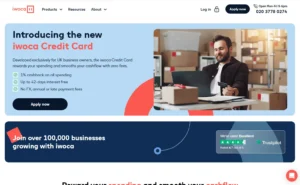
The iwoca Credit Card has been designed to combine business credit with simple rewards.
Its key features are:
- 1% cashback
- No annual fee
- No fx fee
- No late-payment fee
- Up to 42 days interest-free
- Rates beginning at 14.99% and
- Potential limits reaching £250,000.
iwoca currently states a representative APR of 35.40% variable.
Why It Is Interesting for Newer Businesses?
Many business lenders prefer applicants with a substantial trading record.
That creates a financing paradox.
A young company often needs working capital most when it has the least historical evidence to give lenders.
iwoca positions its card more flexibly towards UK business owners, making it an option worth investigating when a company does not satisfy the trading-history requirements of another provider.
Businesses still establishing their legal structure can first work through the practical steps involved in registering a business in the UK before applying for company borrowing.
Rewards
Cashback is automatically applied against the account balance.
That is operationally useful because directors do not need to remember to redeem points through a separate reward portal merely to obtain basic cashback.
Foreign Spending
There is no iwoca FX fee.
That gives the card a substantial advantage over several high-street alternatives for companies paying overseas suppliers or using cards during international travel.
The Main Problem: Borrowing Cost
The representative APR is relatively high.
A company should not interpret the advertised starting rate of 14.99% as a guarantee.
The rate offered will depend on underwriting.
For a company expecting to leave a £10,000 or £20,000 balance outstanding for months, even attractive cashback becomes secondary to financing cost.
Our verdict: 4.6/5
Particularly worth considering for newer incorporated companies that want rewards without annual and foreign-spending fees.
5. Lloyds Bank Business Credit Card
Check the Lloyds Credit Card Here
Best Business Credit Card for Lower-Cost Borrowing
- Annual fee: No fee in first 12 months; normally £32 per cardholder afterwards
- Fee waiver: Available subject to qualifying annual spending condition
- Purchase rate: 14.9% variable
- Representative APR: Around 15.95% variable
- Credit limit: Up to £25,000
- Interest-free period: Up to 56 days
- Cashback: 1% fuel/EV charging and 0.5% on other qualifying purchases
- Existing account: Lloyds business banking relationship required
Rewards tend to dominate business-credit-card advertising, but interest cost can matter far more.
Lloyds is therefore important because its purchase rate is considerably lower than several specialist cashback cards.
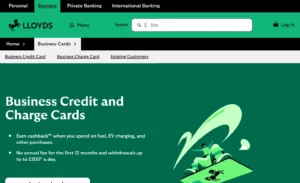
Its Business Credit Card currently offers borrowing of up to £25,000, up to 56 days interest-free on purchases when the conditions are met and cashback on qualifying expenditure. Lloyds advertises 1% cashback on fuel and charging and 0.5% on other purchases.
Annual Fee
There is no annual fee for cards added during the first 12 months of the business-card account.
Afterwards Lloyds normally charges £32 per cardholder, although its current terms provide a spending-based waiver.
That makes annual spend important.
A business that comfortably reaches the waiver threshold may effectively obtain the card without an annual membership cost.
Why a Lower APR Can Beat More Cashback?
Consider two hypothetical cards:
- Card A: 1% cashback and 35% APR.
- Card B: 0.5% cashback and approximately 16% APR.
A business paying every statement in full could prefer Card A because no purchase interest is incurred.
A company that regularly carries £10,000 may reach exactly the opposite conclusion.
Saving close to 20 percentage points of annual borrowing cost can dwarf an additional 0.5% reward.
Main Restriction
Lloyds requires the appropriate business banking relationship.
Companies should not automatically move their entire current account solely to obtain a credit card without comparing the costs and functionality of the banking package.
UK businesses considering a switch can compare the best business bank accounts for small businesses before making that decision.
Our verdict: 4.5/5
A strong choice for an existing Lloyds business customer that values a lower borrowing rate more than maximum cashback.
6. Santander Business Cashback Credit Card
Check the Santander Credit Card Here
Best High-Street Cashback Business Credit Card
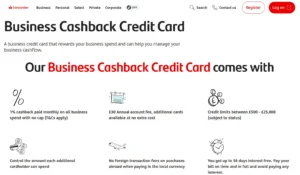
- Annual fee: £30 per business account
- Additional card fee: £0
- Cashback: 1% with no stated cap, subject to terms
- Representative APR: 23.7% variable
- Purchase rate: 18.9% variable
- Credit limit: £500 to £25,000 subject to status
- Interest-free period: Up to 56 days
- Foreign purchase fee: None when paying in local currency
- Existing Santander account: Required
Santander’s Business Cashback Credit Card is one of the strongest traditional-bank alternatives to specialist fintech cards.
It offers:
- 1% cashback
- A £30 annual account fee
- Additional cards without another annual membership charge
- Credit limits from £500 to £25,000
- No foreign transaction fee on qualifying purchases abroad when paying in local currency and
- Up to 56 days interest-free when the balance is paid in full and on time.
The representative APR is currently 23.7% variable, based on an 18.9% purchase rate and the annual fee.
Why the Per-Account Fee Matters?
Many business-card fees are charged per employee card.
Santander instead charges one annual account fee.
That can materially improve the economics for a small team.
The bank currently allows up to four cards in total under the relevant account arrangements.
Imagine a company with four cardholders.
A competitor charging £30 per card could cost £120 annually.
Santander’s £30 account fee would remain £30.
Cashback Break-Even Point
At 1% cashback, the £30 annual fee is recovered after around £3,000 of qualifying annual spending.
At £30,000 annual spend:
Gross cashback = £300
Less annual fee = £30
Approximate net reward = £270
At £100,000:
Gross cashback = £1,000
Less annual fee = £30
Approximate net reward = £970
Foreign Spending
The absence of a foreign transaction fee on qualifying purchases is another major advantage.
For an internationally active company, this can be worth much more than the annual fee.
Main Restriction
Businesses need an eligible Santander Business Current Account.
Applicants must also satisfy the ownership, residency and credit conditions set out by Santander.
Our verdict: 4.5/5
Excellent for an existing Santander business, especially where several employees need cards.
7. Metro Bank Business Credit Card
Check the Metro Credit Card Here
Best Straightforward No-Annual-Fee High-Street Card
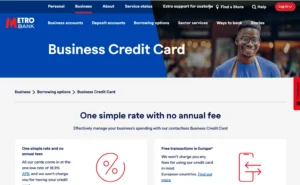
- Annual fee: £0
- Representative APR: 18.9% variable
- Purchase rate: 18.9%
- Interest-free period: Up to 56 days
- European card use: No Metro Bank card-usage fee in qualifying SEPA countries
- Existing account: Metro Bank Business or Commercial Current Account required
- Application: Branch-led
Metro Bank’s card does not attempt to compete through large cashback promises.
Instead, it has a very simple proposition:
18.9% representative APR and no annual card fee.
It also provides up to 56 days interest-free on purchases where the statement is repaid in full and on time.
Who Is It Best For?
The card can make sense for a relatively low-spending business that:
- Already banks with metro
- Does not want to pay a card-membership fee
- Values a lower APR
- Occasionally carries a balance and
- Is comfortable with metro bank’s branch-led service model.
London Advantage
Metro Bank’s physical-store network has historically been concentrated heavily around London and the South East.
That means a London business may find the branch requirement less inconvenient than a company based somewhere with little or no Metro Bank coverage.
What Is Missing?
There is no headline 1% cashback programme comparable with Capital on Tap or Funding Circle.
For a company clearing £10,000 of card expenditure every month, that missing cashback can add up.
At £120,000 annual spend, a 1% no-fee cashback card could produce £1,200 before considering other costs.
Why Metro Still Ranks Highly?
A card used for borrowing should not necessarily be evaluated like a card used purely for payments.
Someone paying significant interest should care more about APR than points.
Our verdict: 4.3/5
A straightforward choice for an existing Metro Bank customer that values low ongoing cost over rewards.
8. NatWest Business Plus Credit Card
Check the NatWest Credit Card Here
Best Business Credit Card for Fuel, Trade Supplies and Category Cashback
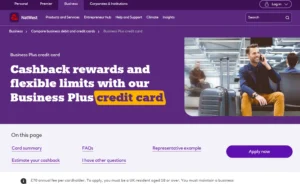
- Annual fee: £70 per cardholder
- General cashback: 0.5%
- Travel/accommodation: 1% on eligible spending
- Trade/business supplies: 2%
- Fuel and EV charging: 3%
- Annual cashback cap: £600 per account
- FX fee on overseas purchases: £0
- Interest-free period: Up to 56 days
- Existing NatWest account: Required
- Turnover: Eligibility ceiling applies
NatWest Business Plus is much more interesting than its 0.5% standard cashback rate initially suggests.
The card pays different rates according to the eligible merchant category:
- 0.5% on general purchases
- 1% on qualifying travel and accommodation
- 2% on eligible trade and business supplies and
- 3% at qualifying fuel and electric-vehicle charging locations.
Cashback is capped at £600 per account each year.
Who Benefits Most?
Think about a construction company.
Its spending might include:
- Fuel
- Builders’ merchants
- Tools
- Accommodation for employees working away
- General office costs.
That expenditure profile maps far more closely to NatWest’s enhanced categories than the spending of a software consultancy.
A trades business might therefore generate a materially higher effective cashback rate than the 0.5% headline base.
Overseas Spending
The Business Plus card also removes NatWest’s normal non-sterling transaction fee on purchases abroad.
That is particularly useful for companies combining domestic trade spending with overseas travel.
Where the Maths Becomes Less Attractive?
There are two limitations.
First, the card costs £70 per cardholder.
A five-card team could therefore face £350 of annual card fees.
Second, cashback is capped at £600 per account annually.
A very high-spending business can therefore reach a point where extra expenditure earns no further cashback.
Best Fit
The card is strongest where:
The business already banks with natwest
A meaningful share of spending falls into 2% or 3% categories
Overseas purchases are common and
The company does not need large numbers of employee cards.
Our verdict: 4.3/5
Potentially excellent for the right expenditure profile, but weaker for a large multi-card team.
9. Virgin Money Business Credit Card
Check the Virgin Money Credit Card Here
Best for Existing Virgin Money Business Customers
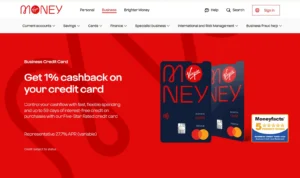
- Annual fee: £0 in year one
- Fee after year one: £28 per card
- Cashback: 1% on eligible expenditure with no stated cap
- Representative APR: 27.7% variable
- Purchase rate: 21.9% variable
Interest-free period: Up to 59 days - Employee cards: Multiple cards available under shared account limit
- Existing account: Virgin Money business current account required
Virgin Money offers a relatively straightforward cashback card.
Businesses receive 1% cashback on eligible purchases, with no annual card fee during the first year.
From the second year there is a £28 annual fee per card.
The card’s representative APR is currently 27.7% variable based on a 21.9% purchase rate.
Team Spending
Virgin Money lets companies add multiple cardholders while managing a shared overall credit facility.
Individual spending limits can also be used.
That can help businesses decentralise day-to-day purchasing without giving each employee unrestricted access to the company’s entire credit line.
Reward Value
At £50,000 of annual qualifying expenditure:
1% cashback = £500
In year one, there is no annual card fee.
From year two, a company using one card would have around £472 of net cashback after a £28 card fee, ignoring other charges.
With five employee cards, however, the £28-per-card pricing becomes more important.
Foreign Spending
Virgin Money is weaker than Capital on Tap, Funding Circle and Santander for many international transactions because non-sterling fees can apply, although particular currency and regional exceptions should be checked against the current tariff.
Best Fit
The strongest candidate is an existing Virgin Money business customer that:
- Spends enough to benefit meaningfully from 1% cashback
- Primarily spends in sterling and
- Values integrated banking and card management.
Our verdict: 4.2/5
Good cashback, but the current-account requirement and per-card fee reduce its appeal outside the Virgin Money customer base.
10. HSBC Commercial Card
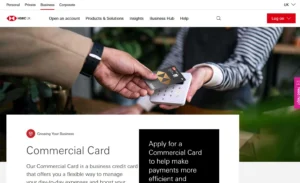
Check the HSBC Commercial Credit Card Here
Best Lower-Rate Card for Existing HSBC Businesses
- Annual fee: £32 per card
- First-year fee: Currently waived
- Representative APR: 22% variable
- Purchase rate: 15.9% variable
- Interest-free period: Up to 56 days depending on repayment method and transaction timing
- FX fee: Typically 2.99% on non-sterling transactions
- Rewards: Merchant offers rather than a major flat cashback programme
- Existing HSBC account: Required
HSBC Commercial Card occupies a different part of the market from cashback-focused fintech cards.
Its principal strength is borrowing cost.
HSBC currently advertises a 22% representative APR and a business credit card designed to provide working capital for ordinary expenses and larger purchases. An HSBC business current account is required.
Why HSBC Can Beat a 1% Cashback Card?
Imagine a business that expects to carry a £15,000 balance for several months.
Choosing a card because it pays an extra £150 of annual cashback would be irrational if the alternative financing arrangement reduces interest by hundreds or thousands of pounds.
That is why APR deserves much more prominence in business-card comparisons.
Weaknesses
HSBC does not offer the simple 1% unlimited cashback proposition available from several competitors.
There is also a foreign-exchange fee on non-sterling spending.
That makes the card relatively unattractive for frequent overseas expenditure.
Best Fit
Consider HSBC if:
- the business already banks there;
- borrowing cost matters more than rewards;
- most purchases are in sterling; and
- directors prefer to keep credit and banking within the same institution.
Our verdict: 4.1/5
A sensible relationship-bank credit facility rather than a rewards card.
11. NatWest Business Credit Card
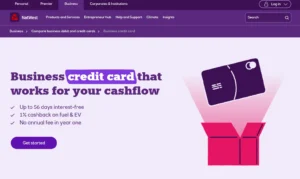
Check the NatWest Credit Card Here
Best Standard NatWest Business Credit Card
- Annual fee: £30 per cardholder
- Year-one fee: Waived
- Later fee waiver: Available when qualifying annual spending reaches £6,000
- Purchase rate: 16.9% variable
- Representative APR: 24.3% variable
- Interest-free period: Up to 56 days
- Fuel/EV cashback: 1% at eligible providers
- FX fee: 2.95%
- Existing NatWest account: Required
- Turnover: Designed for businesses below the applicable £2 million threshold
The standard NatWest Business Credit Card is considerably cheaper than Business Plus.
It currently has:
- A £30 annual fee per cardholder
- No card fee during the first year
- A fee waiver from the second year where annual card spending meets the required threshold
- 1% cashback at qualifying fuel and electric-vehicle charging providers and
- A 16.9% variable purchase rate.
NatWest’s representative APR is currently 24.3% variable.
Standard or Business Plus?
The answer depends almost entirely on spending.
Choose the standard card where the business:
- Spends mainly in the UK
- Wants a lower annual fee
- Does not buy enough trade supplies, fuel or travel to justify business plus and
- Can reach the spending threshold that removes the annual fee.
Business Plus becomes more compelling where category cashback and zero overseas purchase fees compensate for the £70-per-card cost.
Main Weakness
The standard card charges a 2.95% non-sterling transaction fee.
A company spending £20,000 annually in foreign currencies could therefore incur around £590 of such fees before considering exchange rates and other charges.
That is a major disadvantage compared with a zero-FX business card.
Our verdict: 4/5
A respectable everyday card for smaller existing NatWest businesses with primarily UK expenditure.
12. RBS Business Plus Credit Card
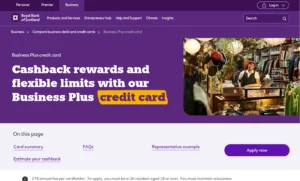
Check the RBS Credit Card Here
Best Enhanced Cashback Card for RBS Businesses
- Annual fee: £70 per cardholder
- Cashback: Up to 3% on selected categories
- General cashback: 0.5%
- Annual cashback cap: £600 per account under the current main product terms
- Foreign purchases: No non-sterling transaction fee
- Interest-free purchases: Up to 56 days
- Existing RBS bank account: Required
- Minimum limit: £500; maximum subject to status
Royal Bank of Scotland Business Plus closely resembles NatWest Business Plus because the two brands operate within the same wider banking group.
RBS currently advertises:
- 0.5% general cashback
- Enhanced cashback across eligible travel, accommodation, business supplies, fuel and ev charging
- No foreign transaction charge on purchases abroad and
- Up to 56 days interest-free.
The current product page lists a £70 annual fee per cardholder and a £600 annual cashback limit per account.
Who Should Consider It?
This is primarily a relationship card.
There is little reason for a company banking elsewhere to restructure its finances purely to obtain it unless the broader RBS banking proposition also makes sense.
For an existing RBS customer spending heavily on:
- Fuel
- Building materials
- Trade suppliers
- Hotels and
- Business travel.
the enhanced categories can make it very competitive.
Watch the Cashback Cap
Once £600 has been earned in a year, additional qualifying expenditure does not continue increasing cashback indefinitely.
Very high-spending companies should therefore calculate the effective percentage return across the entire year’s expenditure rather than simply looking at “up to 3%”.
Our verdict: 4/5
Good for an established RBS business whose spending naturally falls into the enhanced categories.
13. RBS Business Credit Card
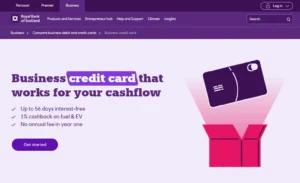
Check the RBS Credit Card Here
Best Basic Business Credit Card for RBS Customers
- Annual fee: £30 per cardholder
- Year one: No card fee
- Later fee waiver: Available after qualifying annual spend
- Representative APR: 24.3% variable
- Purchase rate: 16.9% variable
- Fuel/EV cashback: 1%
- Interest-free period: Up to 56 days
- Foreign transaction fee: 2.95%
- Existing RBS business bank account: Required
- Turnover: Up to £2 million under current eligibility
The standard RBS Business Credit Card provides a simpler alternative to the Business Plus card.
Its main features are:
- First year without the annual card fee
- £30 annual fee afterwards
- Potential fee waiver when annual card expenditure reaches £6,000
- 1% cashback at qualifying fuel and ev-charging providers
- 16.9% variable purchase rate and
- 24.3% representative APR.
The product requires an RBS business account in the same legal entity name.
Best for Smaller Businesses
For a company with modest expenditure, paying £70 per person for Business Plus may be difficult to justify.
The standard card is therefore better suited to businesses that mainly need:
- A working-capital buffer
- Employee purchasing
- Fuel rewards
- A bank-linked credit facility and
- Up to 56 days to pay when the statement is cleared.
Overseas Weakness
Like NatWest’s standard card, the 2.95% FX charge means it is not an attractive travel card.
At £10,000 of applicable foreign expenditure, 2.95% represents approximately £295.
Our verdict: 3.9/5
A practical card for an existing RBS small business rather than a market-wide rewards leader.
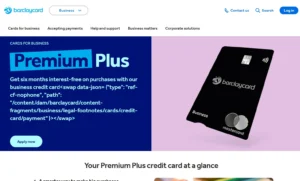
14. Barclaycard Premium Plus Business Credit Card
Check the Barclaycard Credit Card Here
Best Business Credit Card for a Planned Large Purchase
- Annual fee: £150 per account
- Introductory purchase offer: 0% for six months from account opening
- Representative APR: Currently 54.3% variable on Barclaycard’s comparison page
- Purchase rate after promotion: Variable
- Cashback: 0.5%
Annual cashback cap: £400 - Foreign transaction fee: 0.99%
- Interest-free period after promotion: Up to 56 days when conditions are met
- Travel insurance: Included subject to policy terms
Premium Plus is unusual because its main attraction is not cashback.
It is the six-month 0% purchase offer.
That makes it potentially useful for a company planning a substantial expenditure immediately after opening the account.
Examples could include:
- Computer equipment
- Marketing campaigns
- Stock
- Furniture
- Professional equipment
- Office fit-out items or
- Other eligible business purchases.
Barclaycard also pays 0.5% cashback, capped at £400 a year, and currently charges a reduced 0.99% non-sterling transaction fee.
When Can £150 Be Worth Paying?
Assume a company needs £20,000 of equipment.
If another financing facility would charge meaningful interest over six months, the value of Premium Plus’s introductory purchase period can exceed the £150 annual account fee.
That is where this card becomes interesting.
The Danger
The 0% period ends.
A business that enters the six-month period without a realistic repayment plan risks moving from inexpensive short-term finance into much more costly revolving debt.
The current representative APR is high partly because the £150 fee forms part of the representative calculation.
Cashback Limit
0.5% cashback capped at £400 means the maximum annual cashback is reached once qualifying spending reaches £80,000.
Higher spending will not keep increasing the reward.
Our verdict: 3.9/5
Very useful for a planned purchase with a defined six-month repayment strategy; less compelling as an ordinary everyday cashback card.
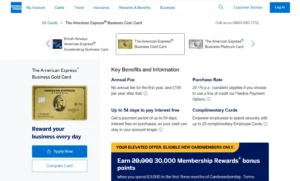
15. American Express Business Gold Card
Check the American Express Credit Card Here
Best Business Card for Flexible Membership Rewards
- Annual fee: £0 in the first year
- Annual fee afterwards: £195
- Rewards: 1 Membership Rewards point per eligible £1
- Amex Travel: 2 points per eligible £1 under current terms
- Interest-free period: Up to 54 days
- Flexible Payment Option rate: 29.1% variable
- Employee cards: Up to 20 complimentary cards
- Business type: Current new applications are aimed at eligible UK limited companies and LLPs
American Express significantly changed the structure of Business Gold in January 2026.
For applications made from 28 January 2026, the card includes a Flexible Payment Option.
That means an eligible amount no longer necessarily has to be paid in full every month. Businesses can pay the full statement, the minimum due or an amount in between, with interest applying when the Flexible Payment Option balance is carried.
The current purchase rate applying to Flexible Payment Option borrowing is 29.1% variable.
Membership Rewards
Business Gold earns one Membership Rewards point for each eligible £1 spent and enhanced points on qualifying American Express Travel bookings.
Membership Rewards is valuable because points are flexible.
Depending on the current programme and redemption option, points can potentially be moved into travel partners rather than locking the company into one airline.
Employee Cards
Businesses can add up to 20 complimentary employee cards under the current proposition.
That can make the £195 fee after year one more reasonable for a team than a business card charging £30 to £70 for every employee.
Who Should Choose Gold?
Business Gold makes the most sense for a company that:
- Clears most spending in full
- Places a meaningful level of expenditure on Amex
- Understands membership rewards
- Has employees needing cards
- Values travel-related features and
- Will generate enough value after year one to justify £195.
Amex Acceptance
American Express acceptance has improved substantially but remains less universal than Visa or Mastercard.
A business should check its biggest suppliers before making Amex its only payment card.
Our verdict: 3.9/5
A flexible rewards option for incorporated businesses with meaningful Amex-eligible spending.
16. British Airways American Express Accelerating Business Card
Check the British Airways Credit Card Here
Best Business Credit Card for Avios
- Annual fee: £250
- Purchase rate: Variable
- Representative APR: High because of annual fee
- Avios earning: 1.5 Avios per eligible £1 until 6 October 2026
- New earning rate: 1.25 Avios per eligible £1 from 7 October 2026
- Annual spending bonuses: Available under current programme rules
- Sole traders: Eligible subject to criteria
- BA benefits: Designed around Avios and British Airways-related rewards
This card is designed for one specific type of business owner: somebody who understands and uses Avios.
At the time of this review, it earns 1.5 Avios for every eligible £1 spent, but that changes on 7 October 2026, when the standard rate falls to 1.25 Avios per £1.
Businesses using old comparison articles should therefore be careful because the earning rate shown in an older review may become inaccurate almost immediately.
Annual Avios Bonuses
Under the revised structure, businesses can still earn additional Avios when annual expenditure reaches specified thresholds.
That can increase the effective reward for companies capable of concentrating significant expenditure on the card.
The £250 Question
A £250 annual membership fee needs to be recovered.
The correct calculation is:
Value of Avios actually redeemed + other benefits used − £250 annual fee − any avoidable card costs
A director who regularly redeems Avios for valuable flights or upgrades can extract considerably more value than somebody who accumulates points without a plan.
Sole-Trader Advantage
One important difference from Capital on Tap is accessibility to eligible sole traders.
That makes the BA card particularly notable for self-employed professionals who want a travel-rewards business card.
Main Drawbacks
The business needs to deal with:
- £250 annual membership fee
- Amex acceptance limitations
- Variable value of avios
- Changing programme terms and
- A lower standard earning rate from 7 October 2026
Our verdict: 3.8/5
One of the best specialist cards for Avios-focused businesses, but poor value if British Airways and Avios are not already part of the company’s travel strategy.
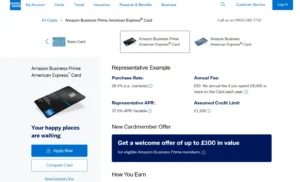
17. Amazon Business Prime American Express Card
Check the Amazon Credit Card Here
Best Business Card for Amazon Business Prime Customers
- Annual fee: £50
- Fee waiver: Available after £8,000 of annual card spending
- Purchase rate: 26.4% variable
- Representative APR: 37.6% variable
- Amazon reward: 2% on qualifying Amazon spending within the applicable annual band
- Other purchases: 0.5%
- Alternative benefit: Up to 90-day extended payment terms on eligible Amazon purchases instead of rewards
- Eligibility: Includes eligible sole traders and small businesse
- Amazon Business Prime: Required for this version
For a company that buys heavily through Amazon Business, a general 1% cashback card may not automatically be the best option.
The Amazon Business Prime American Express card offers 2% Amazon Rewards on eligible UK Amazon spending up to the programme’s applicable annual expenditure threshold, with 1% thereafter.
Other eligible purchases earn 0.5%.
Businesses can also choose extended payment terms on individual eligible Amazon transactions instead of earning the reward.
Annual Fee Can Disappear
The annual membership charge is £50.
However, American Express currently waives that fee where annual card expenditure reaches at least £8,000 under the relevant terms.
For a genuine business user, £8,000 can be a fairly low threshold.
Example
Imagine an ecommerce business spending £40,000 per year on qualifying Amazon Business purchases.
At 2%, that could generate approximately £800 of Amazon Rewards, subject to current eligibility and programme terms.
A generic 1% cashback card would generate about £400 on the same £40,000.
The Amazon card could therefore provide significantly more value if all of that spending qualifies and Amazon Rewards are genuinely useful to the company.
Extended Payment Option
Instead of rewards, businesses can select extended payment terms for qualifying Amazon purchases.
That gives the card a useful cash-flow dimension for companies buying stock or equipment.
Main Weakness
The 0.5% reward rate outside Amazon is ordinary.
A business might therefore use this as a specialist Amazon card alongside another Visa or Mastercard for everyday spending.
Our verdict: 3.8/5
Excellent in its niche and potentially one of the most rewarding cards for a heavy Amazon Business Prime user.
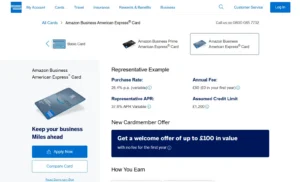
18. Amazon Business American Express Card
Check the Amazon Credit Card Here
Best Amazon Card Without Business Prime
- Annual fee: £0 in year one
- Later annual fee: £50
- Purchase rate: 26.4% variable
- Representative APR: 37.6% variable
- Amazon Rewards: 1.5% on eligible Amazon purchases within the annual threshold
- General spending: 0.5%
- Sole traders: Potentially eligible subject to terms
- Amazon Business Prime membership: Not required
The standard Amazon Business American Express Card follows the same basic idea as the Prime version but with a lower Amazon reward rate.
Businesses currently earn 1.5% Amazon Rewards on eligible Amazon expenditure up to the specified annual spending threshold and 0.5% on eligible expenditure elsewhere.
Prime or Non-Prime?
A company should compare:
- How much it spends through Amazon
- Whether it already pays for Amazon business prime
- The difference between 1.5% and 2%
- Annual card fees and
- The wider benefits of prime membership.
At £50,000 of eligible Amazon expenditure:
- 1.5% = £750
- 2% = £1,000
That £250 reward difference alone can materially influence the decision.
First-Year Value
There is no annual membership fee in the first year on the standard card under the current offer.
That makes it relatively easy for an eligible business to assess whether it generates enough value before the £50 annual charge begins.
Main Limitation
Like the Prime card, this is a specialist proposition.
A business rarely using Amazon has little reason to choose it over a stronger general-purpose card.
Our verdict: 3.7/5
Good for consistent Amazon expenditure where Business Prime is not required.
19. Capital on Tap Pro
Check the Capitalontap Pro Credit Card Here
Best Premium Visa Business Rewards Card
- Annual fee: £299
- Standard cashback: 1%
- Preloaded-funds cashback: 1.25%
- Avios/Virgin Points conversion: Enhanced 1:1 conversion on Pro
- Airport lounges: Unlimited main-cardholder access under current Priority Pass proposition
- Guest passes: Two complimentary guest visits under current terms
- FX fee: £0
- Credit limit: Potentially up to £250,000
- Employee cards: Free employee cards available
- Other benefits: Radisson Rewards VIP status and additional premium features
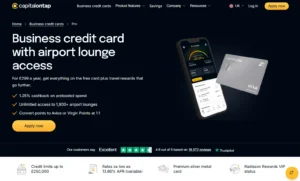
Capital on Tap Pro is not a completely different underlying credit facility from the standard Capital on Tap proposition.
It is the premium £299-a-year tier.
The important question is therefore not whether Pro is good.
It is whether Pro provides £299 more annual value than the already excellent free version.
Capital on Tap currently adds benefits including enhanced 1:1 Avios and Virgin Points conversion, 1.25% cashback on spending from preloaded balances and extensive Priority Pass lounge access for the main cardholder.
Why Preloading Matters?
Preloading allows a business to put its own money onto the card before spending.
This can allow purchases above the ordinary credit limit while continuing to earn rewards.
For Pro customers, qualifying spending from preloaded funds earns 1.25% cashback.
Cashback Break-Even
If we looked only at the extra 0.25 percentage point on preloaded spending:
£299 ÷ 0.25% = approximately £119,600
So a business would need very substantial preloaded spending to justify the entire fee purely through the additional 0.25%.
That is why Pro should normally be evaluated through the whole benefit package, particularly:
- Airport lounge use
- Better airline-points conversion
- Travel benefits
- Welcome bonus where eligible and
- Other premium services.
Who Should Choose It?
A London consultant flying several times per month could potentially recover £299 through travel benefits.
A local trades company whose owner flies once every three years probably will not.
Our verdict: 3.7/5 overall, potentially much higher for frequent travellers
The free Capital on Tap card remains better value for most businesses, while Pro is a compelling upgrade for the right travel-heavy user.
20. American Express Business Platinum Card
Check the American Express Credit Card Here
Best Premium Business Travel Card
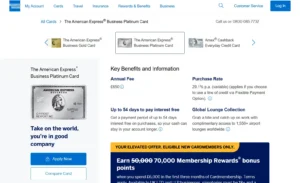
- Annual fee: £650
- Rewards: Membership Rewards
- Flexible Payment Option: Available to qualifying new-card structure
- Borrowing rate under FPO: 29.1% variable under current terms
- Employee cards: One complimentary Platinum employee card plus multiple Gold employee cards under current arrangements
- Travel focus: Airport lounges, insurance and premium travel benefits
- Foreign transaction fee: Applies under Amex terms
- Eligibility: Current structure aimed at qualifying incorporated businesses
At £650 per year, American Express Business Platinum is not a card that should be chosen casually.
The annual fee immediately makes it inappropriate for many microbusinesses.
The card is designed for high-spending businesses whose directors and employees can extract significant value from premium travel benefits.
New Gold and Platinum business applications from 28 January 2026 include American Express’s Flexible Payment Option, meaning eligible balances can be carried rather than automatically requiring every pound to be cleared monthly.
Why Businesses Pay £650?
The attraction is not the basic rate of Membership Rewards points alone.
Businesses are primarily paying for a wider package including travel features, lounge access, employee-card options, insurance benefits and premium services.
The Correct Way to Value Platinum
Do not add up the advertised retail value of every theoretical perk.
Instead ask:
What would the business genuinely have paid for anyway?
If the directors already buy airport lounge memberships and frequently use covered travel benefits, part of the £650 can be viewed as replacing existing expenditure.
If nobody in the company travels, assigning £500 of theoretical value to airport facilities would be meaningless.
Business Gold vs Platinum
Gold costs £195 after the first year.
Platinum costs £650.
That creates a £455 annual premium.
A company should therefore identify at least £455 of additional realistic Platinum value before upgrading solely from Gold.
Main Drawbacks
- Very high annual fee
- Amex acceptance limitations
- Foreign transaction charges
- Premium benefits may go unused
- Points alone normally do not justify the price and
- Carrying a balance at 29.1% can become costly.
Our verdict: 3.6/5
For a typical SME, much higher for a genuine frequent-travel business
Best Business Credit Cards by Business Type
The top-20 ranking is useful, but choosing by business profile can be more practical.
| Business Requirement | Our Starting Choice |
| Best overall incorporated SME | Capital on Tap |
| Highest introductory cashback | Funding Circle Cashback |
| Sole trader | Barclaycard Select Cashback |
| Newly incorporated company | iwoca |
| Lower-cost borrowing | Lloyds |
| Existing Santander business | Santander Business Cashback |
| No annual fee with high-street bank | Metro Bank |
| Fuel and trade supplies | NatWest Business Plus |
| Existing Virgin Money business | Virgin Money |
| Existing HSBC customer | HSBC Commercial |
| Six-month planned purchase | Barclaycard Premium Plus |
| Flexible points | Amex Business Gold |
| Avios | BA Accelerating Business Amex |
| Amazon Business spending | Amazon Business Prime Amex |
| Premium Visa travel rewards | Capital on Tap Pro |
| Premium international travel | Amex Business Platinum |
Best Business Credit Card for Cashback
For pure cashback, we would narrow the field to four cards.
Funding Circle Cashback
The strongest promotional proposition:
2% for six months up to the promotional cap, then 1%.
Capital on Tap
The strongest simple long-term proposition:
1% unlimited cashback with no annual fee.
Santander Business Cashback
Strong for an existing Santander customer:
1% cashback with a relatively small £30 annual account charge.
Virgin Money
Another 1% option, particularly for existing Virgin Money customers.
The correct choice depends on eligibility and annual spending.
Business Credit Card Cashback Examples
Suppose a business pays the full balance every month and all spending qualifies.
| Annual Spend | 0.5% Cashback | 1% Cashback | 1.5% Cashback | 2% Cashback |
| £12,000 | £60 | £120 | £180 | £240 |
| £25,000 | £125 | £250 | £375 | £500 |
| £50,000 | £250 | £500 | £750 | £1,000 |
| £100,000 | £500 | £1,000 | £1,500 | £2,000 |
| £250,000 | £1,250 | £2,500 | £3,750 | £5,000 |
The table demonstrates why card fees matter less as spending rises.
A £30 annual membership fee is substantial against £120 of cashback.
It is almost irrelevant against £2,500.
However, spending should never be increased merely to earn rewards.
Best Business Credit Card for Sole Traders
Sole traders face a narrower market.
Capital on Tap excludes sole traders, and several specialist finance products are designed around incorporated companies.
Three particularly useful options are therefore:
- Barclaycard Select Cashback for straightforward everyday cashback.
- British Airways Accelerating Business American Express for Avios-focused sole traders.
- Amazon Business American Express cards for self-employed businesses with substantial Amazon expenditure.
Legal structure therefore needs to be checked before comparing reward rates.
A founder who is still deciding whether to operate as a sole trader or company can use our broader guide to starting a small business in the UK before structuring business banking and borrowing.
Best Business Credit Card for a Limited Company
Limited companies have the widest range of options.
Our starting shortlist would be:
- Capital on Tap – best overall.
- Funding Circle Cashback – strongest introductory cashback for an eligible established company.
- iwoca – particularly interesting for newer businesses.
- Lloyds – attractive where a lower borrowing cost is more important.
- Amex Gold – useful where travel rewards and employee cards matter.
Best Business Credit Card for a New Business
A newly incorporated company should not apply indiscriminately to multiple lenders.
Some cards require:
- Minimum turnover
- Established trading history
- An existing business bank account
- Strong company credit
- Director information or
- Personal guarantees.
iwoca is particularly interesting because it positions its card towards businesses needing a flexible credit facility without large recurring fees.
Capital on Tap may also be available where the applicant satisfies its eligibility requirements.
The objective should be to obtain an appropriate facility rather than simply the largest possible credit limit.
Best Business Credit Card for Overseas Spending
Foreign transaction fees can completely alter the ranking.
Consider £30,000 of annual foreign-currency purchases.
At a 2.99% foreign transaction fee:
£30,000 × 2.99% = £897
Even if that card pays 1% cashback:
£30,000 × 1% = £300
The business could still be approximately £597 worse off before accounting for annual fees or exchange-rate effects.
Cards particularly worth comparing for international purchases include:
- Capital on tap
- Funding circle cashback
- Iwoca
- Santander business cashback
- Natwest business plus and
- Rbs business plus.
Check the precise current terms before travelling because cash withdrawals may still carry fees even where overseas purchases do not.
Best Business Credit Card for Fuel
Fuel-intensive companies should compare enhanced category rewards rather than general cashback alone.
NatWest Business Plus
Currently offers up to 3% cashback at eligible fuel and electric-vehicle charging providers.
RBS Business Plus
Also provides enhanced category cashback.
Lloyds Business Credit Card
Pays 1% on qualifying fuel and charging expenditure.
Standard NatWest and RBS Cards
Also provide 1% at qualifying fuel and EV charging providers.
A haulage, property-maintenance or construction business could therefore reach a different conclusion from an office-based company.
Best Business Credit Card for Avios
Three products deserve particular attention.
British Airways Accelerating Business Amex
Best where the company’s reward strategy is explicitly built around British Airways and Avios.
Capital on Tap Free
Rewards can be converted into Avios, although the free tier conversion ratio differs from Pro.
Capital on Tap Pro
Offers enhanced 1:1 Avios conversion under the current Pro programme.
The value of an Avios point is not fixed.
Its real value depends on redemption.
A business should therefore compare the flight or upgrade it genuinely intends to book rather than assigning an arbitrary cash value to thousands of unused points.
Best Business Credit Card for Employee Expenses
Companies issuing cards to employees should look beyond the headline annual account fee.
Ask:
- Is the fee per account or per cardholder?
- Can individual employee limits be set?
- Can cards be frozen instantly?
- Are transactions visible in real time?
- Does the card integrate with accounting software?
- Can virtual cards be created?
- Are receipts easy to capture?
- Can expenditure categories be restricted?
A £70 annual card fee becomes £700 when ten employees need cards.
That can completely change which provider is cheapest.
Capital on Tap’s free employee-card approach is therefore a major advantage for expanding teams.
Santander is also notable because its £30 annual charge applies to the account rather than separately to each permitted cardholder.
Business Credit Card vs Charge Card: What Is the Difference?
This is one of the biggest content gaps in many business-card comparisons.
A business credit card normally provides revolving credit.
If the company cannot repay the full statement balance, it can usually pay at least the minimum and carry the remainder, with interest charged according to the agreement.
A traditional charge card requires the statement balance to be cleared in full according to its payment cycle.
A debit card spends money already held in the company’s bank account.
An expense card can describe several different arrangements and may be debit, prepaid, charge-style or connected to another finance facility.
These products should not automatically be compared as though they are identical.
American Express adds another complication.
From 28 January 2026, new Business Gold and Business Platinum applications include its Flexible Payment Option, giving eligible spending a revolving-credit element that older Amex business charge-card accounts did not have.
Should a Business Choose Rewards or Low Interest?
This comes down to one question:
Will the statement normally be cleared in full?
If yes, interest rates become much less important because purchase interest may never be charged.
The business can concentrate on:
- Cashback
- Rewards
- Annual fees
- Fx charges
- Employee cards
- Accounting integration and
- Travel benefits.
If no, the ranking changes.
APR becomes one of the most important features.
Example
Suppose a business has £40,000 annual card spending and earns 1% cashback.
Annual cashback = £400
Now suppose the business carries an average £10,000 balance and pays approximately £2,500 of interest over the year.
The £400 cashback has not made the borrowing inexpensive.
It has merely reduced a much larger financing cost.
Cashback should never be used to rationalise expensive debt.
How Much Should You Spend to Justify an Annual Fee?
A simple formula is:
Annual card fee ÷ additional reward rate = spending required to recover the fee
Suppose:
- Free Card = 1% cashback
- Premium Card = 1.5%
- Premium fee = £300
- Additional reward = 0.5%
- £300 ÷ 0.5% = £60,000
The business would need £60,000 of qualifying expenditure simply to recover the £300 fee through the extra 0.5% reward.
Only spending above that point creates an incremental cashback advantage.
Travel perks can change the calculation, but only when the business genuinely uses them.
Do You Need a Business Bank Account to Get a Business Credit Card?
You will usually need appropriate banking arrangements to make repayments, but that is different from needing an account with the card provider itself.
Cards such as Capital on Tap, Funding Circle and Barclaycard can be used without moving the company’s primary banking relationship to that provider.
Traditional banks frequently require an existing account.
Examples include:
- Lloyds
- NatWest
- RBS
- HSBC
- Santander
- Virgin Money and
- Metro Bank.
This is important because changing a business bank account can affect:
- Direct debits
- Accounting feeds
- Payroll
- Supplier payments
- Customer details
- Overdraft arrangements
- Cash banking
- International payments and
- Staff permissions.
Businesses should therefore compare the whole banking proposition rather than switching solely for a card.
What Credit Limit Can a Business Get?
There is no universal business credit limit.
Some providers advertise potential facilities reaching £250,000, while high-street products can have much lower published maximums.
The limit offered can depend on:
- Turnover
- Profitability
- Available cash
- Trading history
- Existing borrowing
- Payment history
- Business credit profile
- Director information
- Sector
- Bank-account conduct and
- Lender underwriting.
A lender advertising “up to £250,000” is not promising £250,000 to every applicant.
A newly incorporated microbusiness may receive a small fraction of the maximum.
Do Business Credit Cards Affect Personal Credit?
They can.
Business cards do not exist entirely in isolation from their owners and directors.
Depending on the provider and structure, the application process may involve:
- Business credit searches
- Personal soft searches
- Personal hard searches
- Director checks
- Shareholder check and
- Personal guarantees.
The precise impact varies by lender.
This is another reason not to submit multiple speculative applications within a short period.
Where available, an eligibility checker using a soft search can help a business assess its prospects before making a full application.
What Is a Personal Guarantee?
A personal guarantee is an agreement under which an individual agrees to become personally responsible for business borrowing if the company does not meet its obligations.
That is particularly important for limited-company directors.
Limited liability does not automatically mean that every business loan, credit card or finance agreement can fail without personal consequences.
Where a card requires a personal guarantee, directors should understand:
- What debt is guaranteed
- Whether liability is capped
- When the lender can pursue the guarantor
- What happens if the director leaves the company
- How the guarantee can be released and
- Whether independent legal advice is appropriate.
Do not sign a personal guarantee simply because the online application describes it as a routine formality.
Can a Business Credit Card Help Build Business Credit?
Potentially.
Responsible use of business borrowing can contribute to a company’s wider credit history where the provider reports information to commercial credit-reference systems.
Helpful behaviours normally include:
- Making payments on time
- Staying within agreed limits
- Avoiding persistent arrears
- Maintaining stable company information and
- Borrowing proportionately.
However, taking unnecessary debt purely to “build credit” is not sensible.
A company’s broader creditworthiness can also be affected by accounts, payment history, CCJs, filing records, existing borrowing and other commercial information.
Can Business Credit Card Fees Be Tax Deductible?
Some legitimate financial costs can be deductible when the relevant tax rules are satisfied.
For self-employed businesses, HMRC specifically lists qualifying bank, overdraft and credit-card charges among potential allowable business financial costs.
For limited companies, deductible revenue expenditure generally needs to satisfy the applicable business-purpose rules and must not be specifically disallowed.
This does not mean every card transaction is tax deductible.
There is an important difference between:
- Making payments on time
- Staying within agreed limits
- Avoiding persistent arrears
- Maintaining stable company information and
- Borrowing proportionately.
- Businesses should record each element properly.
Can Employees Use a Company Credit Card for Personal Spending?
A company should normally have a clear employee-card policy.
HMRC reporting can become relevant when employees use employer-provided credit, debit or charge cards, particularly where the purchase is private or is not clearly being made on the employer’s behalf.
A sensible internal policy should cover:
- Permitted categories
- Prohibited personal use
- Receipt requirements
- Spending limits
- Travel expenses
- Subscription
- Fuel
- Client entertainment
- Refunds
- Lost cards and
- Consequences of misuse.
Expense controls become increasingly important as the company grows.
Can You Pay HMRC With a Business Credit Card?
HMRC accepts certain payments online using a corporate credit card or corporate debit card, but fees apply to corporate card payments.
A personal credit card cannot be used for those tax payments.
HMRC says the applicable corporate-card payment fee is non-refundable.
Businesses should therefore calculate whether card rewards exceed the processing fee before paying tax simply to earn cashback or points.
Do Business Credit Cards Have Section 75 Protection?
Businesses should not assume that a commercial card provides the same Consumer Credit Act protection that somebody may associate with a personal credit card.
The contractual and statutory protections applicable to business purchases can differ according to:
- Agreement type
- Legal business structure
- Borrower
- Transaction and
- Whether the agreement is regulated.
For expensive equipment, software or supplier purchases, check the actual protection included by the card issuer.
Do not rely on a generic statement that “credit-card purchases are protected.”
Should You Use a Personal Credit Card for Business Expenses?
It can sometimes be technically possible, particularly for a sole trader, but regularly mixing personal and business transactions creates unnecessary administration.
A dedicated business card gives the accountant or bookkeeper a much cleaner audit trail.
It also simplifies:
- Vat records
- Expense categorisation
- Employee spending
- Cash-flow analysis
- Year-end accounts
- Receipts
- Management reporting and
- Evidence of the company’s expenditure.
For a limited company, maintaining a clear separation between company money and directors’ private expenditure is particularly important.
How to Choose the Best Business Credit Card?
A business should work through the decision in a logical sequence rather than beginning with cashback.
Step 1: Check Business-Structure Eligibility
Confirm whether the provider accepts:
- Sole traders
- Partnerships
- Llps
- Limited companies
- Plcs
- Charities or
- Unincorporated organisations.
There is no point comparing a card the business cannot obtain.
Step 2: Check Bank-Account Requirements
Determine whether an existing current account is required.
If changing bank would be necessary, assess the banking proposition as well as the card.
Step 3: Decide Whether the Balance Will Be Cleared
If the company reliably pays in full, concentrate more heavily on rewards and fees.
If the company will borrow, concentrate on APR.
Step 4: Calculate Annual Card Spend
Use real accounts rather than guessing.
Review the previous 12 months and identify expenditure that could safely have been placed on the card.
Step 5: Separate UK and Overseas Spending
This exposes how significant FX fees could become.
Step 6: Calculate Net Rewards
Use:
Qualifying annual spend × cashback rate − annual fees − FX fees = approximate net reward
Then account for reward caps and exclusions.
Step 7: Check Employee Requirements
Calculate how many people need cards.
A £70 card fee that looks small for one director may become £700 for a ten-person team.
Step 8: Review Accounting Integration
A business processing hundreds of transactions can save administrative time through bank feeds, automatic categorisation and receipt-management tools.
Step 9: Read the Credit Agreement
Check:
- Purchase APR
- Annual fee
- Cash fees
- Fx fees
- Minimum payment
- Introductory rate
- Promotional expiry
- Personal guarantee
- Late-payment consequences
- Credit limit and
- Excluded reward transactions.
Step 10: Apply Selectively
Use eligibility tools where available.
Avoid repeatedly submitting applications to multiple lenders merely to see which provider offers the largest limit.
Which Business Credit Card Would We Choose?
After comparing the major UK options, our choices would be:
For a typical UK limited company paying in full
Capital on Tap Business Credit Card
The combination of no annual fee, 1% uncapped cashback, no foreign-exchange fee, employee cards and no mandatory bank switch gives it the broadest appeal.
For maximum first-year cashback
Funding Circle Cashback Business Credit Card
The six-month 2% promotional cashback makes it particularly attractive for an established, high-spending limited company.
For a sole trader
Barclaycard Select Cashback
The absence of a Barclays business-bank-account requirement and broader business-structure eligibility make it a practical choice.
For a newly established limited company
iwoca Credit Card
No annual or FX fee and a model designed to consider younger businesses make it worth investigating.
For lower-cost borrowing
Lloyds Bank Business Credit Card
The lower purchase rate can be more valuable than cashback where a balance will occasionally remain outstanding.
For overseas business spending
Start with:
Capital on Tap, Funding Circle, iwoca, Santander Business Cashback, NatWest Business Plus and RBS Business Plus.
Then compare their precise eligibility and reward structures.
For fuel-heavy businesses
NatWest Business Plus
Up to 3% cashback in eligible fuel and EV charging categories can be valuable where vehicle spending is substantial.
For Avios
British Airways American Express Accelerating Business Card
But calculate whether the Avios earned genuinely outweigh the £250 annual fee and remember that its standard earn rate changes on 7 October 2026.
For Amazon-heavy businesses
Amazon Business Prime American Express
Its 2% reward on qualifying Amazon purchases can beat general-purpose 1% cashback for businesses buying heavily through Amazon.
For premium travel
Capital on Tap Pro for a premium Visa-based proposition or American Express Business Platinum for businesses that can make extensive use of premium Amex travel benefits.
Final Verdict: What Is the Best Business Credit Card in the UK?
There is no single best business credit card for every UK company.
But there are clear winners for different circumstances.
For many incorporated SMEs, Capital on Tap Business Credit Card is our number-one overall choice.
It offers the combination most businesses can actually use:
- No annual fee
- Unlimited 1% cashback
- No foreign-exchange fee on purchases
- Potentially substantial credit limits
- Free employee cards
- Travel-reward conversion and
- No requirement to move the company’s main current account.
Funding Circle Cashback comes extremely close and can produce more cashback during the first year for an eligible established limited company.
Barclaycard Select Cashback is particularly important for sole traders and businesses wanting a card without moving bank.
iwoca fills an important gap for newer companies.
Traditional banks such as Lloyds, Santander, HSBC, NatWest, RBS, Virgin Money and Metro Bank remain highly relevant where businesses already hold their current accounts there or where borrowing costs matter more than headline rewards.
The biggest mistake is therefore to search for the card with the highest cashback percentage and stop there.
The correct question is:
Which business credit card produces the lowest total cost and greatest usable value for the way this particular business actually spends and repays money?
For a company that clears its balance every month, that might mean cashback, Avios or travel benefits.
For a company carrying debt, it might mean the lowest achievable interest rate.
For an international business, avoiding a 2.99% FX fee could be worth more than the entire rewards programme.
And for a growing employer, free employee cards and automated accounting may ultimately save more than another fraction of a percentage point of cashback.
That is the basis on which a UK business should choose its credit card in 2026.
Frequently Asked Questions
What is the best business credit card in the UK?
Capital on Tap is one of the strongest all-round options for eligible UK limited companies because it offers unlimited 1% cashback, no annual fee and no FX fee on purchases.
What is the best business credit card for a sole trader?
Barclaycard Select Cashback is a strong starting option because eligible sole traders can apply and a Barclays business bank account is not required.
Which business credit card offers the highest cashback?
Funding Circle currently offers 2% cashback during the first six months, capped at £2,000 of introductory cashback, before moving to 1% uncapped cashback.
Can a new limited company get a business credit card?
Yes, although approval depends on the provider. iwoca is particularly worth examining because its business card proposition can accommodate businesses without the lengthy trading history required by some lenders.
Are there business credit cards with no annual fee?
Yes. Capital on Tap, Funding Circle, iwoca, Barclaycard Select Cashback and Metro Bank Business Credit Card are examples of products currently advertising no annual membership fee under their standard terms.
Can I get a business credit card without changing business bank?
Yes. Options include Capital on Tap, Funding Circle, iwoca and Barclaycard. Many high-street bank cards, however, require an existing current account with that bank.
What is the best business credit card for cashback?
Funding Circle has the stronger introductory cashback rate, while Capital on Tap has one of the simplest long-term propositions at 1% uncapped with no annual fee.
What is the best business credit card for overseas spending?
Cards worth comparing include Capital on Tap, Funding Circle, iwoca, Santander Business Cashback, NatWest Business Plus and RBS Business Plus because their current propositions remove foreign transaction fees on qualifying overseas purchases.
What is the best business credit card for Avios?
The British Airways Accelerating Business American Express Card is designed specifically around Avios. Capital on Tap also allows reward conversion into Avios.
What is the best business credit card for fuel?
NatWest Business Plus is particularly attractive because it currently offers up to 3% cashback at eligible fuel and EV charging providers, subject to its annual cashback cap.
Can business credit card fees be claimed as an expense?
Qualifying business-related credit-card charges can potentially be allowable expenses. HMRC specifically lists eligible credit-card charges among financial costs that self-employed businesses may claim.
Does a business credit card affect personal credit?
It can. Providers may check directors or owners and may require personal guarantees. The exact effect depends on the lender, company structure and type of credit search.
Can employees have business credit cards?
Yes. Many providers offer employee or supplementary cards, although some charge an annual fee for every additional card while others provide them without an extra membership fee.
Is 1% cashback worth having on a business card?
It can be. £100,000 of qualifying annual expenditure generates £1,000 at a 1% rate. However, interest and FX charges can easily exceed the reward if the card is not used carefully.
Should a business credit card be paid in full every month?
Where cash flow allows, clearing the statement in full generally avoids purchase interest and makes rewards much more valuable. Companies deliberately borrowing should compare APR and alternative finance rather than focusing primarily on cashback.