





















Knowing how to avoid paying tax on rental income legally has become more important for UK landlords as the government prepares to increase property income tax rates from April 2027.
The Autumn Budget 2026 announced that landlords in England, Wales and Northern Ireland could face property income tax rates of 24%, 44% and 49% from 6 April 2027. These proposed rates are four percentage points above the standard 2026/27 rates.
However, landlords do not necessarily pay tax on every pound of rent they collect. The actual liability depends on rental profits, permitted expenses, tax allowances, mortgage financing and ownership arrangements.
Our analysis of the current HMRC framework identifies several legitimate opportunities to reduce taxable rental profits.
These include claiming eligible property expenses, using the £1,000 property allowance, benefiting from Rent a Room relief, carrying forward rental losses and reviewing the most suitable ownership structure.
The objective is not to conceal rental income, which is unlawful. It is to avoid paying more tax than HMRC legally requires.
How Much Tax Will Landlords Pay on Rental Income in 2027?
The biggest change is the introduction of separate property income tax rates.
The 2025 Budget originally proposed rates of 22%, 42% and 47%. However, the Autumn Budget announced on 28 October 2026 increased the proposed rates by another two percentage points.
| Property income tax band | 2026/27 rate | Announced 2027/28 rate |
| Basic rate | 20% | 24% |
| Higher rate | 40% | 44% |
| Additional rate | 45% | 49% |
| Increase | — | +4 percentage points |
These rates apply to property income falling within the relevant tax bands, not automatically to all rental receipts. They are subject to the Finance Bill 2026–27 framework. Scotland’s devolved tax position must be considered separately.
For example, a landlord with £15,000 of taxable rental profit falling entirely within the basic-rate band would face a simplified tax calculation of £3,000 in 2026/27 and £3,600 under the announced 2027/28 rate.
That represents an additional £600 annually, before any mortgage finance-cost tax reduction or other adjustments.
For investors managing multiple properties, we examined the implications of the portfolio landlord tax increase alongside changes to rental profitability and borrowing costs.
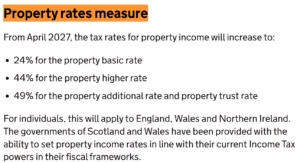
Autumn Budget 2026 confirms the planned property income tax rates of 24%, 44% and 49% from April 2027.
Which Legal Methods Can Reduce Rental Income Tax?
Before selecting a tax-saving strategy, landlords should establish which reliefs actually apply to their property business.
| Tax-saving method | Potential benefit | Most relevant for |
| £1,000 property allowance | Tax-free qualifying property income or a deduction in place of expenses | Small-scale landlords |
| Allowable expenses | Reduces taxable rental profit | Most buy-to-let landlords |
| Rent a Room Scheme | Up to £7,500 tax-free gross receipts | Resident landlords |
| Mortgage finance-cost relief | Reduces qualifying Income Tax liability | Mortgaged residential properties |
| Carried-forward losses | Offsets future property business profits | Landlords with previous losses |
| Joint ownership planning | Can allocate income according to genuine ownership | Couples and joint investors |
| Limited company | Different treatment of company profits and qualifying interest | Long-term property investors |
These methods are not interchangeable. Some cannot be combined, while others require changes to legal ownership or reporting arrangements.
How Can Landlords Use the £1,000 Property Allowance?
The property allowance is one of the simplest ways to receive small amounts of property income without paying Income Tax.
Individuals can generally receive up to £1,000 of qualifying gross property income per tax year tax-free, provided the statutory conditions are satisfied.
For example, someone receiving £800 annually for renting out an eligible parking space could potentially have the entire amount covered by the allowance.
Where gross property income exceeds £1,000, a landlord may be able to deduct the allowance instead of claiming actual expenses.
Consider two approaches for a property receiving £8,000 in annual rent.
| Calculation | Property allowance | Actual expenses |
| Gross rental income | £8,000 | £8,000 |
| Deduction | £1,000 | £650 |
| Taxable property income | £7,000 | £7,350 |
In this example, choosing the allowance produces £350 less taxable property income.
However, landlords cannot generally combine the £1,000 property allowance with actual property-business expense deductions. The allowance can also be unavailable where a residential finance-cost tax reduction is claimed.
Our assessment is that landlords with substantial maintenance, insurance or management costs should compare both methods before making an election.
The allowance applies per eligible individual, not separately to every property they own.
What Rental Property Expenses Can Landlords Legally Deduct?
For established buy-to-let businesses, accurate expense reporting is often more valuable than the £1,000 allowance.
HMRC generally allows expenditure incurred wholly and exclusively for the rental business, subject to the relevant property income rules.
The most common deductible costs include:
- Letting agent fees: Tenant-finding, management and rent-collection charges.
- Repairs: Fixing plumbing, roofs, heating systems and other existing property features.
- Insurance: Buildings, contents and qualifying landlord insurance premiums.
- Professional fees: Eligible accounting and legal expenses connected with the rental business.
- Service charges: Eligible leasehold service charges and ground rent.
- Utilities: Gas, electricity, water and Council Tax paid by the landlord where applicable.
- Property management: Cleaning, gardening, advertising and qualifying travel costs.
However, maintaining an existing property is different from substantially improving it.
Replacing a damaged kitchen with a broadly equivalent modern kitchen may qualify as a repair. Building an extension or adding a new room will generally be treated as capital expenditure.
The same distinction applies when landlords prepare properties for their first tenants. Some renovation work carried out before a property is suitable for letting may be capital rather than deductible repair expenditure.
How Much Can Proper Expense Claims Save?
Consider a landlord receiving £24,000 annually.
| Rental business calculation | Annual amount |
| Rental income | £24,000 |
| Letting agent fees | £3,000 |
| Insurance | £1,600 |
| Property repairs | £2,200 |
| Service charges | £900 |
| Eligible utilities | £700 |
| Total allowable expenses | £8,400 |
| Taxable rental profit | £15,600 |
Assuming all costs qualify, the landlord’s taxable profit is £15,600 before other reliefs.
Using the £1,000 allowance instead would produce £23,000 of property income for tax purposes.
That is £7,400 more taxable income. At the proposed 24% property basic rate, the difference would be £1,776 in tax, assuming it all falls within that band.
These calculations demonstrate why recording expenses accurately can produce greater savings than searching for complicated tax arrangements.
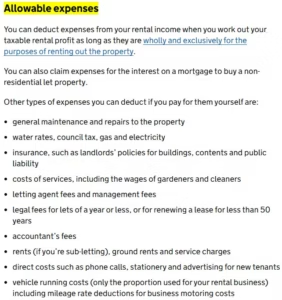
HMRC identifies the running costs and repairs that landlords may deduct from taxable rental income.
Can Mortgage Interest Reduce Rental Income Tax in 2027?
Mortgage interest relief remains one of the most significant areas of confusion for residential landlords.
Under the restrictions commonly called Section 24, individual landlords generally cannot deduct residential mortgage interest directly from property profits.
Instead, qualifying finance costs generate a basic-rate Income Tax reduction, subject to limits.
For 2026/27, this reduction is generally calculated at 20%. From April 2027, it is designed to follow the separate property basic rate, which the October 2026 Budget proposes to increase to 24%.
Consider a higher-rate landlord whose figures are:
| Financial details | Annual amount |
| Rental income | £20,000 |
| Eligible operating expenses | £6,000 |
| Taxable rental profit | £14,000 |
| Qualifying mortgage interest | £6,000 |
| Cash profit before tax | £8,000 |
Assuming the entire £14,000 falls within the higher-rate band and the full finance-cost reduction is available:
| Tax calculation | 2026/27 | Proposed 2027/28 |
| Property tax before finance relief | £5,600 | £6,160 |
| Finance-cost tax reduction | £1,200 | £1,440 |
| Net property-related Income Tax | £4,400 | £4,720 |
| Cash remaining after tax | £3,600 | £3,280 |
The calculation indicates an additional £320 tax liability annually under the proposed 2027 rules.
The important distinction is that the higher property income tax rate and the increased mortgage finance-cost reduction must be assessed together.
Actual relief depends on qualifying finance costs, property profits, adjusted income and other statutory restrictions. Mortgage capital repayments do not qualify as mortgage-interest expenditure.
When Can Rental Income Be Completely Tax-Free?
Paying no Income Tax is possible in certain circumstances, but the result must arise from genuine allowances, losses or the individual’s wider tax position.
One particularly valuable option is the Rent a Room Scheme.
A resident landlord letting furnished accommodation in their main home may receive up to £7,500 annually in gross receipts tax-free. The threshold generally falls to £3,750 per person where income from letting accommodation in the same property is shared.
For example, someone receiving £600 monthly from a qualifying lodger collects £7,200 annually.
That amount can fall entirely within the Rent a Room exemption.
If the annual receipts rise to £8,400, the landlord may be able to elect to pay tax only on the £900 above the £7,500 threshold, rather than calculate profits after expenses.
The appropriate method depends on actual expenditure.
Rent a Room relief does not generally apply to an ordinary buy-to-let property in which the landlord does not live.
Another possibility involves unused Personal Allowance. For 2026/27, the standard allowance is £12,570 for eligible individuals, subject to income-related restrictions.
A landlord with no other taxable income could potentially have rental profits covered by that allowance. Someone whose employment income already uses it cannot claim a second Personal Allowance for their property business.
For a broader explanation of the income threshold, see how much you can earn before paying tax.
Can Married Couples Pay Less Tax by Sharing Rental Income?
Joint ownership planning can affect how rental profits are taxed.
Married couples and civil partners living together are generally treated as receiving rental income equally from jointly owned property.
Where their beneficial interests in both the property and its income are genuinely unequal, they may be able to declare those shares to HMRC using Form 17.
For example, a genuine 80/20 beneficial ownership arrangement may support taxation on that basis where the relevant conditions and declaration requirements are satisfied.
However, simply sending rent into one partner’s bank account does not establish a different taxable ownership split.
Form 17 must normally reach HMRC within 60 days of the declaration, with appropriate evidence of beneficial ownership.
Changing ownership can also affect Capital Gains Tax, Stamp Duty Land Tax or devolved equivalents, mortgages and estate planning.
For that reason, this approach should be considered as a long-term ownership decision, not merely an annual tax-return adjustment.
Is a Limited Company Better for Rental Property Tax?
A limited company may offer a different tax outcome because qualifying company borrowing costs can generally be deducted when calculating taxable profits.
Companies also pay Corporation Tax instead of the individual property income tax rates.
For 2026/27, the headline Corporation Tax rates are generally 19% for qualifying small profits and 25% at the main rate, with marginal relief where applicable.
However, comparing 19% Corporation Tax with 44% personal property tax is misleading unless the entire financial structure is considered.
A company can face additional costs involving mortgage financing, administration, accounting and withdrawing profits as dividends or salary.
Transferring an existing property into a company can also trigger Capital Gains Tax, property transaction tax and refinancing expenses.
Our assessment is that incorporation deserves closer consideration when investors intend to retain profits for future property purchases rather than withdraw most of the rental income for personal spending.
Landlords exploring company registration should model the complete cost of incorporation rather than rely exclusively on headline tax percentages.
How Can Rental Losses Reduce Future Tax Bills?
A landlord may make a taxable loss if legitimate rental-business expenses exceed property income.
For example, a property business might generate a £4,000 allowable loss in 2026/27, followed by £10,000 of property profit in 2027/28.
Under the ordinary loss carry-forward rules, the earlier £4,000 loss could reduce the later taxable property profit to £6,000.
A landlord with multiple UK rental properties generally calculates the results together as one UK property business. Overseas property business results are normally treated separately.
Landlords cannot ordinarily deduct property losses directly from employment income, although limited statutory exceptions exist.
Keeping historic loss records is therefore important, particularly for landlords whose property businesses have experienced high maintenance costs or periods of vacancy.
What Changed for Holiday Let Landlords in 2026?
Landlords operating furnished holiday accommodation must also account for the abolition of the former Furnished Holiday Lettings tax regime.
That special regime ended from April 2025, removing several advantages previously associated with qualifying holiday lets.
These included more favourable finance-cost deductions, certain capital allowances and access to specific Capital Gains Tax reliefs.
Consequently, owners should not assume that ordinary investment property qualifies for Business Asset Disposal Relief merely because it is furnished or offered for short-term accommodation.
Replacement of Domestic Items Relief may still be available for qualifying replacement furniture and appliances, but initial furnishing costs and improvements require separate consideration.
What HMRC Reporting Changes Must Landlords Prepare for in 2027?
Making Tax Digital for Income Tax introduced mandatory digital reporting for the first qualifying group in April 2026.
The next phase begins on 6 April 2027.
| Relevant gross qualifying income | Mandatory start date |
| More than £50,000 in 2024/25 | 6 April 2026 |
| More than £30,000 in 2025/26 | 6 April 2027 |
| More than £20,000 in 2026/27 | 6 April 2028 |
The thresholds generally consider qualifying gross rental income and self-employment income combined, before expenses or tax allowances.
For example, someone receiving £24,000 in annual rent and £12,000 in qualifying self-employment turnover may fall within the April 2027 phase, even if their profits are substantially lower.
Affected landlords must maintain appropriate digital records, provide quarterly updates and complete their annual reporting using compatible software.
Selecting suitable accounting software can make expense tracking easier, although landlords should confirm that their chosen product supports their specific Making Tax Digital obligations.

HMRC’s Making Tax Digital timetable confirms the £30,000 qualifying income threshold from April 2027.
Which Rental Tax Mistakes Could Trigger HMRC Penalties?
Some landlords attempt to reduce tax through arrangements that create greater financial risks than the original tax bill.
In April 2026, HMRC warned about certain hybrid property structures involving partnerships, limited companies and mortgage-related transactions.
These arrangements may be marketed as ways to bypass mortgage-interest restrictions or shift taxable rental profits artificially.
HMRC has challenged the claimed benefits, warning that users could face unpaid tax, interest, penalties and professional costs.
The HMRC landlord tax loophole crackdown is particularly relevant to owners considering complex corporate or partnership structures.
Other mistakes include claiming private expenditure as a rental-business cost, incorrectly deducting mortgage capital repayments, treating improvements as repairs, and failing to disclose taxable rental income.
Where income from previous years has not been declared, HMRC’s Let Property Campaign offers a route for eligible landlords to bring their tax affairs up to date.
What Should Landlords Do Before April 2027?
Our analysis suggests landlords should focus on the financial decisions most likely to affect their actual tax liability.
| Priority | Action |
| Before the 2026/27 year-end | Review deductible expenses and outstanding records |
| Before choosing allowances | Compare the £1,000 allowance with actual expenses and finance-cost relief |
| Before purchasing property | Model personal ownership against limited-company ownership |
| Before changing joint ownership | Confirm beneficial interests and legal consequences |
| Before 6 April 2027 | Check the new property tax rates and Making Tax Digital eligibility |
| Before filing returns | Reconcile rental receipts, eligible expenses and carried-forward losses |
The most effective strategy is generally to calculate the true taxable property profit first, then apply legitimate reliefs and evaluate whether a structural change delivers a sustainable financial benefit.
Final Assessment
Avoiding unnecessary rental income tax in 2027 requires more than selecting the lowest tax rate. Allowable expenses, mortgage restrictions, existing losses, ownership arrangements and compliance obligations all influence the amount payable.
With the announced property income tax increases approaching, landlords should review their financial records and forecast their after-tax rental returns before making expensive ownership or investment decisions.
Tax information reflects published guidance and announcements available in November 2026. Individual circumstances, devolved legislation and subsequent Finance Bill changes may affect the final tax position.
Frequently Asked Questions
How Much Rental Income Can I Receive Tax-Free in 2027?
Qualifying property income of up to £1,000 may be tax-free under the property allowance. The £7,500 Rent a Room Scheme and unused Personal Allowance may also apply in different circumstances.
Can I Avoid Paying Tax on Rental Income if I Have a Mortgage?
Mortgage interest does not automatically eliminate taxable rental profit. Individual residential landlords generally receive a restricted finance-cost tax reduction rather than a direct deduction.
Do I Pay Tax if My Rental Property Makes No Profit?
Generally, no Income Tax arises on a genuine taxable property loss, although mortgage-interest restrictions can mean taxable profits differ from the property’s cash surplus.
Can I Claim a New Kitchen Against Rental Income?
Replacing an existing kitchen with a broadly equivalent modern kitchen may qualify as a repair. Substantial improvements or extensions are generally capital expenditure.
Will Rental Income Tax Increase in April 2027?
The October 2026 Budget announced property income tax rates of 24%, 44% and 49% for England, Wales and Northern Ireland from 6 April 2027, subject to the legislative framework.
Can I Put Rental Income in My Wife’s or Husband’s Name?
A change in the bank account receiving rent is not sufficient. Taxation normally follows the relevant ownership and beneficial entitlement rules, with Form 17 potentially required for unequal interests between spouses or civil partners.
Does HMRC Know About Undeclared Rental Income?
HMRC can obtain information from several sources and investigate discrepancies. Landlords should declare taxable rental income accurately and use legitimate disclosure arrangements where necessary.