





















The UK migrant settlement salary threshold for 2027 is expected to become one of the most significant changes to Britain’s immigration system, affecting thousands of skilled workers, employers and international professionals seeking permanent residence.
On 2 November 2026, Home Secretary Shabana Mahmood announced the government’s revised earned settlement framework.
Under the proposed system, migrants earning at least £50,271 annually could qualify for settlement after five years, while those earning £125,141 could qualify after three years. Most other eligible workers would face a standard ten-year pathway.
The government has also introduced a minimum earnings benchmark of £12,571, with exceptions for certain applicants and special arrangements for public service workers, families and existing care workers.
For businesses, the changes could influence salary negotiations, international recruitment, staff retention and long-term employment costs.
Our analysis of the latest Home Office response, immigration guidance and financial implications suggests that the most important question is no longer simply how much a migrant earns.
It is whether their immigration route, earnings history and employment circumstances collectively satisfy the requirements for settlement.
Important update: As of 6 November 2026, the revised earned settlement framework has been announced, but the detailed Immigration Rules have not yet been implemented. The government expects changes to take effect during 2027, and further technical guidance is awaited.
What Is the UK Migrant Settlement Salary Threshold for 2027?
The proposed framework establishes three principal earnings benchmarks, each associated with a different settlement pathway.
| Annual earnings benchmark | Proposed settlement pathway | Key condition |
| £12,571 | 10 years | Sustained economic contribution and other eligibility requirements |
| £50,271 | 5 years | Threshold met in three of the previous five years |
| £125,141 | 3 years | Threshold met in three of the previous four years |
| £25,000 | 5 years for qualifying existing care workers | Specific sponsorship, employment and transitional conditions |
| Below the earnings thresholds | Depends on individual circumstances | Some applicants qualify through public service, family connections or exemptions |
These figures relate to the government’s November 2026 earned settlement framework. They are not a replacement for every existing visa salary requirement.
The earnings benchmarks have been aligned with important UK tax thresholds. However, eligibility also depends on whether applicants meet the relevant immigration, residency, language, character and contribution requirements.
Why Is the £50,271 Threshold Important?
For many skilled workers, £50,271 is the most commercially significant figure.
It represents the proposed earnings level for accessing settlement after five years rather than the new standard ten-year period.
For example, a sponsored professional earning £45,000 may satisfy the salary requirements associated with their occupation but may not qualify for the proposed five-year earnings-based settlement pathway.
In contrast, an eligible worker consistently earning £52,000 could meet the income condition for accelerated settlement, provided the relevant earnings-history and other requirements are satisfied.
This distinction matters particularly for employers attempting to recruit and retain international professionals.
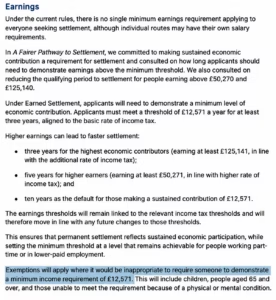
Home Office earned settlement salary thresholds announced in November 2026.
What Changed in the UK Migrant Settlement Rules in November 2026?
The November 2026 announcement revised several elements of the government’s original November 2025 proposals.
The most important change is the move towards a system where settlement eligibility is determined by sustained economic contribution, conduct and integration rather than residence alone.
| Policy area | Earlier position or proposal | November 2026 framework |
| Standard settlement period | Generally 5 years on many qualifying routes | Proposed default of 10 years |
| Higher earners | Usually standard route, unless another accelerated category applies | 5 years at £50,271 |
| Highest earners | Route-specific eligibility | 3 years at £125,141 |
| Some lower-skilled workers | Original proposal included a 15-year period | Revised default of 10 years |
| Qualifying healthcare and education professionals | Route-specific rules | 5-year pathway retained or introduced |
| Existing qualifying care workers | Transitional arrangements under consideration | Targeted 5-year protections |
| English language | B1 under many existing settlement rules | B2 for most applicants, with exemptions |
| Earnings assessment | Different arrangements across visa routes | Sustained contribution and best-years assessment |
The government received more than 200,000 consultation responses before publishing its revised approach.
Those responses raised concerns about salary differences between regions, the value of essential public service work, family responsibilities and the treatment of people already living in Britain.
The revised framework therefore recognises more than salary alone.
For employers, our assessment is that the withdrawal of the proposed 15-year pathway for some lower-skilled workers is particularly important.
A ten-year default would still be a substantial extension compared with five years, but it is approximately 33.3% shorter than the originally proposed 15-year period.
Home Secretary Shabana Mahmood summarised the government’s approach in her November 2026 announcement:
“Those who contribute most will settle fastest.”
However, that principle does not mean earnings alone guarantee settlement.
Will UK Migrants Need to Earn £50,271 to Get Permanent Residency?
No. The £50,271 threshold is associated with accelerated five-year settlement, not with every route to permanent residence.
Under the proposed framework, an eligible worker earning below £50,271 may still qualify after ten years, provided they satisfy the relevant minimum contribution and other requirements.
There are also alternative pathways for certain occupations and family categories.
For example:
- An eligible worker earning £35,000 may be on the standard ten-year pathway.
- An eligible professional earning £55,000 may qualify for the five-year pathway.
- A qualifying doctor or teacher may be eligible after five years without meeting the £50,271 earnings benchmark.
- An eligible partner of a British citizen may retain a five-year pathway under the applicable family rules.
A worker’s gross salary, taxable income, occupational going rate and immigration eligibility are not interchangeable concepts.
We recommend that employers assess these separately rather than treating the highest published settlement figure as a universal minimum salary.
How Is the New £50,271 Settlement Threshold Different From the Skilled Worker Visa Salary?
This is one of the most important distinctions for workers planning to apply for Indefinite Leave to Remain (ILR).
Under the current Skilled Worker settlement guidance in November 2026, applicants will usually need to earn at least the higher of:
- £41,700 annually or
- The standard going rate for their occupation.
Different rules apply to certain healthcare and education workers, Immigration Salary List occupations and workers covered by earlier sponsorship arrangements.
The proposed £50,271 earnings threshold serves a different purpose: determining whether an eligible migrant can qualify for an accelerated five-year pathway under the new model.
Example: A Skilled Worker Earning £45,000
Assume a worker earns £45,000 and the applicable occupation going rate is £43,000.
Under the general current settlement salary test, that individual could satisfy the salary requirement, assuming no other exception or condition changes the assessment.
Under the proposed earned settlement framework, the same £45,000 income would fall below the £50,271 earnings level for a five-year route.
Unless an alternative accelerated pathway applies, the worker could instead face a ten-year qualifying period.
This is why a salary that supports continued sponsorship does not necessarily secure accelerated settlement.
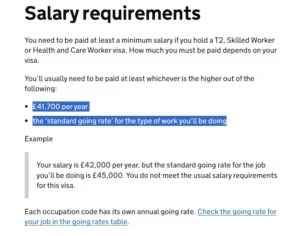
Current Skilled Worker Indefinite Leave to Remain salary requirements compared with the proposed earned settlement threshold.
How Will the Three-Year and Five-Year Earnings Rules Work?
The government’s revised approach introduces a best-years system, recognising that earnings do not always remain constant.
Five-Year Settlement Pathway
To qualify through the £50,271 earnings route, applicants would generally need to meet that threshold in three of the five years immediately before their settlement application.
For example:
| Earnings year | Annual earnings | Meets £50,271? |
| Year 1 | £46,000 | No |
| Year 2 | £51,000 | Yes |
| Year 3 | £54,000 | Yes |
| Year 4 | £48,000 | No |
| Year 5 | £57,000 | Yes |
The worker meets the earnings benchmark in three of the five years.
Subject to all the other conditions, they could qualify for the proposed five-year pathway.
Three-Year Settlement Pathway
The highest-income pathway would generally require earnings of at least £125,141 in three of the four years before applying, or in all three years where settlement is sought after the minimum three-year qualifying period.
This approach could benefit professionals whose compensation varies because of promotions, parental leave or changes in employment.
What About the Ten-Year Pathway?
The Home Office response refers to a basic contribution threshold of £12,571 for at least three years. Its detailed best-years framework specifies earnings at or above that benchmark in five of the seven years immediately before application for the standard ten-year pathway.
The interaction between these requirements will need to be clarified in the detailed Immigration Rules.
The key point is that a temporary reduction in income will not necessarily remove eligibility. Applicants will need sufficient qualifying years and evidence of earnings.
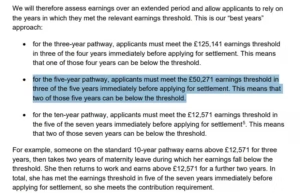
Home Office best-years earnings assessment for the three-year, five-year and ten-year settlement pathways.
How Much More Could UK Employers Pay to Retain Migrant Workers?
The proposed salary-based settlement system could influence recruitment and salary reviews, especially where employers want to retain skilled workers who would otherwise face longer settlement periods.
Consider a worker earning £41,700.
Increasing their salary to £50,271 represents an annual rise of £8,571.
| Employer cost | Current salary | Higher salary | Increase |
| Annual gross salary | £41,700 | £50,271 | £8,571 |
| Salary increase | — | — | 20.6% |
| Additional employer NI at 15% | — | — | £1,285.65 |
| Total additional annual payroll cost before pension adjustments | — | — | £9,856.65 |
This illustration assumes standard employer National Insurance applies to the entire salary increase at the 2026/27 rate and ignores any available Employment Allowance or special NIC treatment.
Actual additional pension costs depend on the employer’s pension scheme and contribution arrangements.
For a company employing ten affected workers, an equivalent increase across all ten would produce an additional annual gross salary bill of £85,710, before associated employer costs.
However, raising salary purely to reach the accelerated settlement threshold should not be treated as a guaranteed immigration solution. Employees must satisfy the relevant earnings-history requirement, and employers remain responsible for salary compliance and genuine employment arrangements.
Businesses preparing their workforce budgets should incorporate these scenarios into their wider business planning and staffing forecasts.
What Is Our Business and Financial Assessment of the Settlement Changes?
Our review identifies three principal commercial risks: higher labour costs, uncertainty over employee settlement timelines and potential changes to international recruitment competitiveness.
The following ratings are editorial assessments, not statistical probabilities or findings from an employer survey. They are intended to illustrate the relative importance of each issue for businesses that rely heavily on sponsored workers.
| Business impact | Our assessment | Reason |
| Workforce retention significance | 90/100 | Settlement timelines may affect employees’ long-term decisions |
| Salary-budget significance | 85/100 | Some employers may face pressure to review pay packages |
| Administrative planning significance | 80/100 | Earnings histories and immigration records become more important |
| Certainty of final implementation details | 50/100 | Further Immigration Rules and technical guidance are awaited |
These scores are qualitative editorial judgements rather than forecasts of how many employers or migrants will be affected.
A particularly important financial consideration is the potential cost of supporting workers through additional years of temporary immigration permission.
For employers offering visa assistance, that may involve more spending on immigration administration and legal advice. The exact cost will depend on the visa category, extension requirements, sponsorship fees and the organisation’s support policy.
Which Healthcare Workers and Care Workers Will Keep Five-Year Settlement?
The revised framework contains specific protections for certain healthcare, education and social care workers.
Doctors, Nurses and Teachers
Eligible professionals in designated health and education occupations paid according to the relevant national pay scales would retain or receive a five-year settlement pathway.
These occupations include qualifying medical practitioners, registered nurses, teachers and several allied health professions.
The eligible occupation list is contained in Annex C of the Home Office’s November 2026 response.
The benefit is not available to every worker employed by a hospital, university, school or public sector organisation. Eligibility depends on the specified occupational category and the applicable rules.
Existing Care Workers
The government has introduced targeted transitional arrangements for some existing care workers who entered or switched into the relevant route before the publication of the Immigration White Paper in May 2025.
Where they meet the relevant sponsorship, employment and £25,000 salary requirements, they may retain the five-year settlement pathway.
Those who do not meet the requirements may have access to a further five-year Health and Care visa, giving them another opportunity to qualify.
The government has also announced additional protections for care workers affected by the revocation of their sponsor’s licence.
From 1 February 2027, eligible affected care workers are expected to have up to 120 days to secure a new job offer and a further 60 days to resolve their visa and employment position.
These protections are important, but they are not a universal five-year settlement guarantee for everyone working in social care.
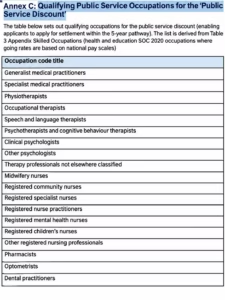
Eligible healthcare and education occupations under the five-year public service settlement pathway.
Will Migrants Already Living in the UK Be Affected by the 2027 Changes?
Yes, potentially.
A central feature of the government’s proposal is that the new settlement requirements may affect people already living and working in the UK who have not yet obtained permanent residence.
There is no general exemption protecting every migrant who entered under the previous five-year system.
This could have significant implications for workers who planned their finances, careers and family arrangements around the expectation of qualifying after five years.
Example: Someone Who Arrived in 2023?
Consider a Skilled Worker who arrived in the UK in 2023 and originally expected to qualify for ILR in 2028.
If the earned settlement reforms take effect before their application and the person does not qualify for an accelerated or protected route, their expected settlement date could move substantially later.
A ten-year qualifying period starting in 2023 would ordinarily point towards 2033, assuming all the relevant years count and the individual remains eligible throughout.
However, that is an illustrative projection, not a confirmed settlement date. The eventual position depends on the final transitional rules, route history and application circumstances.
The government has confirmed that people who already hold settled status will not have that status removed as a result of these reforms.
Some workers sponsored under earlier salary arrangements will also benefit from an extension of existing transitional provisions allowing them to renew permission on relevant previous terms until 2035.
Will the New Rules Affect Migrants’ Families and Dependants?
The revised policy recognises the importance of keeping families together.
Eligible couples will be able to combine earnings to satisfy the basic economic contribution requirement.
The proposed combined household benchmark is £25,142, twice the individual £12,571 figure.
For example:
| Household member | Annual earnings |
| Partner A | £18,000 |
| Partner B | £9,000 |
| Combined earnings | £27,000 |
| Proposed combined minimum | £25,142 |
The combined earnings exceed the proposed household threshold.
That does not automatically establish settlement eligibility, but it may satisfy the relevant basic economic contribution condition.
Under the revised framework, a dependant partner who arrived alongside the principal applicant may continue to settle at the same time, provided the required conditions are met. A partner who joined later would normally need to complete the relevant qualifying period.
Children under 18 will generally be exempt from the earnings, debt, English language and Life in the UK Test requirements, although suitability conditions remain relevant.
Young adults aged 18–24 who retain eligible child-dependant status may also benefit from specific protections.
The rules for adult dependants should not be confused with the separate family-visa income requirements applicable to some British citizens and their partners.
Will English Language and National Insurance Requirements Change in 2027?
Yes.
The proposed earned settlement framework includes stricter mandatory conditions that go beyond salary.
These include:
- Meeting the applicable English-language standard, generally B2 rather than B1 for most adult applicants.
- Passing the Life in the UK Test, unless exempt.
- Having no disqualifying criminal record.
- Having no outstanding specified government debt.
- Demonstrating sustained economic contribution.
- Complying with immigration conditions.
The higher B2 English requirement is already scheduled to apply to settlement applications under specified immigration routes from 26 March 2027.
B2 represents a higher level of language proficiency and may require additional preparation for applicants who previously expected to qualify with B1.
Government debt could also become a more significant consideration.
Outstanding tax, National Insurance or specified NHS debt may affect settlement under the new framework.
For workers, understanding Income Tax and National Insurance thresholds will be useful when reviewing earnings records and obligations.
An applicant should not assume that paying tax through PAYE automatically proves compliance with every settlement requirement.
Could the 2027 Settlement Rules Affect Entrepreneurs and Self-Employed Migrants?
Potentially, although the effect will depend heavily on immigration permission and how qualifying earnings are eventually defined.
The government has indicated that certain high-talent immigration routes, including Global Talent and Innovator Founder, may retain accelerated settlement arrangements.
However, those routes have their own eligibility and residence requirements. The highest-talent category is also subject to further review.
For business founders, the distinction between turnover, business profit, personal salary and dividends may become especially important.
A company generating £150,000 in turnover does not necessarily mean its director personally earns £150,000.
Similarly, a business owner taking a low salary and receiving dividends should not assume that all income will count towards a particular settlement threshold without checking the final Home Office rules.
The November 2026 policy response does not fully resolve how every form of business income will be verified for the accelerated pathways.
Entrepreneurs considering starting a small business in the UK must also ensure their immigration permission allows the proposed business activities.
A Skilled Worker visa does not provide the same freedom to operate a business as settled status.
Our assessment is that internationally mobile founders should consider tax efficiency and immigration eligibility together rather than optimising their salary or dividends for tax alone.
How Will the Settlement Salary Threshold Affect UK Recruitment in 2027?
The planned reforms could change how businesses compete for international talent.
Employers recruiting software engineers, finance professionals, healthcare specialists, researchers and other sponsored workers may increasingly find that candidates ask about their potential route to settlement before accepting an offer.
This creates several possible commercial implications.
- Salary expectations: Workers may attach greater importance to whether a role offers the potential to achieve £50,271 or more over the required period.
- Retention: Employees facing an extended qualifying period may reconsider long-term career plans or seek employers offering greater progression opportunities.
- Recruitment administration: HR teams will need to explain how sponsorship, visa renewal and settlement interact without promising an outcome they cannot guarantee.
- Workforce forecasting: Businesses could need longer-term plans for roles where workers remain sponsored for up to ten years.
- Regional competition: Employers in lower-paying regions may find it harder to offer salaries that meet the same accelerated earnings benchmarks as higher-paying employers elsewhere.
These are plausible commercial consequences, not confirmed forecasts of recruitment or salary increases.
The response of individual businesses will depend on their sector, existing workforce, wage structure and ability to support employees.
What Do the Government’s Financial Estimates Say About Higher-Earning Migrants?
The Home Office’s November 2026 response includes economic modelling intended to illustrate the relationship between migrants’ earnings and their projected lifetime fiscal contributions.
The modelling uses an approach developed by the Migration Advisory Committee, with updated assumptions applied by the Home Office.
Its illustrative figures are:
| Annual earnings | Estimated lifetime net fiscal impact |
| £41,700 | Approximately £347,000 |
| £50,271 | Approximately £456,000 |
| £125,141 | Approximately £1.53 million |
Under these modelled examples, the estimated lifetime fiscal impact at £50,271 is approximately 31.4% higher than at £41,700.
However, these are model-based estimates, not amounts that individual migrants will pay in tax or guaranteed government savings.
The results depend on assumptions involving working life, tax revenue, public expenditure, dependants and future residency.
From a business perspective, the figures explain why the government has linked faster settlement with higher sustained earnings.
They do not demonstrate that every higher-paid worker is economically more valuable to an employer, or that lower-paid professionals make a smaller social contribution.
When Will the New UK Migrant Settlement Rules Start in 2027?
The government intends to begin publishing the detailed changes to the Immigration Rules in December 2026, with implementation expected during 2027.
As of 6 November 2026, an exact universal start date has not been confirmed for the earned settlement framework.
| Date | Development |
| May 2025 | Immigration White Paper introduces longer settlement proposals |
| 20 November 2025 | Earned settlement consultation published |
| 12 February 2026 | Public consultation closes |
| 2 November 2026 | Government publishes revised framework and consultation response |
| December 2026 | Detailed Immigration Rules expected to begin publication |
| 1 February 2027 | Announced additional protections for certain care workers affected by sponsor licence revocation |
| 26 March 2027 | B2 English requirement scheduled for specified settlement routes |
| During 2027 | Wider earned settlement reforms expected to be introduced in phases |
People who meet the existing requirements before the new rules take effect may still be able to apply under the current framework.
However, application timing and decision dates are important. Applicants should check the rules applying to their specific circumstances rather than assuming that a proposed change is already in force or that submitting an application guarantees protection from subsequent changes.
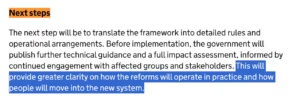
Government response confirming the revised earned settlement framework and outlining the next implementation steps.
What Should UK Employers and Migrant Workers Do Before 2027?
Businesses that depend on sponsored workers should review their immigration and workforce arrangements before the new framework is implemented.
Our recommended preparation includes:
- Review employee visa expiry dates: Identify workers approaching the current five-year settlement milestone and those who may require further permission.
- Compare salaries against the different thresholds: Assess both the current salary requirement for the relevant visa or settlement route and the proposed accelerated-settlement earnings thresholds.
- Check earnings histories: Review whether employees have met the required benchmark for enough qualifying years, not merely their current salary.
- Identify protected occupational groups: Determine whether eligible healthcare, education and existing care workers may qualify through separate pathways.
- Model payroll costs. Calculate how potential salary adjustments, employer National Insurance and other payroll obligations would affect future budgets.
- Review family circumstances and language requirements: These can materially affect the timing and cost of settlement applications.
- Monitor the official Immigration Rules: Update internal HR guidance when detailed changes are published rather than relying solely on initial policy announcements.
Where an employee is close to meeting the current settlement requirements, obtaining advice from a suitably regulated immigration professional can be particularly valuable.
Final Thoughts
The UK migrant settlement salary threshold changes planned for 2027 could fundamentally reshape long-term immigration and workforce planning.
The introduction of a ten-year standard pathway, combined with accelerated settlement for eligible workers earning £50,271 or £125,141, creates a stronger connection between sustained economic contribution and permanent residence.
For businesses, the reforms bring potential recruitment and salary-budget implications. For migrant workers, they make earnings history, immigration compliance and career planning more important.
Our review suggests that employers should focus on accurate workforce modelling rather than assuming that every sponsored employee must receive a higher salary.
The November 2026 announcement establishes the government’s intended direction, but the detailed Immigration Rules remain essential. Workers and employers should verify the legal requirements in force when making settlement decisions.
This article provides general business, financial and immigration-policy information. It is not personalised legal or immigration advice. The figures and future pathways described are based on the government’s November 2026 framework and may be amended during implementation.
Frequently Asked Questions
What is the new UK migrant settlement salary threshold for 2027?
The November 2026 framework proposes £12,571 as the basic earnings contribution benchmark, £50,271 for a five-year earnings-based settlement pathway and £125,141 for a three-year pathway. Exceptions and additional conditions apply.
Will the UK increase the ILR qualifying period from five to ten years?
The government intends to introduce a ten-year standard pathway for many migrants during 2027. Some higher earners, qualifying public service workers and other protected groups will remain eligible sooner.
Can someone earning £40,000 get permanent residency?
Potentially. Earnings below £50,271 do not automatically prevent settlement. An eligible applicant may qualify through the proposed ten-year route or another applicable pathway.
Will existing Skilled Worker visa holders be affected?
Many could be. The government has not announced a universal exemption for people already in the UK, although targeted transitional arrangements will apply to particular groups.
Do migrants need to earn £50,271 every year?
Not necessarily. Under the announced best-years approach, five-year earnings-based settlement would generally require the threshold to be met in three of the previous five years.
Will nurses and teachers need a £50,271 salary?
Not necessarily. Specified healthcare and education professionals will have access to the five-year pathway through their eligible occupations, subject to all applicable settlement conditions.
When will the new settlement salary threshold become law?
The government expects implementation during 2027, following further changes to the Immigration Rules. As of 6 November 2026, the detailed earned settlement rules have not yet taken effect.
Does earning £125,141 guarantee settlement after three years?
No. The applicant must also meet the qualifying residence, earnings-history, immigration, language, character and other relevant requirements.