



















If you have never paid National Insurance, you may still qualify for a UK State Pension. However, your entitlement depends on how many qualifying years appear on your National Insurance record, not simply how much money you have paid in contributions.
This distinction matters particularly for people who have spent years raising children, caring for relatives, working part-time, running a small business or living outside the UK.
Under the new State Pension system, most people need at least 10 qualifying years to receive any State Pension. Those whose National Insurance record began after April 2016 generally need 35 qualifying years to receive the full amount.
For the 2026/27 tax year, the full new State Pension is £241.30 per week, equivalent to approximately £12,547.60 annually.
However, a person with no qualifying years would not normally receive the new State Pension based on their own record. Someone who has never paid National Insurance personally may have accumulated qualifying years through National Insurance credits or other qualifying arrangements.
Our analysis of the current pension rules highlights three areas worth checking before assuming there is no entitlement: missing credits, incomplete employment records and the financial value of voluntary contributions.
Can You Get a State Pension Without Ever Paying National Insurance?
Yes. It is possible to receive the UK State Pension without having made National Insurance payments directly from your earnings.
The government recognises several circumstances in which individuals can build qualifying years without paying conventional employee contributions.
These include:
- Receiving National Insurance credits while raising children.
- Claiming certain unemployment or sickness benefits.
- Providing unpaid care to another person.
- Working on earnings that qualify for NI purposes without an actual employee NI deduction.
- Being self-employed with profits that qualify for treated-as-paid Class 2 contributions.
- Paying eligible voluntary National Insurance contributions.
A person who has never worked could therefore have a stronger pension position than someone who has worked intermittently but failed to build sufficient qualifying years.
The important distinction is between never paying National Insurance and never acquiring National Insurance qualifying years.
If your record contains no qualifying years at all, you will normally need to investigate whether years can be added or whether another form of retirement support is available.
How Many Years of National Insurance Do You Need to Get a Pension?
The number of qualifying years required depends partly on which State Pension system applies to you.
People reaching State Pension age on or after 6 April 2016 are generally covered by the new State Pension.
| National Insurance record | Normal position under the new system |
| 0 qualifying years | No new State Pension based on that record alone |
| 1–9 qualifying years | Usually below the minimum entitlement |
| 10 qualifying years | Normally enough to receive a partial new State Pension |
| 11–34 qualifying years | Potential entitlement to a higher amount |
| 35 qualifying years | Normally enough for the full amount if the NI record began after April 2016 |
| More than 35 years | May be necessary for some people with pre-2016 records |
These are general rules, not a substitute for an individual State Pension calculation.
For people who had National Insurance contributions before April 2016, transitional rules and previous contracting-out arrangements can affect their entitlement.
Someone could have 35 years on their record and still receive less than the full current State Pension rate.
This is why we consider the individual State Pension forecast considerably more useful than estimating retirement income from the number of working years alone.
How Much State Pension Can You Receive With 10, 20 or 35 Qualifying Years?
For someone whose National Insurance record began after April 2016, the full new State Pension can generally be used to illustrate how qualifying years affect entitlement.
Using the 2026/27 full rate of £241.30 per week, the following figures show the potential difference.
| Qualifying years | Approximate percentage of full pension | Weekly pension | Annual pension |
| 0 years | 0% | £0 | £0 |
| 5 years | Below minimum | £0 | £0 |
| 9 years | Below minimum | £0 | £0 |
| 10 years | 28.6% | £68.94 | £3,585 |
| 15 years | 42.9% | £103.41 | £5,377 |
| 20 years | 57.1% | £137.89 | £7,170 |
| 25 years | 71.4% | £172.36 | £8,963 |
| 30 years | 85.7% | £206.83 | £10,755 |
| 35 years | 100% | £241.30 | £12,548 |
Figures are approximate, rounded to the nearest pound annually, and illustrate the standard post-April-2016 calculation. Individual awards may differ.
The table highlights something easily overlooked: the first nine qualifying years do not normally produce a payable new State Pension until the 10-year minimum is satisfied.
Consequently, a person with nine qualifying years may have a particularly important decision to make about acquiring a tenth year.
By contrast, someone who already has enough qualifying years to receive their maximum pension may gain nothing from buying additional contributions.
For a fuller explanation of when retirement payments can begin, the State Pension age of 66 or 67 is another important consideration because the qualifying age is gradually increasing.
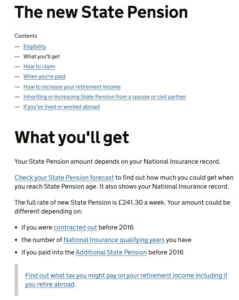
Full new State Pension amount for 2026/27, showing the official weekly payment of £241.30.
Can You Get a Pension If You Have Never Worked?
Yes, provided your National Insurance record contains enough qualifying years or you qualify under a relevant exception.
Not working does not automatically mean having no State Pension entitlement.
Consider someone who spent 15 years caring for children while their partner worked full-time.
They may have paid very little National Insurance through employment. However, if they were registered for Child Benefit and received the appropriate NI credits, several of those years could count towards their State Pension.
In financial terms, these credits can be particularly valuable because they protect future pension entitlement without requiring the individual to purchase each qualifying year.
The position is different for a person who has never worked, never received relevant credits and has no other qualifying National Insurance history.
In that situation, the individual may not qualify for the new State Pension based on their own record.
The next step should be to establish whether there are missing credits, historic contribution errors or other eligibility provisions before considering voluntary payments.
What National Insurance Credits Can Help You Qualify for a Pension?
National Insurance credits protect the pension records of eligible people who cannot build contributions through ordinary paid employment.
Some credits are awarded automatically, while others require an application.
| Circumstance | Potential NI credit route | Important consideration |
| Raising a child under 12 | Child Benefit-related credits | Registration normally matters even if payments are declined |
| Caring for an adult | Carer’s Credit | May be available for eligible carers providing at least 20 hours of care weekly |
| Unemployment | Certain qualifying benefits | Credits depend on the benefit and eligibility conditions |
| Illness or disability | Certain sickness-related benefits | Not every benefit automatically provides the same credits |
| Looking after grandchildren | Specified Adult Childcare credits | Qualifying credits may be transferred in eligible circumstances |
| Historical childcare | Home Responsibilities Protection | Older records may need correction |
The financial importance of credits is substantial.
Under a straightforward 35-year new State Pension calculation, each useful additional qualifying year is equivalent to approximately £6.89 in weekly pension at 2026/27 rates, once the minimum qualifying period has been met.
That is roughly £358.50 annually.
Over 20 years of receiving a pension, one additional qualifying year could therefore represent approximately £7,170 in payments, before allowing for annual pension increases, tax or other financial adjustments.
This is an illustration of long-term pension value rather than a guaranteed payment.
Why Child Benefit Credits Matter?
Parents who stay at home should pay particular attention to how their Child Benefit claim was registered.
National Insurance credits are normally awarded to the person registered for Child Benefit for an eligible child under 12.
The household does not automatically receive two sets of credits simply because both parents are responsible for the child.
For families affected by the High Income Child Benefit Charge, there is another important distinction.
A parent can remain registered for Child Benefit while choosing not to receive the payments. This can preserve eligible National Insurance credits.
Not claiming Child Benefit at all can have a different effect.
There is also a specific historical problem for some parents and carers who were eligible for Child Benefit but did not claim it from 7 January 2013 onwards.
The government’s replacement credits service has been delayed until April 2027. Eligible people approaching or already beyond State Pension age may need to investigate whether that delay has caused a financial loss.
For anyone whose retirement income is unexpectedly low, we would examine these childcare years before recommending that money be spent on voluntary contributions.
Missing Home Responsibilities Protection
Home Responsibilities Protection, commonly called HRP, operated before April 2010 to help protect qualifying pension records for certain parents and carers.
Some historical records have not been credited correctly.
A person who received Child Benefit before May 2000, particularly where their National Insurance number was not properly linked to the claim, may need to check whether HRP is missing.
An error involving several years can affect retirement entitlement significantly.
Our examination of the known causes of incorrect State Pension forecasts shows why missing childcare records should be investigated separately from genuinely unpaid National Insurance contributions.
A gap resulting from an administrative error should not simply be treated as a year the individual must purchase.
What If You Worked but Never Had National Insurance Deducted?
Many people assume that no National Insurance deduction on a payslip means no pension entitlement was built.
That assumption is not always correct.
For employees in 2026/27, earnings between £129 and £242 a week from one employer can count for National Insurance purposes even though the employee does not normally pay Class 1 National Insurance.
The £129 figure is the Lower Earnings Limit, while £242 is the weekly Primary Threshold.
For example, someone earning £180 a week from a qualifying employment arrangement could build National Insurance entitlement without actually having employee contributions deducted from that pay.
This distinction matters for part-time workers, people reducing their hours for childcare and employees approaching retirement.
However, irregular earnings, multiple jobs and incomplete employment years can complicate the position.
If you worked for several employers over the years, do not rely on whether an individual payslip showed an NI deduction.
Check the actual National Insurance record to determine which tax years count.
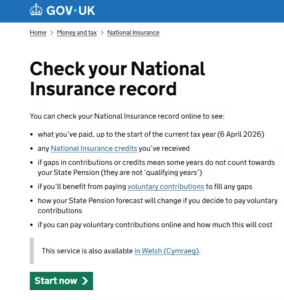
Official National Insurance record service showing how to check qualifying years, credits and contribution gaps.
Can Self-Employed People Get a State Pension Without Paying National Insurance?
Yes. Self-employed National Insurance arrangements changed significantly in April 2024.
For the 2026/27 tax year, self-employed people with annual profits of at least £7,105 are generally treated as having paid Class 2 National Insurance contributions.
They do not need to make an actual Class 2 payment to receive that protection.
Self-employed people with profits below £7,105 may be able to pay voluntary Class 2 contributions at £3.65 per week.
| Annual self-employed profit in 2026/27 | General NI position |
| Below £7,105 | Voluntary Class 2 may be available |
| £7,105 to £12,570 | Class 2 normally treated as paid |
| Above £12,570 | Class 2 protection plus relevant Class 4 liability |
Class 4 contributions generally apply at 6% on profits above £12,570 up to £50,270 and 2% above that.
For small business owners, one of the important considerations is ensuring that HMRC has correctly recorded the individual’s self-employment.
There have been recognised cases involving missing Class 2 National Insurance information for some people who became self-employed between 2015 and 2024.
A person may therefore have a gap despite having legitimately traded during the relevant period.
We would prioritise correcting such records before considering paid pension top-ups.
Can You Pay Voluntary National Insurance to Get a Pension?
Yes. Voluntary National Insurance contributions can help people fill eligible gaps in their records or avoid gaps arising in the future.
Most eligible individuals use either Class 2 or Class 3 contributions, depending on their circumstances.
For 2026/27, the published weekly rates are:
| Contribution type | Weekly rate | Approximate full 52-week cost |
| Voluntary Class 2 | £3.65 | £189.80 |
| Voluntary Class 3 | £18.40 | £956.80 |
Class 2 is generally available only to people meeting particular eligibility conditions, including certain self-employed individuals.
Class 3 is more widely used by people who need to fill qualifying pension gaps.
The important point is that eligibility to pay for a year does not automatically mean the payment will improve the State Pension.
Before spending money, compare your contribution record with your personalised forecast.
For the current eligibility criteria and minimum qualifying-year rules, the government’s official State Pension explanation provides a detailed starting point.
Is Buying Missing National Insurance Years Worth It?
A useful way to assess a voluntary contribution is to compare its cost with the extra retirement income it is expected to produce.
Suppose someone pays £956.80 to complete a qualifying year through Class 3 contributions.
If that additional year increases their State Pension by approximately £358.50 annually, the simple calculation is:
£956.80 ÷ £358.50 = approximately 2.67 years.
This suggests the person could recover the contribution cost after around two years and eight months of receiving the additional pension.
However, this calculation assumes the payment genuinely produces that increase.
It also excludes inflation, future uprating, tax, investment returns, the period between payment and retirement, and the possibility of reduced means-tested benefits.
If the individual is already expected to reach the maximum State Pension through future working years, the same payment may provide no additional benefit.
Former Pensions Minister Steve Webb, now a partner at pension consultancy LCP, has publicly warned that pension top-ups require particular care for people who may rely on retirement benefits. His concern is that an increased State Pension can reduce entitlement to means-tested support, leaving the individual with little or no net financial improvement.
That is an important financial distinction. A favourable theoretical return is not necessarily a favourable outcome for every household.
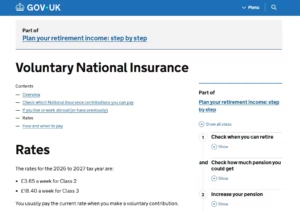
Voluntary National Insurance contribution rates for 2026/27, showing the £18.40 Class 3 and £3.65 Class 2 weekly rates.
How Far Back Can You Pay Missing National Insurance Contributions?
Normally, voluntary National Insurance contributions can be paid for gaps in the previous six tax years.
The deadline for each eligible tax year generally falls on 5 April.
For example, under the normal six-year rule, the deadline to fill an eligible 2020/21 gap is 5 April 2027.
The temporary arrangement that previously allowed certain individuals to fill much older gaps, going back to 2006, ended in April 2025.
Exceptions and special correction arrangements can still apply to particular circumstances.
We recommend examining the oldest eligible gaps first because those years may have the nearest payment deadlines.
It is equally important to confirm whether filling them increases your pension entitlement before paying HMRC.
A person with 20 incomplete years should not assume that all 20 can be purchased or that buying every eligible year is financially worthwhile.
What Happens If You Have Zero National Insurance Qualifying Years?
If you genuinely have zero qualifying years under the new State Pension system, you would not normally qualify for a new State Pension based on your own National Insurance record.
Nevertheless, your options depend on how close you are to retirement and whether any alternative entitlement applies.
Someone aged 40 may have enough time to build qualifying years through future employment, self-employment or credits.
Someone aged 64 with no contribution history faces a more restricted position.
Buying six previous years alone would not normally satisfy the 10-year minimum. Other qualifying years, special provisions or international contribution arrangements may therefore be important.
Before paying voluntary contributions, establish whether the individual has a realistic route to the minimum qualifying period.
Otherwise, substantial expenditure may not produce a payable new State Pension.
What If You Have Nine Qualifying Years?
This situation deserves particular attention.
Nine qualifying years are normally insufficient to receive any new State Pension.
If someone can lawfully acquire one more qualifying year, the position may change substantially.
Under a straightforward post-2016 calculation, 10 qualifying years would produce approximately £68.94 per week at current rates.
That is considerably more important than a typical single-year increase for someone who already has 20 qualifying years.
However, international arrangements, previous pension history and eligibility restrictions can affect the final outcome.
We would not recommend paying for the tenth year without first obtaining confirmation that it would establish a payable entitlement.
Can You Receive Your Husband’s or Wife’s State Pension If You Never Paid National Insurance?
Marriage does not generally give one spouse automatic entitlement to the other’s full new State Pension.
The new State Pension is principally calculated using each person’s individual National Insurance record.
However, there are important exceptions involving older pension arrangements, inherited entitlement and married women who elected to pay reduced-rate National Insurance contributions.
The historical reduced-rate arrangement was sometimes called the married woman’s stamp.
Women who made a qualifying reduced-rate election may be eligible for special transitional rules, potentially providing entitlement even without the usual 10 qualifying years of their own.
People who reached State Pension age before 6 April 2016 are also covered by different basic State Pension rules, which can include provisions based on a spouse’s contribution history.
Widowhood, divorce and civil partnership history can also affect some pension calculations.
These exceptions are significant, but they are not universal.
An individual should have their specific entitlement assessed rather than assuming that their partner’s National Insurance history automatically provides a pension.
What If You Have Never Paid National Insurance Because You Lived Abroad?
People who have spent significant periods outside the UK can face more complicated pension calculations.
In some circumstances, overseas social insurance periods can help establish entitlement under international agreements.
However, qualifying for a UK State Pension and determining how much the UK will pay are separate questions.
It is possible for qualifying overseas periods to help satisfy an eligibility condition without producing the same UK pension amount as equivalent UK contribution years.
There is also an important change affecting voluntary contributions for periods abroad from 6 April 2026.
Under the new rules, voluntary Class 2 contributions are generally no longer available for time spent living or working abroad, subject to particular exceptions.
For new applications to pay Class 3 contributions for periods abroad from 2026/27 onwards, applicants generally need either 10 continuous years of UK residence or 10 qualifying contribution years under the specified rules.
Transitional arrangements apply to some existing contributors and earlier periods.
For someone who has worked in Britain and then relocated overseas, these changes make it especially important to examine contribution eligibility before budgeting for future pension top-ups.
People already receiving their UK State Pension overseas should also understand the separate issue of a frozen State Pension, where annual increases are not payable in certain countries.
Can You Claim Pension Credit If You Have Never Paid National Insurance?
Yes, potentially. Pension Credit is different from the State Pension because it is means-tested.
It is designed to help eligible older people with low retirement incomes.
Unlike the contributory State Pension, Pension Credit does not require a person to have accumulated 10 National Insurance qualifying years.
For 2026/27, the standard Guarantee Credit amounts are:
| Household circumstances | Standard weekly income guarantee |
| Single person | £238.00 |
| Couple | £363.25 |
These figures are income guarantee levels, not automatic fixed payments.
The amount of Pension Credit actually awarded depends on a household’s financial circumstances, including relevant income, savings and other eligibility conditions.
For example, a single person with £70 weekly State Pension and no other assessable income might receive a Pension Credit top-up of approximately £168 per week, assuming the standard guarantee applies.
If their State Pension increased to £77 per week, their Pension Credit could fall to approximately £161.
Their combined weekly income would remain £238.
This illustrates why buying extra National Insurance years is not automatically a sound investment for someone who expects to rely on Pension Credit.
Additional Pension Credit amounts may also apply to eligible people with particular disabilities, caring responsibilities or housing costs.
A person with no State Pension should therefore investigate Pension Credit rather than assuming that having no National Insurance history means receiving no financial support in retirement.
Can You Still Build Qualifying Years After State Pension Age?
Ordinary employment after reaching State Pension age does not normally create new qualifying years for the State Pension.
Employees generally stop paying employee National Insurance contributions when they reach State Pension age, even if they continue working.
Self-employed people also have different National Insurance rules after reaching pension age.
However, it may still be possible in some circumstances to pay voluntary contributions for eligible historical gaps.
Someone already receiving their pension should contact the Pension Service to establish whether filling a particular previous year would increase the amount paid.
This should not be confused with continuing to work after retirement age, which does not ordinarily build additional State Pension qualifying years.
There is also a separate option to defer claiming the State Pension, which can increase future weekly payments under the applicable rules.
Deferral is a different financial decision from purchasing National Insurance years.
How Do You Check Whether You Have Paid Enough National Insurance?
The most practical starting point is to check the official National Insurance record rather than attempt to reconstruct decades of employment from memory.
You can use the government’s National Insurance record checking service to review qualifying years, gaps and available information about voluntary contributions.
The process is straightforward:
- Sign in through the official government service.
- Open your National Insurance record.
- Review completed and incomplete tax years.
- Identify years when you were working, self-employed or receiving benefits.
- Check whether childcare or caring credits are missing.
- Review your State Pension forecast and whether additional years would increase it.
- Contact HMRC or the relevant pension service if the record appears inaccurate.
For someone with a long employment history, the most useful exercise is to compare the National Insurance record against major life events.
This includes years of paid employment, self-employment, childcare, caring responsibilities and periods spent abroad.
An incomplete year is not always an error. Equally, a missing contribution is not always a genuine liability that must be paid.
A previous employer may have reported earnings incorrectly, or an eligible credit may not have been recorded.
It is worth investigating these possibilities before making a financial commitment.
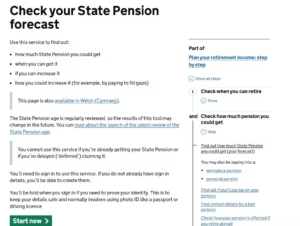
Check your State Pension forecast to see your expected retirement income and whether additional National Insurance contributions could increase it.
What Should You Do If Your National Insurance Record Is Wrong?
An incomplete National Insurance record can result from several different circumstances.
It may reflect genuine periods without contributions, but it can also arise from mistakes in employment reporting, missing childcare credits or problems with historical self-employment registration.
Before requesting a correction, gather relevant evidence such as:
- Previous payslips or P60 forms.
- Employment dates and employer details.
- Self Assessment and self-employment records.
- Child Benefit claim information.
- Relevant benefit award letters.
- Evidence of qualifying caring responsibilities.
The correct contact route depends on the type of missing information.
HMRC normally handles National Insurance record matters, while some benefits and pension entitlement issues require contact with the relevant DWP service.
A person who has already retired may also need their State Pension award reviewed after their National Insurance history is corrected.
Our assessment is that correcting an existing entitlement should take priority over buying an additional entitlement wherever a genuine record error can be established.
That approach can prevent unnecessary spending while ensuring the pension calculation reflects the person’s actual contribution and credit history.
Is Having No National Insurance the Same as Having No Retirement Income?
No. The State Pension is only one element of retirement planning.
A person may have no entitlement to the new State Pension but still hold workplace pension savings, a personal pension, investment income or other retirement assets.
Similarly, someone receiving the full State Pension may still have insufficient income to meet their desired retirement expenditure.
The more useful financial question is whether the household’s total expected retirement income covers essential spending.
This includes housing costs, council tax, utilities, food, transport and healthcare-related expenditure.
National Insurance does not determine the amount held in an ordinary defined contribution workplace pension.
Those funds arise from pension contributions and investment performance, subject to the relevant pension scheme rules.
However, different types of retirement income can affect means-tested support and Income Tax liabilities.
For 2026/27, the standard Personal Allowance remains £12,570, while the full new State Pension amounts to £12,547.60 over 52 weeks.
That places the full new State Pension very close to the standard annual Income Tax threshold.
People receiving additional taxable retirement income should therefore understand how much they can earn before paying tax rather than assuming pension payments are always tax-free.
What Are the Biggest Mistakes People Make About National Insurance and Pensions?
The most costly misunderstandings generally concern entitlement rather than the actual amount paid in contributions.
- Assuming no NI deductions means no pension: Low-paid employees and eligible parents may still build qualifying years.
- Assuming 35 years guarantees the full pension: Pre-April-2016 records and contracting-out rules can alter the calculation.
- Buying gaps without checking the forecast: Some payments will not increase retirement income.
- Ignoring missing childcare credits: Historic Child Benefit and HRP records may need correcting.
- Overlooking the 10-year minimum: A person with nine years generally does not qualify for the new State Pension based on that record alone.
- Confusing Pension Credit with the State Pension: Pension Credit depends on financial circumstances rather than the same contributory conditions.
- Assuming retirement payments start automatically: The new State Pension must normally be claimed.
These mistakes can produce very different financial consequences, from unnecessary voluntary payments to missed pension income.
For anyone approaching retirement, the objective should be to confirm entitlement, correct errors and then assess whether additional contributions provide worthwhile value.
What Should You Do Now If You Have Never Paid National Insurance?
If you are uncertain about your State Pension entitlement, the following sequence provides a practical way to assess your position.
| Step | Action | Why it matters |
| 1 | Check your NI record | Establish your actual qualifying years |
| 2 | Identify missing credits | Find potential entitlement without paying |
| 3 | Check your pension forecast | Understand expected retirement income |
| 4 | Review your State Pension age | Establish the time remaining |
| 5 | Investigate historical errors | Correct genuinely missing information |
| 6 | Assess voluntary contributions | Determine whether paying improves entitlement |
| 7 | Consider Pension Credit | Review low-income retirement support |
| 8 | Review other pension income | Build a complete retirement budget |
The order matters.
A person who immediately purchases every incomplete National Insurance year may spend more than necessary.
Someone who checks their record first may discover that several years qualify through credits, while another may find that future working years will already provide the maximum possible pension.
The correct financial decision depends on the individual’s contribution history, age, retirement income and benefit eligibility.
Conclusion
Having never paid National Insurance does not automatically mean you will receive no UK State Pension. The determining factor is whether you have accumulated enough qualifying years through contributions, credits or other recognised arrangements.
For people covered by the new State Pension, 10 qualifying years are normally required for any entitlement, while 35 years is generally the benchmark for a full pension where the record began after April 2016.
Our analysis suggests that the most valuable first step is checking the official National Insurance record.
Missing credits and record errors should be investigated before voluntary contributions are purchased. Where pension entitlement remains low or unavailable, Pension Credit and other retirement income should also be considered.
Frequently Asked Questions
Will I get a UK State Pension if I have never paid National Insurance?
Possibly. You may qualify through National Insurance credits or other eligible arrangements, even if you never paid contributions directly.
Can I get a State Pension with five years of National Insurance?
Normally not under the new State Pension system, which generally requires at least 10 qualifying years. Specific exceptions may apply.
Can I get a pension if I have never worked in my life?
Yes, potentially. Qualifying years can arise through childcare, caring responsibilities and certain benefits without conventional employment.
How much is the minimum State Pension after 10 qualifying years?
For a straightforward post-2016 record, 10 qualifying years produce approximately £68.94 per week at 2026/27 rates. Individual calculations can differ.
Can I buy 10 years of National Insurance to get a pension?
Not necessarily. Retrospective payments are generally limited to the previous six tax years, with certain exceptions. Eligibility and the effect on entitlement must be confirmed.
Can I receive Pension Credit with zero National Insurance contributions?
Yes, potentially. Pension Credit is means-tested and does not have the same 10-year National Insurance qualifying requirement as the new State Pension.
Does my husband’s National Insurance count towards my pension?
Not automatically under the new system. However, older pension rules, inherited entitlements and certain reduced-rate married women’s arrangements can provide exceptions.
Can I pay National Insurance after turning 66?
You may be able to pay voluntary contributions for eligible historical gaps, depending on your circumstances. Ordinary work after State Pension age does not normally create new qualifying years.