















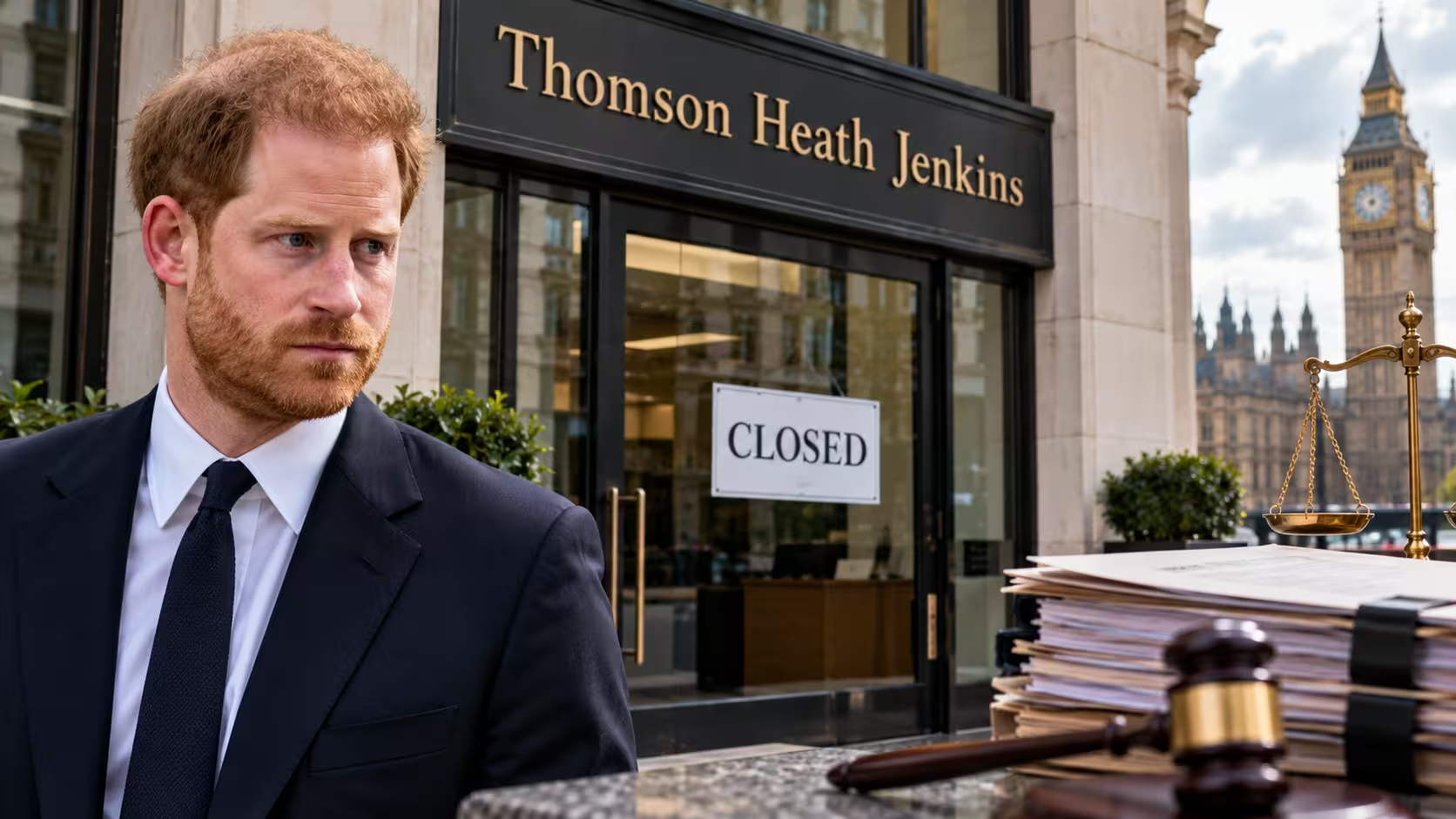
The Thomson Heath Jenkins closure has raised serious questions about the financial stability of specialist London law firms after the Fleet Street practice ceased trading following its involvement in Prince Harry’s unsuccessful privacy case against Associated Newspapers Limited.
Reports emerging on 22 October 2026 confirmed that Thomson Heath Jenkins & Associates had closed its office and engaged insolvency practitioners.
The development followed the High Court’s dismissal of privacy claims brought by seven prominent individuals, including Prince Harry, Sir Elton John and Baroness Doreen Lawrence.
The litigation has attracted particular financial scrutiny because Associated Newspapers reported legal costs exceeding £34.48 million, while the court ordered the claimants to make an initial payment of £9.54 million.
However, an important distinction remains. The £34.48 million figure represents costs claimed by the newspaper publisher, not an established debt owed by Thomson Heath Jenkins.
Our examination of the available corporate records, court findings and regulatory statements indicates that the closure involves several separate issues: the firm’s operational shutdown, reported insolvency involvement, litigation funding exposure and the legal obligations surrounding its clients.
Despite the reported cessation of trading, Companies House continued to show the underlying company as active when checked on 29 October 2026.
This difference between operational closure and registered corporate status is central to understanding what has happened.
What Happened to Thomson Heath Jenkins?
Thomson Heath Jenkins & Associates was a London-based specialist legal practice operating from 3 Fleet Street, an address closely associated with Britain’s legal profession.
The practice handled privacy disputes, defamation, reputation management, media law and other complex litigation.
Established as a practice in 2009 by solicitor Mark Thomson, it developed a reputation for representing public figures in disputes involving newspapers and alleged unlawful information gathering.
Its reported closure came shortly after the conclusion of one of the most expensive and closely watched privacy cases in recent years.
| Key detail | Verified or reported position |
| Law firm | Thomson Heath Jenkins & Associates |
| Registered company | Thomson Heath & Associates Limited |
| Company number | 08965707 |
| London address | 3 Fleet Street, EC4Y 1AU |
| Practice established | 2009 |
| Company incorporated | 28 March 2014 |
| Reported shutdown | 22–23 October 2026 |
| Companies House status | Active as checked on 29 October |
| Insolvency involvement | Practitioners reportedly engaged |
| Legal regulator | Solicitors Regulation Authority |
| SRA number | 621106 |
The closure was reported as unexpected by at least one person associated with the business.
An unnamed company source described the development as “a shock for staff”, suggesting that employees may not have anticipated the timing of the shutdown.
That description does not establish how many staff were affected, when management first considered closure or what financial information had previously been communicated internally.
What Has the Legal Regulator Said?
The Solicitors Regulation Authority confirmed that it was aware of the situation and was communicating with the practice as it arranged an orderly closure.
An SRA spokesperson stated:
“We are aware of the situation and are liaising with the firm”
The regulator also indicated that it would continue monitoring developments and consider intervention if client interests became endangered.
This is a significant distinction.
An orderly closure involves a firm making arrangements to protect client interests and manage outstanding responsibilities. A formal SRA intervention is a separate regulatory action taken when the authority considers it necessary.
There is currently no verified basis for describing the reported closure itself as an SRA disciplinary intervention.
Why Did Thomson Heath Jenkins Close?
The closure followed a major defeat in litigation against Associated Newspapers Limited, the publisher of the Daily Mail and The Mail on Sunday.
The case was resource-intensive, involved multiple claimants and continued through an 11-week High Court trial.
Published reporting indicates that Thomson Heath Jenkins undertook substantial work under a no-win, no-fee arrangement.
If those reported arrangements applied to the relevant instructions, the firm’s ability to recover fees could have depended heavily on the litigation’s outcome.
The financial implications are important.
A professional-services business can incur considerable expenditure before receiving payment. Solicitor salaries, barristers’ fees, specialist research, document review, office costs and other operating expenses may accumulate throughout a lengthy dispute.
When a significant matter ends unsuccessfully, the business may be unable to recover some of the revenue anticipated from that work.
Nevertheless, the precise financial reason for Thomson Heath Jenkins’ closure has not been publicly established through a complete statement of its debts, cash position and outstanding fees.
It would therefore be premature to conclude that the High Court defeat was the sole cause.
Our assessment is that the failed litigation represents a credible commercial pressure associated with the timing of the closure, rather than conclusive proof of the firm’s complete financial position.
How Did Prince Harry’s Privacy Case Affect the Law Firm?
Thomson Heath Jenkins was closely associated with the litigation brought against Associated Newspapers by seven claimants:
- Prince Harry, Duke of Sussex
- Baroness Doreen Lawrence
- Sir Elton John
- David Furnish
- Elizabeth Hurley
- Sadie Frost
- Sir Simon Hughes
The claimants alleged that private information had been acquired through unlawful practices, including phone hacking and other forms of information gathering.
Associated Newspapers denied the allegations.
On 7 July 2026, Mr Justice Nicklin dismissed the claims after finding that the evidence did not establish the alleged unlawful conduct.
The ruling examined allegations involving 55 newspaper stories and considered the evidence supporting the claimants’ case.
The judgment was followed by a dispute over the substantial costs incurred defending the proceedings.
On 21 August 2026, the High Court ordered the claimants to make an interim payment of £9,544,355 towards Associated Newspapers’ costs.
The court also directed that the publisher’s recoverable costs should be assessed on the indemnity basis.
Mr Justice Nicklin described aspects of the claimants’ conduct as “unreasonable to a high degree”.
That judicial finding concerned the conduct of the litigation. It should not be presented as a finding that every solicitor involved committed professional misconduct.
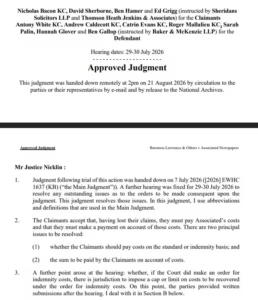
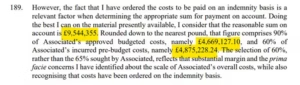
The High Court’s August 2026 costs judgment in the Associated Newspapers litigation, showing the indemnity costs decision and £9,544,355 interim payment.
How Much Money Is Involved in the Thomson Heath Jenkins Closure?
The financial figures associated with this case have frequently appeared together in headlines, but they represent different liabilities and stages of the costs process.
Our analysis separates them to avoid confusing the firm’s commercial difficulties with the claimants’ court-ordered payments.
| Financial figure | What it represents |
| £34,481,622.54 | Legal costs Associated Newspapers reported incurring by 9 July 2026 |
| £9,544,355 | Interim payment ordered from the seven claimants |
| £4,669,127.10 | Component representing 90% of approved budgeted costs |
| £4,875,228.24 | Component representing 60% of incurred pre-budget costs |
| £16 million | Reported after-the-event insurance protection available to the claimants |
| 6 November 2026 | Reported deadline for the relevant appeal notice |
The £9.54 million payment was an interim amount, not a final assessment of the publisher’s recoverable costs.
Likewise, the total £34.48 million claimed by Associated Newspapers had not automatically become the amount the claimants were required to pay.
The eventual recoverable figure may depend on detailed assessment, agreement between the parties and any successful legal challenge.
Does Thomson Heath Jenkins Owe £34.5 Million?
There is no verified evidence establishing that Thomson Heath Jenkins itself owes the full £34.5 million.
The reported legal costs concern Associated Newspapers’ claim against the unsuccessful litigants.
Separate questions may arise about the law firm’s own unpaid expenses, contractual arrangements with barristers and suppliers, professional liabilities and the recovery of fees for work undertaken.
Those amounts have not been established by the publicly available closure reporting.
Confusing them would materially overstate what is known about the firm’s financial position.
What Does the £16 Million Insurance Cover Mean?
The claimants reportedly held after-the-event insurance providing up to £16 million of protection against specified litigation costs.
Matthew Kain, chief executive of legal costs specialist Kain Knight, commented on the importance of this protection following the August ruling.
He said:
“This shows how critically important it is for claimants to take out insurance before they issue a claim.”
Kain also highlighted the potential personal exposure of claimants if recoverable costs ultimately exceeded the available insurance protection.
The insurance figure is equivalent to approximately 46.4% of Associated Newspapers’ reported £34.48 million costs.
That percentage is a comparison of two reported amounts, not an estimate of what insurers will actually pay.
Policy conditions, exclusions, coverage limits and the final assessed costs may all affect the outcome.
Importantly, the claimants’ after-the-event insurance should not be confused with the professional indemnity insurance maintained by a regulated solicitor’s practice.
Is Thomson Heath Jenkins Officially Bankrupt or in Liquidation?
The terminology used to describe the closure deserves careful attention.
Some reports have described Thomson Heath Jenkins as bankrupt, while others refer to insolvency practitioners and a cessation of trading.
For a UK limited company, formal insolvency procedures commonly include administration and liquidation. Bankruptcy generally refers to individuals rather than the usual insolvency procedure for a limited company.
Our review of the official Companies House registration for Thomson Heath & Associates Limited found that the company remained listed as active on 29 October 2026.
Its filing history showed accounts for the financial year ending 31 March 2025, filed in December 2025, and a confirmation statement filed in April 2026.
The latest listed accounts were historical financial statements, not a current assessment of the firm’s liquidity in October 2026.
| Corporate position | Finding |
| Trading operations | Reported to have ceased |
| Fleet Street office | Reported closed |
| Insolvency specialists | Reportedly engaged |
| Companies House registration | Active |
| Publicly established final insolvency outcome | Not yet confirmed |
| Exact liabilities and creditor recoveries | Not publicly established |
A company can stop providing services before its registered status changes.
The appointment or engagement of insolvency advisers does not, by itself, establish that liquidation has been completed.
This distinction matters for creditors because their recovery rights and the people responsible for handling claims depend on the actual legal process.
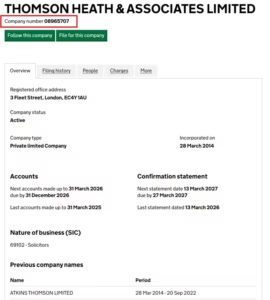
Companies House registration for Thomson Heath & Associates Limited, company number 08965707, displaying its active status and Fleet Street registered address as checked on 29 October 2026.
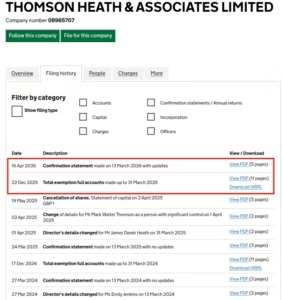
Companies House filing history showing the latest available annual accounts and confirmation statement for Thomson Heath & Associates Limited.
What Does the Closure Reveal About Financial Risk in London’s Legal Sector?
The Thomson Heath Jenkins closure highlights a commercial problem that can affect even highly regarded professional-services businesses: expertise and reputation do not necessarily provide protection against cash-flow disruption.
From a financial-management perspective, the distinction between potential earnings and cash received is critical.
A litigation practice may appear to have substantial work in progress, but that work does not automatically translate into available cash.
Where payment depends on winning a case, the risk becomes more pronounced.
Consider a hypothetical specialist practice that allocates 50% of its fee-generating resources to one major dispute.
If that case continues for an extended period without producing recoverable fees, the firm still needs to meet payroll and operating expenses.
The potential business impact can extend well beyond the value of the original instruction.
How Can Case Concentration Affect a Law Firm’s Finances?
The following example illustrates the possible commercial exposure of a hypothetical practice. It does not represent Thomson Heath Jenkins’ actual accounts.
| Share of fee-generating capacity committed to one case | Illustrative business exposure |
| 20% | A failed recovery creates pressure on one part of the practice |
| 40% | A significant share of work may produce little or no recoverable fee income |
| 60% | Dependence on one outcome may threaten the broader firm’s liquidity |
| 80% | Failure could create an exceptionally severe concentration problem |
These percentages are scenarios rather than industry failure probabilities or ratings assigned to Thomson Heath Jenkins.
They demonstrate why smaller specialist practices should measure work in progress, expected fee recovery and the proportion of resources dependent on particular outcomes.
The commercial principle also applies outside legal services.
A consultancy relying on a single enterprise client, an engineering contractor dependent on one major project or an agency working primarily for one customer can face similar concentration risk.
Our wider examination of how businesses are valued in the UK shows why predictable earnings, client diversification and sustainable cash generation can be more important than reputation alone.
For legal practices, the challenge is particularly acute when senior fee earners and specialist resources are committed to lengthy proceedings with uncertain outcomes.
Can Professional Insurance Protect a Law Firm From Closure?
Insurance can help protect a professional practice against specific liabilities, but it does not guarantee financial survival.
Professional indemnity insurance typically responds to covered claims arising from professional services, subject to the policy terms.
It does not automatically replace fees lost because a client loses a case or compensate a business for unsuccessful commercial decisions.
For company owners evaluating broader protection, understanding the difference between professional indemnity, business interruption and other forms of business insurance is essential.
The Thomson Heath Jenkins situation demonstrates why litigation funding, insurance protection, working capital and revenue concentration must be considered together rather than independently.
How Reputable Was Thomson Heath Jenkins Before Its Closure?
The reported shutdown is particularly notable because the firm had continued to receive professional recognition shortly before the news emerged.
On 15 October 2026, just one week before the first closure reports, Thomson Heath Jenkins announced its recognition in the Chambers and Partners UK Guide 2027.
The practice was recognised for its defamation and reputation management expertise, while founder Mark Thomson retained a Band 1 ranking.
Other members of the practice also received recognition for their specialist legal work.
Mark Thomson had previously been involved in major phone-hacking litigation and represented public figures including Sienna Miller and Sadie Frost.
In earlier proceedings involving Mirror Group Newspapers, Frost secured a privacy damages award of £260,000.
These achievements help explain why the firm’s reported closure attracted considerable interest across London’s legal community.
However, professional rankings reflect legal capability and market reputation. They are not financial audits or guarantees that a company has sufficient liquidity to meet its obligations.
A highly rated professional practice can experience financial difficulty even when its lawyers remain respected for their expertise.
The timing also illustrates how quickly the public picture of a business can change when operational problems become known.
What Happens to Thomson Heath Jenkins Clients After the Closure?
For clients with ongoing matters, the practical consequences may be more urgent than the firm’s eventual corporate status.
An outstanding court deadline, pending settlement, document transfer or unresolved payment cannot necessarily be delayed simply because the original solicitor’s practice has ceased trading.
Clients should establish who currently has responsibility for their instructions and whether another regulated solicitor has been appointed to take over their matter.
The Solicitors Regulation Authority’s public register identifies the practice under SRA number 621106 and provides information about its regulatory status.
Clients who have not received clear communication should take the following steps:
- Confirm responsibility for their case. Establish whether the original solicitor, another solicitor or a successor firm is handling the matter.
- Check urgent deadlines. Review forthcoming hearings, appeal deadlines, limitation dates and contractual obligations.
- Request client documents. Ask where case files, original documents and relevant correspondence are being held.
- Clarify any money held. Request a statement showing client funds, outstanding bills and payments already made.
- Contact the SRA when necessary. If the firm cannot be contacted or client interests appear to be at risk, seek regulatory guidance.
A client should not assume that another practice will automatically continue the legal work without arrangements being agreed.
The SRA’s published guidance explains that firms closing voluntarily should arrange for ongoing work, client papers and client money to be managed appropriately.
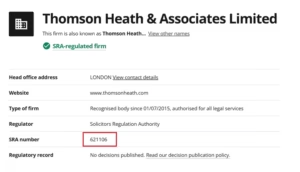
Solicitors Regulation Authority record for Thomson Heath & Associates Limited, showing SRA number 621106, its trading names and registered office.
What Could the Closure Mean for Employees and Creditors?
The reported closure creates uncertainty for employees, suppliers, barristers and other professionals with outstanding financial arrangements involving the practice.
However, the number of employees affected, any redundancies, outstanding salary obligations and the firm’s full creditor position have not been publicly confirmed.
An orderly closure may involve transferring files, resolving existing obligations and coordinating administrative arrangements before the company’s final legal status changes.
Where an employer enters a qualifying insolvency procedure, affected employees may have access to statutory protections for certain unpaid employment entitlements, subject to eligibility and applicable limits.
Those protections should not be assumed to apply until the relevant employment and insolvency circumstances are established.
For commercial creditors, the priority is determining the identity of the contracting company and whether a formally appointed insolvency office-holder is responsible for receiving claims.
A creditor who supplied services to the practice should preserve invoices, engagement agreements and evidence of work completed.
It is also important to distinguish the debts of the law firm from those of its litigation clients.
The two are not interchangeable simply because they arose in connection with the same High Court proceedings.
What Happens Next for Thomson Heath Jenkins?
Several developments will determine the longer-term consequences of the reported closure.
- Formal insolvency filings: Any new Companies House records or official insolvency notices could clarify whether the business enters liquidation, administration or another process.
- Client arrangements: The outcome of the orderly closure process will determine how ongoing instructions and retained documents are handled.
- Legal costs assessment: The final recoverable costs in the Associated Newspapers litigation remain a separate financial question from the firm’s own liabilities.
- Appeal proceedings: A deadline of 6 November 2026 has been reported for the relevant appeal notice. Any appeal, if pursued, could affect the wider legal dispute, although the firm’s future involvement is uncertain.
- Staff and creditor claims: Further information may identify the relevant parties responsible for dealing with employment liabilities and outstanding commercial debts.
From a London business perspective, the closure represents a substantial development in the specialist media-law market.
A firm associated with major privacy litigation, prominent clients and respected lawyers has reportedly ceased trading within months of an exceptionally expensive court defeat.
What remains unresolved is the extent to which that defeat contributed to the firm’s financial position, the structure of its closure and the ultimate consequences for outstanding matters.
Conclusion
The Thomson Heath Jenkins closure is more than a high-profile legal industry story involving Prince Harry and the Daily Mail.
It illustrates the financial uncertainty that can arise when a specialist professional-services business commits considerable resources to complex litigation with uncertain revenue recovery.
The verified position is that the Fleet Street practice has reportedly ceased trading, insolvency specialists have become involved and the SRA is monitoring the orderly closure. The underlying company nevertheless remained marked active in the Companies House records checked on 29 October 2026.
The £34.48 million costs figure, the £9.54 million interim payment and the reported £16 million insurance protection are important parts of the surrounding litigation, but they do not establish the law firm’s own total debts.
Our assessment is that the most significant unanswered questions now concern the firm’s formal insolvency position, the transfer of client matters, creditor exposure and the future of the litigation.
For London’s legal and professional-services sector, the wider commercial lesson is clear: legal expertise, professional recognition and prominent clients cannot replace adequate cash-flow management, diversified earnings and disciplined financial risk control.
Frequently Asked Questions
Has Thomson Heath Jenkins permanently closed?
The firm reportedly ceased trading and closed its Fleet Street office in October 2026. Its final corporate insolvency outcome has not yet been confirmed through the available public records.
Why did Thomson Heath Jenkins shut down?
The closure followed its involvement in an unsuccessful privacy lawsuit against Associated Newspapers. However, the precise financial causes have not been fully established.
Did Prince Harry cause Thomson Heath Jenkins to close?
There is insufficient evidence to make that claim. The firm worked on litigation involving seven claimants, and its complete financial circumstances have not been publicly disclosed.
Is Thomson Heath Jenkins liable for £34.5 million?
No publicly verified finding establishes that liability. The £34.48 million represents costs reported by Associated Newspapers in the litigation involving the seven claimants.
Who owns Thomson Heath Jenkins?
Mark Thomson is identified as the controlling shareholder of Thomson Heath & Associates Limited. The firm’s other directors include James Heath and Emily Jenkins.
Can clients recover their documents or money?
Clients should contact the responsible solicitor or closure team and seek guidance from the SRA if necessary. Recovery arrangements depend on the circumstances and any formal regulatory intervention.
Will Prince Harry appeal the High Court ruling?
Appeal proceedings have been discussed publicly, with a relevant deadline reported as 6 November 2026. An appeal outcome should not be assumed before further court developments are confirmed.