
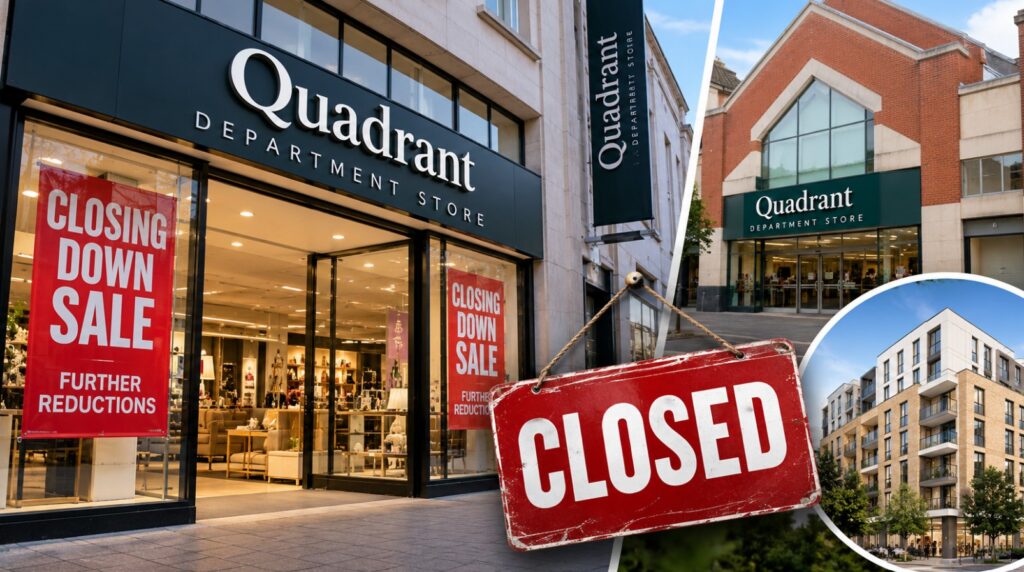








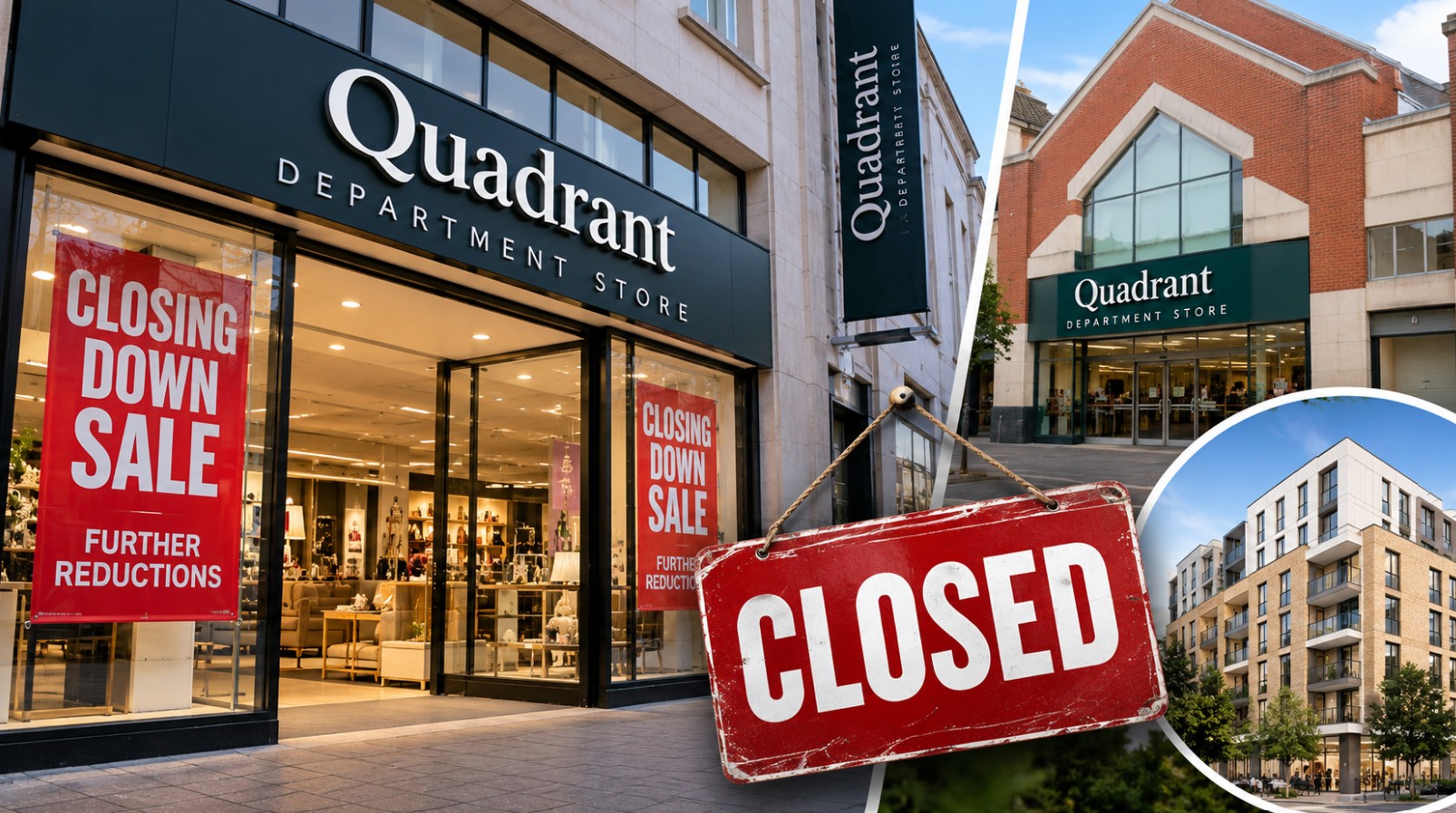
The Quadrant department store closure marked the end of one of Essex’s longest-established retail traditions. On 25 October 2025, the independent department stores in Chelmsford and Braintree permanently closed following years of financial losses, changing consumer habits and increasing pressure on traditional high-street retail.
Owned by Chelmsford Star Co-operative Society, Quadrant had built a reputation for furniture, fashion, homeware and personalised customer service. However, the business had reportedly failed to generate a profit since 2008, making continued operations increasingly difficult.
Our analysis of the closure announcements, business developments and subsequent property records examines why the stores could no longer remain commercially viable, what happened to employees, how customers were affected and what the former retail locations could become.
What Happened to Quadrant Department Stores?
Quadrant permanently closed both its Essex department stores on Saturday, 25 October 2025, following a decision made earlier that year by Chelmsford Star Co-operative Society.
The closure affected two locations:
| Department store | Location | Final trading date | Current status |
|---|---|---|---|
| Quadrant Chelmsford | 220 Moulsham Street, Chelmsford | 25 October 2025 | Permanently closed |
| Quadrant Braintree | George Yard Shopping Centre, Braintree | 25 October 2025 | Permanently closed |
The decision ended the Quadrant department store operation rather than simply reducing the number of branches.
The company had operated in Chelmsford since 1881, while its Braintree store opened in 1991. Both locations became important retail destinations for shoppers seeking household furnishings, fashion brands and personal customer service.
According to the owner’s public statements, long-term financial losses made the business unsustainable.
Our review identifies three important facts:
- 100% of the Quadrant department store estate closed, representing both branches.
- 51 employees were affected by the closure programme, although this does not establish that all 51 ultimately became redundant.
- Neither store had reportedly made a profit since 2008, indicating that financial challenges existed long before the final closure announcement.
The closure should also be distinguished from the wider Chelmsford Star co-operative business. The department stores closed, but other co-operative services continued under the group’s new ownership arrangements.
Why Did Quadrant Department Stores Close Permanently?
The main reason for the Quadrant department store closure was sustained financial underperformance.
Chelmsford Star Co-operative Society explained that its department stores had experienced substantial and continuing losses for many years.
The business reportedly had not generated a profit since 2008. This suggests that the closure was not simply the result of a temporary decline in consumer confidence or a single difficult trading year.
From a commercial perspective, a business that consistently struggles to generate operating profit eventually faces difficult decisions over investment, staffing, store maintenance and future viability.
1. Long-Term Financial Losses
Department stores typically operate with significant fixed costs, including property expenditure, staffing, utilities, stockholding and building maintenance.
Many of these expenses remain even when customer numbers decline.
For example, imagine a hypothetical department store generating £4 million in annual revenue with a gross profit margin of 35%.
That would produce £1.4 million in gross profit before deducting operating costs. If wages, property expenditure, administration and other expenses exceeded this amount, the business would remain loss-making despite generating millions of pounds in sales.
This is an illustrative model, not a representation of Quadrant’s unpublished financial accounts.
For Quadrant, the crucial evidence was the duration of its reported losses.
A retailer can sometimes survive a difficult year by drawing on reserves or adjusting expenditure. Maintaining a loss-making operation for more than a decade creates a significantly more complicated commercial problem.
2. Competition From Online Retailers
Online shopping has fundamentally changed the economics of traditional department stores.
Customers can now compare furniture prices, clothing collections, product reviews and delivery options without visiting a physical shop.
Large online retailers may also offer wider product selections and use distribution systems that differ substantially from those of a traditional high-street store.
However, it would be misleading to suggest that ecommerce alone caused Quadrant’s closure.
The company’s financial difficulties predated the pandemic and the most recent developments in online retail.
Digital competition likely added pressure to an already challenging business model.
3. Changing Consumer Spending Patterns
Department stores depend heavily on discretionary spending.
Furniture, clothing and home accessories are purchases that households can often postpone when financial circumstances become uncertain.
For consumers facing increased mortgage payments, household bills or other financial commitments, discretionary retail spending can become less of a priority.
This has consequences for businesses selling larger household purchases.
A customer delaying a £1,500 sofa purchase can have a greater immediate effect on a furniture department’s sales than a modest reduction in spending on everyday essentials.
Retailers therefore need sufficient sales volume and gross margins to cover their ongoing operating expenses.
4. Pressure From Physical Retail Costs
Traditional department stores occupy relatively large retail premises.
These properties may require substantial expenditure on heating, lighting, maintenance, security and staffing.
A large store must also maintain enough inventory and selling space to justify its operating costs.
For independent retailers, spreading these expenses across only a small number of locations can be more difficult than for national chains with larger purchasing and distribution networks.
There is no publicly verified cost breakdown establishing exactly how much Quadrant spent on each category.
Nevertheless, the relationship between fixed costs, sales and gross profit is essential to understanding why prolonged losses eventually make a retail operation difficult to sustain.
5. Reduced Scope for a Sustainable Turnaround
When a retailer has struggled financially for many years, management must assess whether further investment would realistically improve profitability.
A turnaround might involve reducing floor space, improving stock management, renegotiating occupancy costs or building a stronger online operation.
Each option requires a financial assessment.
More investment is not necessarily the best decision if the expected returns remain below the cost of maintaining the business.
In Quadrant’s case, the board concluded that permanently closing the stores was necessary.
That decision illustrates the difference between a business with a recognised local brand and one capable of maintaining financial sustainability.
When Was the Quadrant Department Store Closure Announced?
The closure developed over several months rather than happening without warning.
| Date | Development |
|---|---|
| May 2025 | Chelmsford Star’s board approved a proposal to close both Quadrant stores |
| June 2025 | The planned closures became public, with long-term financial losses identified as the principal reason |
| 15 September 2025 | Chelmsford Star transferred into Central Co-op |
| 24 September 2025 | A public farewell and clearance-sale announcement was published |
| 2 October 2025 | The final closing-down sale began |
| 13 October 2025 | Further reductions were announced |
| 25 October 2025 | Both stores closed permanently |
| July 2026 | A proposed conversion of the Chelmsford store’s upper floors into 41 apartments received prior approval |
| September 2026 | A further proposal for seven additional apartments was submitted |
The timeline shows that the closure decision preceded the September 2025 transfer into Central Co-op.
This distinction is important because the merger should not automatically be described as the direct cause of the department stores shutting.
The underlying financial difficulties were already established.
How Did the Closure Affect Quadrant Employees?
The closure programme affected 51 employees across the two department stores.
Chelmsford Star worked with the retail trade union USDAW as part of the consultation and employee-support process.
The organisation also indicated that redeployment opportunities elsewhere in the business would be explored.
However, the number of employees affected is not necessarily identical to the number ultimately made redundant.
Some workers may have had opportunities to move into alternative roles, while others could have left through redundancy or different arrangements.
The precise final breakdown has not been publicly established in the material reviewed.
From an employment perspective, store closures raise several important issues:
- Whether suitable alternative employment is available.
- Whether an employee qualifies for statutory redundancy pay.
- The employee’s contractual and statutory notice entitlement.
- Payment for outstanding annual leave.
- Whether the employer followed the necessary consultation procedures.
Retail employers must assess the legal requirements applicable to their circumstances. Collective consultation obligations depend on factors including the number of proposed redundancies at a particular establishment within the relevant period.
The closure also affected the loss of retail experience built up over many years.
Long-serving department store employees often develop specialist knowledge of furniture, product selection and individual customer requirements.
For an established community retailer, losing that experience represents more than a reduction in staff numbers.
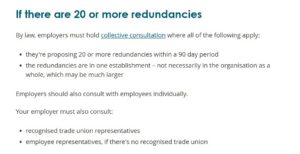
Official Acas guidance explaining employee consultation requirements during a business closure or redundancy programme.
What Happened During Quadrant’s Final Closing-Down Sale?
Before closing, Quadrant organised a major clearance sale across both stores.
The event began on 2 October 2025, allowing the retailer to reduce its remaining stock before permanent closure.
Final reductions were subsequently announced on 13 October.
The official clearance information included:
| Product category | Advertised final discount |
|---|---|
| Furniture and sofas | 55% off |
| Beds and mattresses | 55% off |
| Fashion | 30%–70% off |
| Mirrors and rugs | More than 50% off |
| Housewares and small electricals | 40% off |
These were historical promotional discounts, not offers available in October 2026.
Furniture brands associated with the closing-down sale included G Plan, Ercol, Relyon, Hypnos and Harrison Spinks.
The sale also featured clothing and other household products, with the available brands and items varying between stores.
Why Were Discounts So High?
Large clearance discounts can serve an important operational purpose when a retailer is permanently closing.
Remaining stock occupies space, requires handling and may create additional costs if it cannot be sold before the premises are vacated.
A retailer may therefore accept a lower selling price rather than incur further storage, transportation or disposal expenses.
For example, a 55% discount reduces a product with an original selling price of £1,000 to £450.
That does not establish whether the retailer made a profit or loss on the individual sale, because the original purchase cost and other expenses are unknown.
Our assessment is that the final sale represented an inventory-disposal strategy rather than evidence that the underlying retail operation had returned to profitability.
Was the Quadrant Closure Connected to the Central Co-op Merger?
Quadrant’s closure occurred during a wider organisational change involving Chelmsford Star Co-operative Society.
The society transferred into Central Co-op on 15 September 2025, following approval by members.
This brought Chelmsford Star’s continuing operations into a larger co-operative organisation.
Central Co-op confirmed that local co-operative services and membership arrangements would continue, with existing membership benefits maintained.
The distinction between the department store closure and the wider organisational transfer is financially significant.
The decision to close Quadrant had been made in May 2025, before the transfer was completed.
Consequently, describing the department stores as having closed simply because Central Co-op acquired the organisation would misrepresent the chronology.
A more accurate interpretation is that Chelmsford Star was already dealing with prolonged losses in its department store operation while undergoing a broader structural transition.
From a strategic business perspective, this illustrates how different divisions within a diversified organisation can have very different commercial prospects.
A co-operative may maintain viable food, travel or funeral operations while concluding that a particular non-food retail format is no longer commercially sustainable.
This does not mean that every other service owned by the society faced closure.
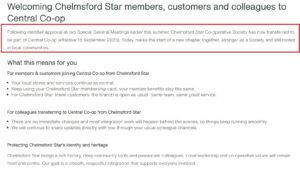
Central Co-op confirms the transfer of Chelmsford Star on 15 September 2025 and explains the arrangements for continuing services.
Did Quadrant Department Stores Go Into Administration?
There is an important distinction between closing a loss-making retail division and a company entering administration.
The Quadrant department stores were closed following a decision by Chelmsford Star Co-operative Society.
The available closure announcements do not establish that the Quadrant business was placed into a separate formal administration process.
The wider co-operative organisation also continued through its transfer into Central Co-op.
This matters because administration, liquidation, voluntary closure and corporate restructuring are different legal and commercial events.
Administration generally involves a formal insolvency process intended to achieve an outcome for creditors, while a business may close particular operations without the wider organisation being insolvent.
Customers and employees should therefore not automatically assume that an insolvency practitioner was appointed simply because the department stores shut.
A useful comparison is the continuing restructuring of other British retailers.
For example, Shoe Zone’s store closure programme demonstrates how individual shop closures can form part of wider estate-management decisions without the entire retail company ceasing to operate.
Understanding the legal and commercial distinction helps readers avoid drawing incorrect conclusions from closure headlines.
What Happens to Quadrant Customers With Orders, Gift Cards or Warranties?
One of the most important questions following a department store closure concerns customers who bought goods shortly before trading ended.
Because Quadrant sold furniture and mattresses, customers may have placed orders for products requiring delivery after the purchase date.
Quadrant subsequently stated publicly that deliveries of outstanding furniture orders were continuing after the shops closed.
However, that historical assurance should not be treated as confirmation of the status of any particular order in October 2026.
Outstanding Furniture Orders
Customers who believe an order remains unresolved should retain their original receipt, order confirmation, payment details and any delivery correspondence.
The first step is to contact the relevant continuing co-operative customer-service operation to establish responsibility for the contract.
A customer should not assume that an undelivered order was automatically cancelled when the physical shop closed.
Gift Cards and Vouchers
Unused gift cards require separate consideration.
Whether a voucher can be redeemed or refunded depends on its terms, issuer and the arrangements made following the closure.
No current universal redemption arrangement for all former Quadrant vouchers has been established by our review.
Customers should therefore check the voucher’s original conditions and contact the issuer rather than assuming that Central Co-op automatically accepts it.
Faulty Products and Warranties
Store closure does not automatically erase rights attached to a purchase.
The Consumer Rights Act 2015 establishes statutory standards for goods supplied by traders.
However, the practical route for seeking a refund, repair or replacement depends on the identity of the legal seller and the circumstances.
A manufacturer’s guarantee may provide an additional route for support, but it is not a substitute for statutory consumer rights.
Card Payments and Refund Protection
Customers with unresolved purchases may also be able to approach their card provider.
Section 75 protection can apply to qualifying credit-card transactions where the cash price of the item or service is over £100 and no more than £30,000, subject to the relevant legal conditions.
Chargeback may offer another route for eligible card transactions, although it is a card-scheme process rather than an automatic legal entitlement.
These options depend on the payment method, transaction and applicable time limits.
Importantly, Quadrant’s closure should not be treated as proof that its wider legal seller became insolvent.
Anyone with an unresolved purchase should establish the responsible business and seek appropriate consumer advice.
For a wider illustration of how consumer remedies differ when a company is formally wound up, the FunnyFuzzy Tech UK closure highlights the additional complications associated with liquidation and unpaid customer claims.
What Will Happen to the Former Quadrant Store in Chelmsford?
One of the most significant developments after the closure concerns the former Chelmsford department store at 220 Moulsham Street.
Planning records show that a proposal to convert upper-floor commercial space into 41 residential apartments received prior approval on 21 July 2026.
The relevant planning reference is 26/00638/CUPAMA.
A separate application, reference 26/01120/CUPAMA, was submitted in September 2026 proposing seven additional residential units.
The later application would increase the proposed total to 48 apartments if approved alongside the earlier scheme.
As of the latest planning information reviewed in October 2026, the additional seven-unit application was awaiting a decision.
The approval for the initial 41 apartments should not be confused with evidence that construction is complete or that residents have moved into the building.
What Does the Redevelopment Mean for Chelmsford?
The potential conversion illustrates an increasingly important consideration for owners of large town-centre commercial properties.
Buildings designed for traditional department stores may no longer attract sufficient demand from retailers needing several floors of selling space.
Residential conversion can represent an alternative use, subject to planning requirements, physical suitability and financial viability.
A mixed-use approach may also allow parts of a building to retain commercial functions while upper floors serve a different purpose.
For town centres, this creates both opportunities and trade-offs.
Additional residents may support nearby shops, restaurants and local services. However, the loss of traditional retail space can reduce the range of businesses available in a particular location.
The financial outcome ultimately depends on development costs, property demand, planning conditions and the feasibility of the proposed conversion.
What Has Happened to Quadrant’s Braintree Location?
Quadrant’s Braintree store operated within the George Yard Shopping Centre.
Its closure removed an established non-food retailer from the town-centre shopping environment.
The former store’s future use should be considered separately from the Chelmsford redevelopment.
There is no basis for assuming that the Braintree premises are subject to the same residential conversion proposals.
Following the closure, the co-operative’s Braintree travel operation separately publicised its relocation to premises within George Yard.
That distinction is important for customers who previously associated the travel service with the department store.
The closure of the main retail business did not necessarily mean that all services previously connected with the Quadrant premises ceased.
For Braintree, the longer-term commercial impact will depend partly on whether the former retail space attracts replacement tenants and how the surrounding shopping area performs.
Large vacant units can create challenges for neighbouring businesses, particularly when they previously attracted regular customers.
However, a replacement tenant with a different retail or service proposition could eventually create new footfall.
Without verified local footfall and vacancy data, the precise financial effect on neighbouring shops cannot be quantified.
What Does the Quadrant Closure Reveal About UK High-Street Retail?
The closure illustrates several structural issues facing traditional department stores.
Our analysis identifies the most important commercial lesson as the distinction between an established brand and a financially sustainable retail operation.
A business can have longstanding customer loyalty, considerable historical significance and an experienced workforce while continuing to experience losses.
Those strengths remain valuable, but they do not automatically offset declining sales or persistently high costs.
Our Editorial Assessment of Quadrant’s Retail Position
The following percentage ratings are qualitative editorial assessments based on the publicly documented closure circumstances. They are not audited business results, customer-survey findings or measured financial probabilities.
| Assessment category | Editorial rating | Explanation |
|---|---|---|
| Historical and community significance | 95% | The co-operative’s long heritage and established local retail presence |
| Financial sustainability before closure | 5% | Persistent reported losses and the owner’s decision to cease trading |
| Ability of the traditional store model to withstand market changes | 25% | Significant exposure to changing shopping habits and physical-store operating costs |
| Certainty of the permanent closure | 100% | Both stores confirmed closed on 25 October 2025 |
| Potential for alternative use of the Chelmsford property | 80% | Initial residential conversion approval, with implementation still uncertain |
The ratings illustrate our interpretation of the available evidence and should not be used as a substitute for Quadrant’s financial statements or an independent property valuation.
Why Retailers Need to Monitor Store-Level Profitability
A diversified retailer should assess the performance of individual branches instead of relying entirely on company-wide revenue.
The key measures include gross profit, occupancy costs, labour expenses, inventory turnover, contribution margin and cash generation.
A store producing substantial revenue can still destroy value if the cost of generating those sales is greater than its contribution.
This is why store-level performance matters.
A business that waits until cash reserves are severely depleted may have fewer restructuring options available.
Why Digital Investment Is Not Automatically a Solution
An ecommerce platform can improve market reach, but it introduces additional expenditure.
Online retailers incur costs associated with payment processing, fulfilment, product returns, customer acquisition and technology.
Traditional department stores also face complicated stock-management decisions when operating physical and digital sales channels simultaneously.
Launching a website alone does not guarantee that a loss-making retail operation becomes profitable.
A successful multichannel strategy needs to be financially justified.
Why Property Strategy Matters
Large high-street premises can be valuable assets, but their commercial usefulness depends on changing market demand.
When a building becomes difficult to operate profitably as a department store, owners may consider subdivision, alternative retailers, leisure use, offices or residential conversion.
The former Chelmsford store’s planning developments demonstrate how commercial property decisions may continue long after the retailer occupying the building has closed.
For business owners, this is an important reminder that operational decisions and property decisions should be assessed together.
Could Quadrant Department Stores Reopen?
There is no confirmed announcement establishing that Quadrant Department Stores will reopen in Chelmsford or Braintree.
Both branches permanently ceased trading in October 2025.
The subsequent planning developments involving the Chelmsford property suggest that alternative uses are being considered for at least part of the former store.
However, a planning application does not establish the future of the brand itself.
A genuine reopening would require a new and verifiable commercial announcement.
Until such an announcement exists, the correct position is that the original Quadrant department store operation has ended.
Final Thoughts
The Quadrant department store closure represents the end of a longstanding Essex retail institution and offers an important lesson about the financial pressures facing traditional high-street businesses.
Although the stores maintained a strong local identity, their continued losses made the existing business model difficult to sustain.
The closure affected 51 employees, ended a historic retail operation and prompted questions about the future use of prominent town-centre premises.
The later planning approval for apartments at the former Chelmsford store also demonstrates how the commercial consequences of retail closures can extend beyond the businesses themselves.
Our analysis suggests that the wider lesson is not simply that online shopping is replacing traditional stores. It is that retailers must continually evaluate profitability, operating costs, customer demand and long-term property commitments.
For independent businesses and co-operative retailers alike, commercial resilience depends on adapting before prolonged financial underperformance leaves too few viable options.
Frequently Asked Questions
When did Quadrant Department Stores close?
Both the Chelmsford and Braintree stores permanently closed on Saturday, 25 October 2025.
Why did Quadrant department stores shut down?
The owner attributed the closure to prolonged financial losses, with neither department store reportedly making a profit since 2008. Changing consumer shopping habits added to the pressure.
How many Quadrant stores closed?
Two stores closed: one in Chelmsford and one in Braintree. This represented the entire Quadrant department store operation.
How many employees were affected by the closure?
A total of 51 employees were affected. The final number who became redundant has not been independently established.
Was Quadrant closing because of the Central Co-op merger?
The closure decision preceded the completion of the merger. The department stores’ longstanding financial losses were the stated reason for shutting them.
What is happening to the former Chelmsford Quadrant building?
A conversion of its upper floors into 41 apartments received planning prior approval in July 2026. A further seven apartments were proposed in September 2026, with that additional application still awaiting a decision in the records reviewed.
Can customers still claim refunds for Quadrant purchases?
Potentially, depending on the purchase, legal seller and payment method. Customers should retain their evidence and contact the responsible business or their card provider where appropriate.
Is Quadrant Department Store reopening in 2026?
There is no verified reopening announcement. Both original department stores remain permanently closed.