



















Finding the best small business accounting software is no longer simply about replacing spreadsheets.
For UK businesses in 2026, accounting software can play a central role in invoicing, expense tracking, bank reconciliation, VAT returns, cash-flow monitoring, payroll and Making Tax Digital compliance.
Making Tax Digital for Income Tax became mandatory from 6 April 2026 for qualifying sole traders and landlords with annual qualifying income above £50,000.
The threshold is scheduled to fall to more than £30,000 from April 2027 and more than £20,000 from April 2028. Businesses affected by the rules need compatible software capable of maintaining digital records and sending the required information to HMRC.
The right accounting platform nevertheless depends on much more than MTD. A freelance consultant may prioritise invoicing and Self Assessment, while a growing limited company may need payroll, inventory, project profitability, multiple users and detailed management reporting.
Businesses that are still establishing their financial systems should ideally set up bookkeeping alongside banking and tax administration rather than waiting for the first filing deadline.
This is particularly important when starting a small business in the UK, because clean financial records are considerably easier to establish from the first transaction than reconstruct later.
Best Small Business Accounting Software at a Glance
The following ranking considers UK suitability, accounting functionality, Making Tax Digital support, pricing, usability, integrations, automation and how well each package can grow with a business.
| Rank | Accounting Software | Best For | Starting or Typical Price* |
| 1 | Xero | Growing small businesses | From £18/month |
| 2 | QuickBooks Online | All-round small business accounting | From £16/month |
| 3 | Zoho Books | Value and automation | Free plan available |
| 4 | FreeAgent | Freelancers and sole traders | From £19/month; free with eligible banks |
| 5 | Sage Accounting | Businesses needing accounting and payroll | From £20/month |
| 6 | Pandle | Low-cost bookkeeping | Free or £5/month |
| 7 | QuickFile | Very small and low-transaction businesses | Free or £60/year |
| 8 | FreshBooks | Consultants and service businesses | From £16/month |
| 9 | Clear Books | UK sole traders and small businesses | Free and paid plans |
| 10 | IRIS KashFlow | Traditional UK SMEs | From £13.50/month |
| 11 | Countingup | Banking and accounting in one app | From £5/month |
| 12 | Coconut | Sole traders and landlords | From £12.99/month for MTD filing |
| 13 | Crunch | Businesses wanting software plus accountancy support | Software/accountancy options available |
| 14 | AccountsPortal | Straightforward cloud bookkeeping | Starting from £10/month |
| 15 | VT Transaction+ | Desktop bookkeeping | £90 + VAT/year |
| 16 | Tide Accounting | Tide customers wanting integrated accounting | From £13.99/month |
| 17 | ANNA Auto Accountant | Automated banking and bookkeeping | £29/month add-on |
| 18 | AccountsOS | AI-led accounting | Around £20/month |
| 19 | Odoo Accounting | Businesses wanting accounting within an ERP | Free and paid plans |
| 20 | Sage 50 Accounts | Established businesses wanting desktop-style depth | Higher-tier pricing |
*Headline prices are indicative standard or entry prices checked in September 2026 and normally exclude VAT. Promotional discounts, annual billing and feature limits can significantly change the effective cost.
1. Xero
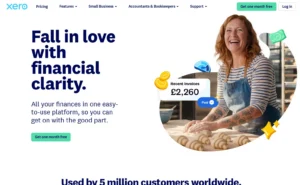
Best for: Growing businesses that want a strong accounting ecosystem
Xero remains one of the strongest choices for UK small businesses that expect their accounting requirements to become more complicated over time.
Its entry-level Ignite plan has a standard price of £18 per month excluding VAT, although introductory discounts are frequently available.
It includes bank reconciliation, smart document capture, reporting, MTD for Income Tax support and direct VAT submissions to HMRC. Higher plans expand invoicing, bills, analytics, expenses and other capabilities.
One of Xero’s biggest advantages is its wider software ecosystem. Businesses can connect accounting records with payment systems, ecommerce platforms, payroll, inventory management and numerous specialist applications.
Xero is particularly attractive when an external accountant already works within the Xero ecosystem because both parties can work from the same financial information.
Key strengths:
- Strong bank reconciliation
- Mtd functionality
- Vat filing
- Extensive integrations
- Cash-flow visibility
- Accountant collaboration
- Scalable plans
- Payroll options.
Potential drawback: The lowest plan limits invoices and bills, so an active business may need to move onto a higher subscription relatively quickly.
2. QuickBooks Online
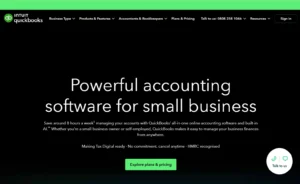
Check the QuickBooks Software Here
Best for: Small businesses wanting broad accounting and reporting tools
QuickBooks Online is another major contender for the best small business accounting software in the UK.
QuickBooks Simple Start currently has a standard price of around £16 per month plus VAT, while Essentials, Plus and Advanced provide progressively greater functionality and additional users
. Its features include invoicing, receipt capture, mileage tracking, bank feeds, reporting, cash-flow insights and direct HMRC submissions.
The Plus plan is particularly relevant to businesses requiring stock management, budgeting or project profitability.
QuickBooks also incorporates increasing levels of automation and AI-assisted categorisation, which can reduce repetitive bookkeeping work.
Key strengths:
- Strong financial reporting
- Receipt and mileage tracking
- Vat and mtd functionality
- Inventory on appropriate plans
- Project profitability
- Extensive app integrations
- Payroll available separately.
Potential drawback: Moving through the plans can make QuickBooks considerably more expensive than the initial headline subscription suggests.
3. Zoho Books
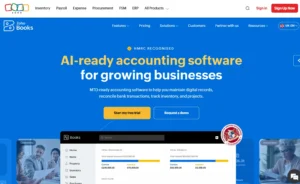
Check the Zoho Books Software Here
Best for: Businesses wanting excellent value and automation
Zoho Books deserves serious consideration because its feature-to-price ratio is exceptionally competitive.
There is a free plan, while Standard costs £12 per organisation per month, or £10 per month when billed annually. Professional starts at £24 monthly and introduces capabilities including purchase orders, vendor bills, multi-currency accounting and inventory.
Even the free plan includes invoicing, quotes, expenses, journals, receipt scanning, mileage tracking, recurring invoices, VAT returns and more than 50 reports.
Businesses already using Zoho CRM, Zoho Projects or other parts of the Zoho ecosystem may find the platform especially attractive.
Key strengths:
- Genuine free plan
- Low-cost paid plans
- Mtd vat filing
- Receipt scanning
- Extensive automation
- Customer portal
- Inventory on higher plans
- Strong reporting.
Potential drawback: Businesses needing a complete UK payroll solution may need an additional product or integration.
4. FreeAgent
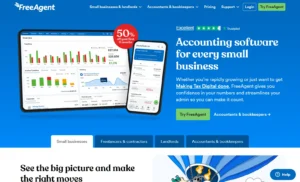
Check the FreeAgent Software Here
Best for: Freelancers, contractors and sole traders
FreeAgent has been designed heavily around smaller UK businesses rather than adapting a global accounting platform to UK requirements.
Standard pricing currently varies by structure. The regular monthly price is approximately £19 for a sole trader and £33 for a limited company, excluding VAT.
The major differentiator is that eligible business account customers with NatWest, Royal Bank of Scotland, Ulster Bank or Mettle can receive FreeAgent without paying the normal subscription charge.
Features include invoicing, expenses, automatic bank feeds, tax timelines, cash-flow forecasting, Self Assessment functionality and smart transaction categorisation.
Key strengths:
- Particularly strong for freelancers
- UK tax-focused
- Self assessment functionality
- Mtd compatible
- Invoicing and estimates
- Cash-flow forecasting
- Free for eligible banking customers.
Potential drawback: Larger businesses requiring sophisticated inventory or operational management may eventually outgrow it.
5. Sage Accounting
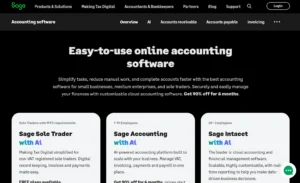
Check the Sage Accounting Software Here
Best for: Small employers and established UK businesses
Sage has been one of the most recognisable names in UK business accounting for decades, but its current cloud platform goes well beyond traditional bookkeeping.
Sage Accounting Start currently costs £20 per month excluding VAT after promotional pricing, while Standard and Plus increase functionality and user numbers. Sage currently bundles payroll and Sage Copilot into its accounting plans.
The software handles invoicing, bills, bank reconciliation, VAT, cash-flow management and financial reporting.
Standard introduces functionality suitable for businesses dealing with suppliers, CIS and accrual accounting, while Plus adds inventory and multi-currency capability.
Key strengths:
- Strong UK accounting heritage
- Payroll included
- Mtd-ready
- Vat submissions
- Cash-flow forecastin
- Cis functionality
- Inventory on higher plans
- Telephone support.
Potential drawback: Standard renewal prices can be substantially higher than introductory promotional prices.
6. Pandle
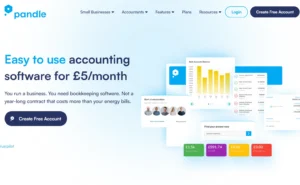
Check the Pandle Software Here
Best for: Businesses wanting accounting software on a very small budget
Pandle provides one of the lowest-cost entry points in the UK bookkeeping market.
There is a free version, while Pandle Pro costs just £5 per month plus VAT.
Pandle Pro includes bank feeds, receipt uploads, projects, cash-flow forecasting, stock control, multi-currency transactions and additional automation.
MTD Income Tax submissions and VAT returns are also supported through the relevant functionality.
Key strengths:
- Very low monthly price
- Free version available
- Unlimited users
- Vat submissions
- Bank feeds
- Invoicing
- Stock control
- Cash-flow forecasting.
Potential drawback: Its integration ecosystem is smaller than platforms such as Xero and QuickBooks.
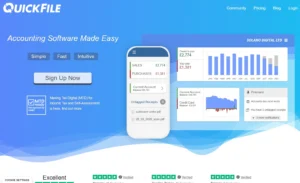
7. QuickFile
Check the QuickFile Software Here
Best for: Low-volume businesses wanting inexpensive accounting
QuickFile takes an unusual approach to pricing.
Very small accounts can use the software without a normal subscription charge, while businesses exceeding its free usage threshold move onto a £60 plus VAT annual subscription. Automated bank feeds are available separately.
The software includes invoicing, purchase and receipt management, reporting, multi-currency support, unlimited users and MTD-compatible VAT returns.
QuickFile also offers MTD Income Tax functionality through its Power User features.
Key strengths:
- Extremely low annual cost
- Unlimited users
- Vat filing
- Mtd income tax functionality
- Multi-currency
- API access
- No long-term contract.
Potential drawback: The interface may feel less polished than larger cloud-accounting platforms.
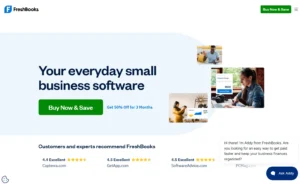
8. FreshBooks
Check the FreshBooks Software Here
Best for: Consultants, agencies and service businesses
FreshBooks has traditionally concentrated heavily on invoicing, time tracking and client management.
That makes it particularly suitable for service businesses that need to understand how much time is being spent on individual clients or projects.
Its Lite plan normally costs around £16 per month, although introductory promotions can reduce the initial cost. The plan supports unlimited invoices to five clients, expense tracking, quotations, reporting and MTD-compliant VAT returns.
Higher plans increase customer limits and add additional capabilities.
Key strengths:
- Excellent invoicing
- Time tracking
- Expense management
- Client-focused workflows
- Online payments
- Vat submissions
- Useful mobile functionality.
Potential drawback: Product-based businesses may find inventory-focused competitors more suitable.
9. Clear Books
Check the Clear Books Software Here
Best for: UK businesses wanting a domestic accounting platform
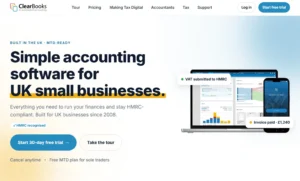
Clear Books is a UK-developed accounting platform serving sole traders, landlords, limited companies and other organisations.
Its sole-trader product supports bank connectivity, invoicing, bills and Making Tax Digital submissions.
Clear Books states that its software is recognised for both MTD for Income Tax and VAT, making it particularly relevant as more sole traders move into mandatory digital reporting.
Key strengths:
- Designed specifically for UK users
- Mtd income tax support
- Mtd vat
- Invoicing
- Bank feeds
- Uk-based support
- Options for different business structures.
Potential drawback: It has a smaller third-party ecosystem than the biggest cloud-accounting platforms.
10. IRIS KashFlow
Check the IRIS KashFlow Software Here
Best for: UK SMEs wanting straightforward bookkeeping
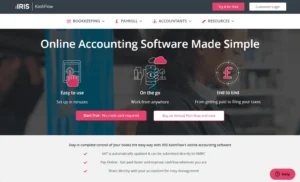
IRIS KashFlow provides accounting software aimed specifically at sole traders, contractors and small companies.
The Starter plan currently has a standard price of £13.50 per month, while Business is £27.50 per month before promotional discounts.
Starter includes VAT submissions, bank feeds, mileage tracking, receipt capture and more than 50 reports. Business removes several transaction restrictions and adds multi-user functionality.
Key strengths:
- Uk-focused
- Vat submissions
- Bank feeds
- Receipt capture
- Payroll included for a limited number of employees
- Multi-currency on appropriate plans
- Strong reporting.
Potential drawback: The Starter plan places limits on invoices and bank reconciliation.
11. Countingup
Check the Countingup Software Here
Best for: Owners wanting banking and accounting in one app
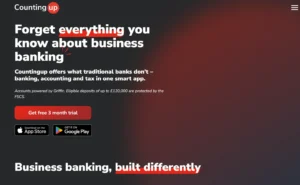
Countingup combines a business current account with bookkeeping and tax features.
Following its three-month free period, current monthly pricing is based on incoming deposits:
- £5 for deposits up to £750
- £12 for £750.01 to £7,500
- £20 for higher monthly deposits.
Its subscription includes invoicing, receipt capture, automatic categorisation, financial reporting, tax estimates and direct MTD-compliant VAT filing.
Combining banking and bookkeeping reduces the need to connect a separate accounting platform to a separate current account.
Best suited to: sole traders, freelancers and very small limited companies that want a mobile-first solution.
12. Coconut
Check the Coconut Software Here
Best for: Sole traders and landlords dealing with MTD
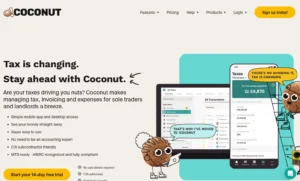
Coconut focuses primarily on self-employed people and landlords rather than trying to serve every type of company.
Its MTD Filing plan costs around £12.99 per month or £129.99 annually and includes digital bookkeeping, quarterly MTD submissions, an annual MTD submission and tax estimates.
It can automatically import transactions, categorise expenses, store receipts, produce invoices and connect to HMRC.
There is also an MTD bridging option for people who prefer to continue maintaining their records in spreadsheets.
Best suited to: sole traders or landlords wanting a simpler alternative to a full business accounting suite.
13. Crunch
Check the Crunch Software Here
Best for: Businesses wanting accounting software and professional accountancy together
Crunch occupies a different position from conventional DIY accounting software.
It combines proprietary accounting technology with access to professional accounting services. Its accountancy packages currently start around £27 plus VAT per month for sole traders, with limited-company services priced at a higher level.
This can suit owners who do not simply want software but also want support with accounts and tax responsibilities.
Key strengths:
- Bookkeeping software
- Invoicing
- Expenses
- Bank feeds
- Professional accounting support
- Packages for different business structures.
Potential drawback: Businesses that only need software may find cheaper standalone platforms elsewhere.
14. AccountsPortal
Check the AccountsPortal Software Here
Best for: Small businesses wanting simple, affordable cloud accounting
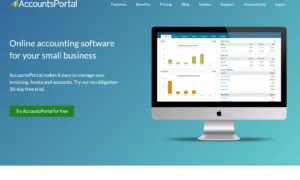
AccountsPortal is a straightforward cloud accounting platform designed for contractors, freelancers, sole traders and small businesses that want essential bookkeeping features without the complexity of a larger accounting ecosystem.
It currently costs £10 per month and provides access to all of its main features under a single pricing plan.
The subscription includes unlimited transactions and users, making it particularly attractive for small businesses that do not want their accounting costs to increase simply because they need to give an accountant, bookkeeper or employee access.
AccountsPortal supports invoicing, quotes, purchase orders, bank transactions, inventory and stock tracking, customer and supplier records, financial reporting and VAT accounting.
It is also recognised for Making Tax Digital for VAT and Making Tax Digital for Income Tax, allowing eligible users to maintain digital records and submit relevant information directly to HMRC.
Key strengths:
- Simple £10 monthly pricing
- Unlimited users
- Unlimited transactions
- Mtd for income tax support
- Mtd vat submissions
- Invoicing and quotes
- Inventory and stock tracking
- Purchase orders
- Real-time financial reporting
- Cloud access.
Potential drawback: AccountsPortal has a smaller integrations ecosystem than platforms such as Xero and QuickBooks, so businesses requiring a large selection of third-party apps may find the bigger platforms more flexible.
Best suited to: Sole traders, freelancers, contractors and small companies wanting affordable UK-focused cloud accounting without complicated subscription tiers.
15. VT Transaction+
Check the VT Transaction+ Software Here
Best for: Businesses that prefer desktop accounting software
Not every small business wants its accounting system entirely in the cloud.
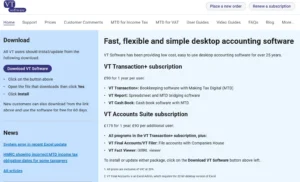
VT Transaction+ remains a useful alternative for businesses that prefer traditional desktop software. The current single-user subscription costs £90 plus VAT per year and includes VT Transaction+, VT Cash Book and MTD-related tools.
It supports bookkeeping, customer and supplier ledgers, invoices, recurring transactions, bank reconciliation, financial reports and VAT returns.
It can also submit MTD Income Tax quarterly updates.
Potential drawback: It is Windows-focused and does not provide the same cloud-first, multi-device experience as platforms such as Xero.
16. Tide Accounting
Best for: Existing Tide customers
Tide has expanded from business banking into accounting, invoicing and administration.
Tide Accounting currently costs approximately £13.99 plus VAT per month for sole traders and £19.99 plus VAT for limited companies.
The main attraction is integration. Banking transactions already occur inside the same ecosystem used for accounting, which can reduce setup and reconciliation work.
Its accounting services include tax estimates, VAT functionality and Self Assessment-related features, although eligibility and supported VAT arrangements should be checked before subscribing.
Best suited to: Tide customers who want to reduce the number of separate financial tools their business uses.
17. ANNA Auto Accountant
Check the ANNA Auto Software Here
Best for: Owners who want bookkeeping attached directly to business banking
ANNA combines business banking, invoicing, receipt capture and financial administration.
Its Auto Accountant service is available alongside ANNA’s business account and is currently advertised at £29 per month after the initial promotional period. ANNA also provides MTD Income Tax filing within its banking plans and spreadsheet-based VAT filing functionality.
The main advantage is automation around transactions that are already passing through the ANNA business account.
Best suited to: micro-business owners wanting banking, expenses, invoicing and bookkeeping under one provider.
18. AccountsOS
Check the AccountsOS Software Here
Best for: Businesses interested in AI-led bookkeeping
AccountsOS is one of the newer entrants attempting to redesign accounting around AI rather than simply adding AI tools to an existing bookkeeping interface.
Its published pricing has been around £20 per month, with features aimed at UK limited companies including bookkeeping automation, VAT, Corporation Tax, expenses and company-related administration.
As a newer platform, it does not have the long operating history or accountant ecosystem of Xero, Sage or QuickBooks.
However, businesses that want to experiment with a more automated approach to bookkeeping may find it worth investigating.
19. Odoo Accounting
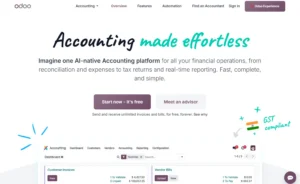
Best for: Businesses wanting accounting as part of a larger operational platform
Odoo is very different from standalone accounting software.
Accounting sits within a much wider ERP system that can also cover CRM, sales, ecommerce, inventory, projects, purchasing and other operational functions.
Odoo supports UK fiscal localisation, including accounting structures prepared for UK reporting and MTD VAT submission through its UK accounting modules.
It can therefore make sense for a business that wants accounting deeply connected to its wider operations.
Best suited to: ecommerce, manufacturing, wholesale and other businesses that are beginning to outgrow isolated software tools.
Potential drawback: Configuration can be considerably more complex than using a dedicated small-business bookkeeping package.
20. Sage 50 Accounts
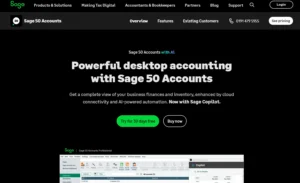
Check the Sage 50 Software Here
Best for: Established small businesses needing deeper accounting and stock control
Sage 50 Accounts remains relevant for businesses that want more traditional accounting depth than a lightweight cloud bookkeeping platform provides.
It combines established accounting functionality with newer connected services and can support inventory, reporting, VAT and more advanced financial processes.
Current market comparisons place Sage 50 significantly above entry-level cloud accounting products on price, so it is unlikely to make financial sense for a simple freelancer or very small sole trader.
However, an established trading business that requires more sophisticated stock, reporting and accounting processes may justify the higher cost.
Which Accounting Software Is Best for a Small Business?
There is no single platform that is best for every business.
For a typical growing small company, Xero and QuickBooks provide some of the broadest functionality and integration options.
Businesses prioritising value should look closely at Zoho Books, Pandle and QuickFile.
Freelancers and contractors may find FreeAgent particularly attractive, especially when they qualify for a free licence through an eligible business bank account.
Small employers should compare Sage Accounting because payroll is now included within its main accounting plans.
Sole traders and landlords primarily concerned with MTD for Income Tax may prefer a more focused platform such as Coconut.
Businesses should also consider their future structure before choosing. Somebody currently operating as a sole trader may later incorporate, register for VAT or employ staff.
Understanding the financial and administrative implications when registering a business in the UK can help prevent selecting software that has to be replaced shortly afterwards.
What Features Should Small Business Accounting Software Have?
At minimum, a good UK small business accounting platform should make daily bookkeeping easier rather than simply digitising manual work.
Important features include:
- Automatic bank feeds
- Transaction categorisation
- Invoicing
- Expense recording
- Receipt capture
- Vat calculations
- Mtd submissions where required
- Profit and loss reportin
- Balance sheets
- Cash-flow monitoring
- Customer and supplier records
- Accountant access
- Secure backups
- Mobile access
- Export functionality.
Growing businesses may additionally need payroll, inventory management, multi-currency transactions, project accounting, budgets, purchase orders, CIS functionality or ecommerce integrations.
Why Making Tax Digital Matters When Choosing Accounting Software?
MTD has become one of the most important considerations for self-employed businesses.
From 6 April 2026, qualifying sole traders and landlords with relevant annual income above £50,000 are required to use Making Tax Digital for Income Tax.
The timetable then expands:
| Qualifying Income | MTD Start |
| More than £50,000 | 6 April 2026 |
| More than £30,000 | 6 April 2027 |
| More than £20,000 | 6 April 2028 |
Affected users must create and maintain digital records and submit information through compatible commercial software. HMRC does not provide its own complete accounting product for this purpose.
This means businesses should not assume that every bookkeeping application automatically satisfies every MTD requirement.
Check the exact version and plan before purchasing, particularly where a provider has several subscriptions with different tax-filing capabilities.
Free vs Paid Accounting Software
Free accounting software can work perfectly well for some businesses.
Zoho Books, Pandle, QuickFile and selected Clear Books products provide particularly low-cost entry points.
However, the important question is not simply whether software is free today.
Check what happens when the business needs:
- More invoices
- Additional users
- Bank feeds
- Payroll
- Vat
- Inventory
- Multi-currency
- Receipt scanning
- Mtd income tax
- Corporation tax
- Additional integrations.
A business can save £10 a month initially and still spend far more moving systems if it chooses something unsuitable for its next stage of growth.
Accounting software should therefore be considered part of the wider operating infrastructure established after a business plan is completed.
Once a founder moves from planning into implementation, setting up tax, VAT and accounting systems early reduces the risk of poor records becoming a larger problem as transaction volumes increase.
Cloud Accounting vs Desktop Accounting
Most of the leading small-business platforms are now cloud-based.
Cloud accounting makes it possible to access records from multiple devices, automatically connect bank feeds, collaborate with accountants and receive software updates without manually installing new versions.
Desktop software can nevertheless remain useful.
VT Transaction+ is a good example. A business that values local data files, traditional bookkeeping workflows and low annual costs may prefer it to a subscription-based cloud platform.
The correct approach depends on how the business operates rather than automatically assuming cloud software is always superior.
How Much Should Small Business Accounting Software Cost?
A straightforward small business can realistically find useful accounting software for anywhere from £0 to around £40 per month.
More advanced systems can cost considerably more.
The mistake is comparing only the cheapest advertised headline prices.
Check:
- The normal renewal price
- Whether vat is added
- Annual versus monthly billing
- Invoice limits
- Transaction limits
- Number of users
- Payroll charges
- Receipt-capture limits
- Bank-feed charges
- Mtd capabilities
- Additional app costs.
Introductory offers can reduce subscriptions dramatically for the first few months, but long-term cost is more important when accounting software may remain in use for years.
Final Thoughts
The best small business accounting software ultimately depends on the way the business earns money, how complex its finances are and where it expects to be in several years.
Xero is particularly strong for businesses expecting to scale and connect numerous third-party systems.
QuickBooks combines broad accounting functionality with strong reporting and project-management capabilities.
Zoho Books provides one of the strongest combinations of price and functionality, including a useful free tier.
FreeAgent remains especially compelling for freelancers, contractors and eligible NatWest Group or Mettle customers.
Sage Accounting deserves consideration where payroll, UK-focused accounting and established support are priorities.
At the lower end of the market, Pandle and QuickFile demonstrate that useful bookkeeping does not necessarily require an expensive subscription.
The most important principle is to choose software based on the business’s actual workflow and likely future requirements rather than the largest introductory discount.
A platform that saves several hours of bookkeeping each month, keeps records organised and supports the business’s HMRC obligations can deliver far greater value than the difference of a few pounds in monthly subscription fees.
Frequently Asked Questions
What is the best accounting software for a small UK business?
Xero, QuickBooks, Zoho Books, FreeAgent and Sage are among the strongest general-purpose options, but the best choice depends on business structure, budget and required features.
What is the best free accounting software for UK small businesses?
Zoho Books, Pandle and QuickFile all provide free or very low-cost entry options, although limits and MTD functionality should be checked before relying on a free plan.
Which accounting software is best for sole traders?
FreeAgent, QuickBooks, Coconut, Zoho Books and Pandle are all worth considering. The right option depends particularly on whether MTD for Income Tax applies.
Can accounting software submit VAT returns to HMRC?
Many UK accounting packages can submit MTD VAT returns directly, including Xero, QuickBooks, Sage, Zoho Books, FreeAgent, Pandle, QuickFile and KashFlow.
Do small businesses legally need accounting software?
Not every small business is legally required to use a particular accounting package. However, businesses within Making Tax Digital requirements need compatible digital software to maintain and submit the required records.
Can accounting software replace an accountant?
Software can automate bookkeeping, reporting and some tax submissions, but it does not automatically replace professional advice on complex tax, company structure, financing or accounting decisions.