




















The Universal Credit loophole £1500 is not a secret Department for Work and Pensions payment, government bonus or legal trick that guarantees claimants an extra £1,500.
The phrase has a much more complicated history.
Part of the confusion comes from genuine Universal Credit advance payments, where a claimant can receive some of their expected benefit before their first regular payment arrives. But the £1,500 figure is also closely connected to an older Universal Credit fraud problem that attracted national attention in 2019.
That distinction matters in 2026.
A legitimate advance can provide important short-term cash flow, but it normally has to be repaid. Giving false information to obtain money can instead create an overpayment, repayment liability and potentially a benefit-fraud investigation.
For workers, sole traders and business owners receiving Universal Credit, there is another issue: earnings and business income can change the amount of Universal Credit paid each month. There is therefore no single £1,500 payment available simply because someone has discovered a loophole.
Is the Universal Credit Loophole £1500 Real?
No official Universal Credit £1500 loophole exists.
There is no DWP rule stating that every claimant can receive an additional £1,500 by selecting a particular option, changing wording in their journal or using an unofficial adviser.
What does exist is a Universal Credit advance system.
Someone waiting for their first Universal Credit payment may be able to request an advance if they need help with bills or other costs.
The maximum first-payment advance is based on the claimant’s estimated first Universal Credit payment rather than being fixed at £1,500.
This means two people can receive very different advance amounts because Universal Credit is calculated according to individual household circumstances.
A claimant with housing costs, children or other qualifying elements may have a substantially larger estimated award than another claimant.
The important distinction is therefore:
| Claim | Reality |
| Everyone can claim £1,500 | No |
| There is a hidden DWP £1,500 bonus | No |
| A first-payment advance can be substantial | Yes, depending on entitlement |
| An advance is free money | No |
| A Budgeting Advance can be £1,500 | Not under the current standard limits |
| Giving false information creates a legal loophole | No |
| Working people can receive Universal Credit | Yes, depending on income and circumstances |
Where Did the £1,500 Universal Credit Loophole Come From?
This is one of the most important pieces of context missing from many current articles.
The phrase has roots in a Universal Credit fraud problem reported nationally in 2019.
Fraudsters were reported to be obtaining people’s personal information and using the Universal Credit system to create bogus claims. Once a claim had been established, advance payments could be requested.
Some scammers reportedly presented themselves as people who could arrange government loans or financial assistance.
A victim might see money arrive and assume they had received legitimate assistance, while the person arranging the claim took part of the payment.
The problem was that the Universal Credit claim and advance could remain attached to the claimant.
Contemporary reports described affected people potentially being left up to £1,500 out of pocket, helping establish the figure that continues to appear in searches today.
This historical background changes the meaning of the keyword considerably.
The £1,500 was never a secret entitlement waiting to be discovered. The phrase became associated with a fraud problem involving Universal Credit advances.
Why Is the Universal Credit £1500 Loophole Trending Again?
There are several reasons the phrase continues to return through search engines and social media.
The first is financial pressure. Rent, household bills, food and borrowing costs can make the idea of an unexpected government payment particularly attractive.
The second is that genuine Universal Credit awards can sometimes be worth £1,500 or considerably more when several elements are included.
A household could therefore receive a large normal Universal Credit payment without exploiting anything.
The third reason is social media.
Words such as “loophole”, “hack”, “secret payment” and “government money” generate attention. A genuine but repayable advance can quickly be presented online as if someone has discovered free cash.
The distinction becomes even more important in 2026 because there is no nationwide Universal Credit Cost of Living Payment scheduled for 2026. Anyone seeing claims about a new bonus should distinguish them from the previous national payments. UK Business Blog has separately examined the current position on the Universal Credit Cost of Living Payment.
Can You Legally Receive a £1,500 Universal Credit Advance?
Potentially, but £1,500 is not a standard limit or guaranteed amount.
For someone applying for an advance before receiving their first Universal Credit payment, the maximum available is normally the value of their first estimated payment.
That means a claimant whose first estimated award were £600 would not receive £1,500 simply because they requested it.
Likewise, someone with a considerably higher entitlement could potentially have a higher advance available.
The DWP also requires an applicant to explain why the advance is required, verify their identity and provide information relating to money or savings.
There is therefore no separate application called the “£1,500 loophole”.
It is simply the normal advance-payment system.
How Long Does a Universal Credit Advance Take to Repay?
A first-payment Universal Credit advance normally has to be repaid within 24 months, with deductions usually beginning from the first regular Universal Credit payment.
That makes the cash-flow effect particularly important.
Someone receiving a large amount upfront should not treat it in the same way as a grant.
The household is effectively bringing forward money and then receiving less disposable Universal Credit later while the advance is being recovered.
If a claimant is struggling with repayments on a first-payment advance, current rules allow them to ask for repayments to be delayed for three months in qualifying circumstances.
This is one reason the word “loophole” can be financially dangerous.
Receiving £1,500 now and then having future payments reduced is very different from becoming £1,500 wealthier.
How Much Can DWP Deduct From Universal Credit in 2026?
The current deduction rules are particularly important because some older articles still refer to significantly higher limits.
In most circumstances, the maximum overall amount taken from Universal Credit towards debts is now capped at 15% of the household’s standard allowance.
The Fair Repayment Rate lowered the normal cap from 25% to 15% from 2025.
There are limited exceptions for certain last-resort deductions, including situations involving housing arrears, energy arrears and child maintenance.
Recent DWP data shows how significant deductions have become.
In May 2026:
| DWP Deduction Measure | May 2026 Position |
| UC households with at least one deduction | About 3.3 million |
| Share of all UC households with deductions | 47% |
| Households repaying advance debt | 32% |
| Average total monthly deduction | £53 |
| Households reaching the normal 15% cap | Around 21% |
These figures put the £1,500 discussion into a different financial context.
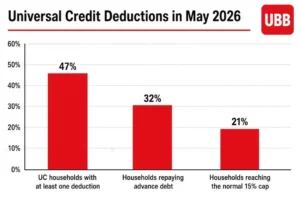
Millions of households already have money deducted from Universal Credit to repay advances and other debts.
For a household struggling with monthly expenditure, the relevant question is therefore not simply “How much can I receive today?”
It is also: “How will the repayment affect my household cash flow over the following months?”
Is a Budgeting Advance the Same as the £1,500 Loophole?
No. A Budgeting Advance is a separate form of repayable Universal Credit support for eligible people who need help with certain one-off costs.
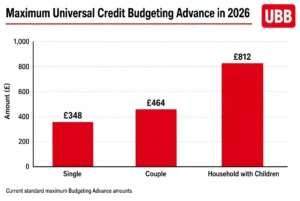
Current maximum amounts are:
| Household Circumstances | Maximum Budgeting Advance |
| Single | £348 |
| Couple | £464 |
| Household with children | £812 |
The minimum amount available is £100.
A Budgeting Advance can potentially help with expenses such as essential household items, clothing, certain repairs, funeral expenses, a tenancy deposit or removal costs.
It cannot normally be used for ongoing expenses such as ordinary food bills, rent, gas or electricity bills, or paying off debts.
Budgeting Advances are also normally repaid over 24 months.
Consequently, a person claiming there is a standard £1,500 Budgeting Advance in 2026 is confusing different parts of the Universal Credit system.
What Is the Difference Between an Advance, Normal Universal Credit and a £1,500 Scam?
The easiest way to understand the issue is to separate the three.
| Situation | What Happens | Repayable? |
| Normal Universal Credit award | Household receives its calculated monthly entitlement | No |
| First-payment advance | Part or all of the estimated first payment is received early | Yes |
| Budgeting Advance | Eligible claimant borrows for qualifying one-off expenditure | Yes |
| False £1,500 “loophole” offer | Unofficial person promises guaranteed money, potentially using misleading or false information | Potentially creates debt and fraud risk |
| Genuine one-off government support | Separate scheme introduced and officially announced | Depends on the scheme |
This distinction also prevents the £1,500 rumour being confused with changes to ordinary payment dates.
For example, bank holidays can move a DWP payment forward without increasing the amount received. The latest DWP bank holiday payment changes are another example of why an unusual payment date should not automatically be interpreted as extra government money.
What Happens If False Information Is Used to Get £1,500?
Providing information that is knowingly false is fundamentally different from legitimately applying for an advance.
Universal Credit calculations depend on information such as household circumstances, income, housing and other relevant factors.
If incorrect information results in too much benefit being paid, the DWP can seek recovery.
Where deliberate benefit fraud is established, available enforcement action can include recovery of overpayments, administrative penalties and, in appropriate cases, prosecution.
Benefit-loss penalties can also apply following certain convictions.
The rules were updated in April 2026. Loss-of-benefit penalties following relevant convictions can last 13 weeks, rise to 26 weeks for a qualifying second offence, and reach three years in specified repeat or serious fraud cases.
Someone who discovers that incorrect information has been entered on their claim should therefore address the problem through official Universal Credit channels rather than attempting to hide it.
How Can You Spot a £1,500 Universal Credit Scam?
One warning sign alone does not prove that someone is committing fraud, but several characteristics should cause immediate concern.
Typical warning signs include promises of a guaranteed £1,500 payment, requests for Universal Credit passwords or security details, demands for a share of the money, claims about an “inside contact” at the DWP, pressure to provide inaccurate information or messages saying a secret payment will disappear unless action is taken immediately.
Genuine Universal Credit support does not depend on giving an unknown social-media user access to a claimant’s account.
Claimants can manage advances and messages through their official Universal Credit account, Jobcentre Plus or the Universal Credit helpline.
What Should Someone Do If a Scammer Has Already Used Their Details?
Someone who believes their Universal Credit account or personal information has been compromised should act quickly.
They should secure their account credentials, check their Universal Credit journal and payment information, contact Universal Credit through an official channel and explain what has happened.
Where false information appears in a claim, it is particularly important to make the DWP aware of the problem rather than leaving incorrect details in place.
Suspected benefit fraud can also be reported through the official benefit-fraud reporting system.
The exact outcome will depend on what happened, whether money was received, where it went and whether the claimant knowingly participated.
A person who was genuinely deceived should clearly explain that when communicating with the relevant authorities.
Can Working People Get Universal Credit?
Yes.
Universal Credit is not restricted to people who are completely unemployed.
Working employees can continue to receive Universal Credit where their household remains eligible.
For every additional £1 of relevant employment earnings, Universal Credit generally falls by 55p once any applicable work allowance has been taken into account.
There is no fixed maximum number of working hours that automatically prevents Universal Credit entitlement.
This matters to businesses because some employees may legitimately receive both wages and Universal Credit.
In most employed cases, employers report earnings through payroll and the Universal Credit system uses reported earnings when calculating the claimant’s award.
People interested in the interaction between gross earnings and personal taxation can separately read UK Business Blog’s analysis of how much you can earn before paying tax.
How Does Universal Credit Work for the Self-Employed?
The £1,500 loophole discussion is particularly relevant to sole traders and people building small businesses because their Universal Credit calculation can be more complicated than that of a straightforward PAYE employee.
Self-employed claimants generally have to report business income and expenses each month.
For people classed as gainfully self-employed, the Minimum Income Floor can eventually affect the Universal Credit calculation.
There is also a potential start-up period of up to 12 months for qualifying new businesses. During an eligible start-up period, Universal Credit can use actual monthly business earnings rather than applying the Minimum Income Floor.
This makes accurate record keeping important.
A sole trader should not attempt to manipulate income or business-expense figures in order to increase Universal Credit. Business records used for Universal Credit should accurately reflect the claimant’s circumstances.
People considering flexible self-employment should also distinguish gross earnings from actual profit after business costs. The same issue arises with gig-economy work such as Amazon Flex UK, where fuel, insurance, maintenance and tax can materially change the amount ultimately retained.
Why Should Employers Understand the £1,500 Universal Credit Rumour?
Employers do not determine an employee’s Universal Credit entitlement, but understanding how the system interacts with earnings can still be useful.
A significant part of the UK workforce combines employment income with means-tested support.
Changes to hours, overtime, bonuses and monthly pay can therefore affect an employee’s Universal Credit award.
For most employees, earnings information is transmitted through payroll rather than requiring the worker to manually report every salary payment.
This can create monthly variation in household income, particularly where shifts and overtime change regularly.
For employers considering financial-wellbeing programmes, the important lesson is that workers receiving Universal Credit may be managing not only normal household expenditure but also benefit deductions or advance repayments.
The latest DWP figures showing millions of households experiencing deductions demonstrate why short-term household cash flow remains a significant economic issue.
Is There a Legitimate Way to Increase Universal Credit?
There is no loophole, but claimants should make sure their actual circumstances are correctly recorded.
Universal Credit can contain different elements depending on housing costs, children, caring responsibilities, health circumstances and other factors.
Employment income, self-employment, savings and household changes can also alter entitlement.
The objective should therefore be to receive the correct legal entitlement, not to find a way around the rules.
Anyone whose circumstances change should update their Universal Credit account so the award can be recalculated properly.
Why Is Calling It a “Loophole” Potentially Misleading?
The word suggests someone has discovered a legal technicality that government rules accidentally allow.
That does not accurately describe what is happening here.
A lawful Universal Credit advance is an intentional part of the benefit system.
Normal Universal Credit elements are also intentional.
A scam involving false information is fraud rather than clever financial planning.
Combining all three under the word “loophole” creates confusion and can persuade financially vulnerable people to take risks they do not fully understand.
For businesses, policymakers and households alike, the more useful way to think about the issue is as one of cash flow, debt recovery, benefit administration and online financial misinformation.
Universal Credit Loophole £1500: What Is the Final Answer?
There is no legitimate Universal Credit loophole £1500 giving every claimant £1,500 in free government money.
The phrase appears to have survived partly because of historic fraud involving Universal Credit advances and partly because genuine Universal Credit payments can sometimes reach substantial amounts.
A legitimate first-payment advance can provide early access to money, but the maximum normally depends on the claimant’s estimated first payment and the advance generally has to be repaid.
A Budgeting Advance is different again and currently has maximum limits of £348 for a single claimant, £464 for a couple and £812 where the claimant has children.
The latest DWP figures also show why repayment matters: almost half of Universal Credit households had some form of deduction in May 2026, with advances the most common category.
The safest financial principle is therefore straightforward:
Claim every pound that the rules genuinely entitle the household to, but do not treat a repayable advance or an offer involving false information as free money.
Frequently Asked Questions
Is the Universal Credit £1500 Loophole Real in 2026?
No. There is no official DWP scheme that guarantees Universal Credit claimants a free £1,500 payment through a loophole.
Can Universal Credit Give You a £1,500 Advance?
A first-payment advance depends on the amount of the claimant’s estimated first Universal Credit payment. It is therefore possible for some households to receive a substantial advance, but £1,500 is not a standard or guaranteed figure.
Do You Have to Repay a Universal Credit Advance?
Yes. A first-payment advance normally has to be repaid, usually through deductions from subsequent Universal Credit payments.
How Long Do You Have to Repay a Universal Credit Advance?
First-payment advances are normally repayable over a period of up to 24 months.
Is a Budgeting Advance Worth £1,500?
No under the standard current limits. The maximum is £348 for a single person, £464 for a couple and £812 where the claimant has children.
Can DWP Take Money From Universal Credit to Repay an Advance?
Yes. Advances are normally recovered through deductions from future Universal Credit payments.
What is the Maximum Universal Credit Deduction in 2026?
In most cases, total debt deductions are normally capped at 15% of the Universal Credit standard allowance. Certain last-resort deductions can exceed that limit.
Can Someone Work and Still Receive Universal Credit?
Yes. Universal Credit can be paid to working households depending on their income and circumstances. Earnings generally reduce the award rather than automatically ending entitlement once someone starts work.
Do Self-employed People Qualify for Universal Credit?
Potentially. Self-employed claimants must normally report business income and expenses monthly, and rules including the Minimum Income Floor can affect the calculation.
What Happens if Someone Lies to Get an Extra Universal Credit Payment?
Deliberately providing false information can lead to overpayment recovery, penalties, investigation and potentially criminal prosecution depending on the circumstances.
Is There a Universal Credit Cost of Living Payment in 2026?
There is currently no nationwide Universal Credit Cost of Living Payment scheduled for 2026. Claims about new lump-sum government payments should therefore be checked carefully.
Why Does the £1,500 Figure Keep Appearing Online?
The figure is strongly associated with historic Universal Credit advance-payment fraud reported in 2019, while modern social-media posts also use it to attract attention to supposed benefit “hacks”.
Note: This article provides general information about Universal Credit, benefits and household finances. Individual entitlement depends on personal circumstances and current Department for Work and Pensions rules.