



















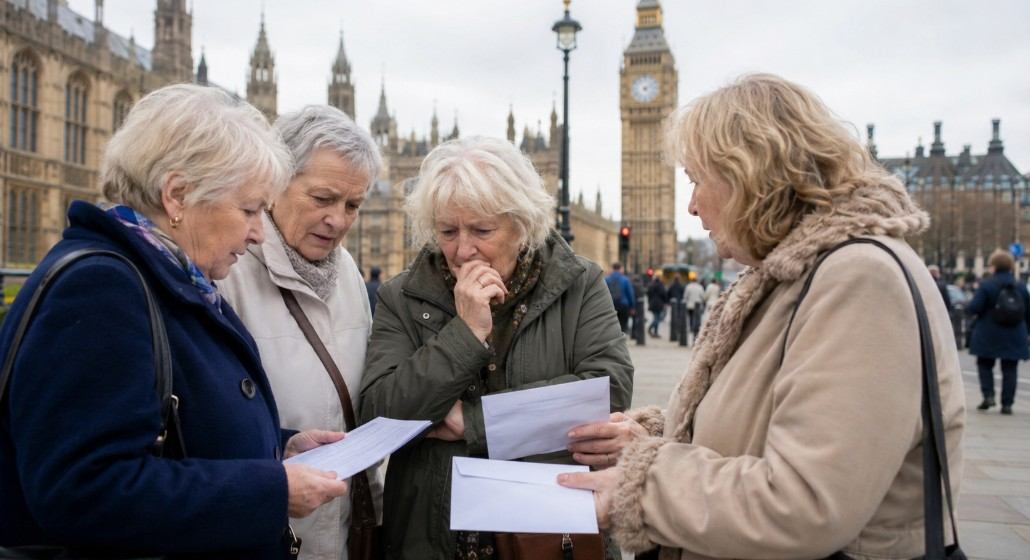
The DWP WASPI pension compensation dispute has moved back into the political and financial spotlight following a change in government leadership and renewed pressure from campaigners representing women affected by increases to the State Pension age.
As of 27 August 2026, there is still no approved national compensation scheme, no confirmed £2,950 payment and no official DWP application process.
However, the issue can no longer be viewed purely as a closed policy decision.
Prime Minister Andy Burnham took office on 20 July 2026, while John Healey became Chancellor. WASPI chair Angela Madden subsequently wrote to both on 4 August requesting talks over a possible form of redress for women born in the 1950s.
For businesses, taxpayers and policymakers, the key question is no longer simply whether compensation should be paid.
It is whether the Government can design a financially sustainable redress framework without creating a multibillion-pound fiscal commitment or an expensive case-by-case administrative system.
What Is the DWP WASPI Pension Compensation Dispute?
WASPI stands for Women Against State Pension Inequality.
The campaign represents women, particularly those born during the 1950s, who argue that changes to their State Pension age were not communicated adequately or early enough.
Historically, women could claim the State Pension at age 60 while men generally qualified at 65.
The Pensions Act 1995 began the process of equalising pension ages. Later legislation accelerated parts of the timetable.
Women’s State Pension age reached 65 in November 2018, while the increase to 66 for both men and women was completed by October 2020.
Readers examining the wider pension timetable may also find it useful to understand whether the State Pension age is 66 or 67.
The WASPI dispute does not primarily challenge Parliament’s legal authority to increase the pension age.
Instead, it focuses on how the Department for Work and Pensions communicated those changes and whether affected women had sufficient notice to adjust retirement, employment and financial plans.
That distinction is particularly important from a business and policy perspective because the issue concerns administrative failure and financial redress, rather than reversing the pension-age reforms themselves.
Why Does the WASPI Case Matter Economically?
The significance of the dispute extends beyond individual compensation claims.
Any nationwide settlement could create several financial consequences for government.
These include:
- Billions of pounds in potential compensation expenditure
- Administrative costs associated with assessing eligibility
- Possible legal costs from continuing judicial review proceedings
- Treasury implications for future spending plans
- Precedent risks for other public-sector compensation cases
- Political pressure to balance fairness against fiscal restraint
The central policy challenge is therefore whether Government can provide redress without creating disproportionate costs for taxpayers.
That is one reason the issue remains commercially and economically relevant even though it is fundamentally a pensions dispute.
Did the DWP Make a Mistake?
The Parliamentary and Health Service Ombudsman found maladministration in parts of the DWP’s communication process.
One of the central findings concerned the period in which the Department could have acted sooner to send direct letters explaining changes to State Pension age.
The Ombudsman concluded that DWP could have decided in August 2005 to communicate directly with affected women but that there was a delay of approximately 28 months before the relevant mailing exercise began.
The PHSO concluded that this reduced some women’s ability to make informed decisions about work, retirement and personal finances.
From an economic perspective, that matters because retirement planning can influence:
- Employment decisions
- Household savings
- Pension contributions
- Mortgage repayment plans
- Business ownership decisions
- Long-term investment choices
However, the Government has disputed the Ombudsman’s interpretation of the resulting financial injustice.
The DWP’s position has been that it does not agree with the Ombudsman’s approach to assessing the consequences or the appropriate remedy.
Will WASPI Women Receive £2,950?
There is currently no confirmed £2,950 payment.
The amount became widely associated with the campaign because the Ombudsman indicated a Level 4 remedy for the six sample complainants it investigated.
That range was:
| PHSO Level 4 Remedy | Amount |
| Lower end | £1,000 |
| Upper end | £2,950 |
Five of the six sample cases were considered to fall towards the higher end of the range.
However, this should not be interpreted as a Government commitment to pay £2,950 to every affected woman.
There is currently:
- No approved national compensation fund
- No confirmed payment timetable
- No DWP application form
- No automatic £2,950 entitlement
- No formal registration process
From a public-finance perspective, the difference between compensating a small number of individual cases and creating a nationwide scheme covering millions of women is substantial.
How Much Could WASPI Compensation Cost the Government?
Potential cost is one of the biggest obstacles to establishing a national compensation programme.
Previous estimates have suggested that applying payments across a large cohort could cost several billion pounds.
| Compensation Scenario | Approximate Cost |
| Lower-value widespread payments | Around £3.5 billion |
| Higher-value widespread payments | More than £10 billion |
The Government has previously referred to a potential cost of approximately £10.3 billion under a broad flat-rate compensation model.
For comparison, spending at that level would create a significant call on public finances.
A Government considering such a programme would need to assess:
- Whether expenditure could be funded from existing departmental budgets
- Whether additional Treasury funding would be needed
- Whether payments should be universal or means-tested
- Whether compensation should vary according to individual circumstances
- How much the assessment process itself would cost
- Whether alternative forms of redress could reduce the fiscal burden
This is one reason the WASPI debate has increasingly become a question of financial design, not simply whether campaigners have a legitimate grievance.
Why Did the Government Reject Compensation?
The Government’s latest completed formal decision came on 29 January 2026, when compensation was rejected again.
The original decision not to establish a financial scheme had been announced in December 2024.
Following legal action, the Government agreed in December 2025 to reconsider its response.
The second decision still concluded that a nationwide compensation programme would not represent an appropriate use of public money.
The Government’s reasoning included several commercial and administrative considerations.
Difficulty Proving Individual Financial Loss
One of the biggest challenges is determining what each woman knew and when she knew it.
Government argued that receiving a letter earlier would not automatically have changed a person’s financial or retirement decisions.
That makes it difficult to calculate direct financial loss.
Administrative Complexity
A highly individualised compensation scheme could require officials to review millions of historical cases.
That could involve examining:
- Employment records
- Pension correspondence
- Financial decisions
- Retirement plans
- Historical evidence of what claimants knew
The administrative cost could therefore become substantial even before compensation payments were made.
Risk of Overcompensation
A universal flat-rate payment would be much simpler to administer.
However, Government argued that it could result in payments to people who were already aware of the pension-age changes or who did not suffer the specific injustice identified by the Ombudsman.
Public Spending Pressure
A multibillion-pound compensation scheme would compete with spending demands in areas such as healthcare, infrastructure, defence, welfare and debt servicing.
That fiscal trade-off remains central to the policy debate.
What Does Andy Burnham Becoming Prime Minister Mean for WASPI?
The change in Prime Minister has reopened political discussion around the dispute.
Andy Burnham became Prime Minister on 20 July 2026.
Before entering Downing Street, he had expressed sympathy with WASPI campaigners.
At a Makerfield hustings in June 2026, Burnham said WASPI women “deserve some recompense for the unfairness”.
Those comments created expectations that a future Burnham administration could revisit the issue.
However, his team subsequently clarified that he accepted the existing decision not to introduce financial compensation and suggested that other forms of assistance could potentially be considered.
That distinction is important.
Burnham’s remarks should not be interpreted as a commitment to a £2,950 cash payment.
WASPI Has Taken the Issue Directly to the New Government
The campaign increased political pressure after Burnham entered Downing Street.
On 4 August 2026, WASPI chair Angela Madden wrote to the Prime Minister and Chancellor John Healey requesting urgent talks.
The campaign’s latest position appears to leave room for different forms of redress rather than focusing exclusively on one standard compensation payment.
That may create greater scope for negotiation.
From a Treasury perspective, alternatives to universal cash compensation could include:
- Targeted compensation
- Tiered payments
- Concessionary benefits
- Non-cash support
- Payments linked to demonstrated financial loss
- A capped redress fund
None of these options has been formally announced.
However, they illustrate how a Government could attempt to reduce the financial exposure associated with a universal scheme.
By late August, Madden said she believed Burnham was in “listening mode”.
That signals an active political discussion, but it does not amount to confirmation of compensation.
Could the Government Introduce a More Affordable Redress Model?
Potentially.
The central obstacle to a national scheme has always been the tension between fairness and cost.
A flat-rate scheme would be easy to understand but potentially expensive.
An individual assessment model could be more targeted but far more costly to administer.
A future Government therefore has several possible structures available.
Flat-Rate Compensation
Every eligible woman could receive the same payment.
Business advantage: simple administration.
Financial drawback: potentially very high total cost.
Tiered Compensation
Payments could depend on factors such as date of birth or degree of impact.
Business advantage: more targeted than a universal payment.
Financial drawback: greater administrative complexity.
Evidence-Based Compensation
Women could be required to demonstrate financial loss.
Business advantage: Government would theoretically pay only where measurable harm occurred.
Financial drawback: potentially expensive and difficult to administer at scale.
Alternative Redress
Government could provide travel concessions, benefits or other support instead of direct cash payments.
Business advantage: potentially lower immediate Treasury cost.
Financial drawback: may not satisfy campaigners seeking compensation for maladministration.
Who Could Potentially Be Included in a WASPI Scheme?
WASPI primarily represents women born from:
6 April 1950 to 5 April 1960.
However, being born within that period does not currently create a legal entitlement to compensation.
| Date of Birth | WASPI Campaign Cohort? | Guaranteed Payment? |
| Before 6 April 1950 | Generally outside the main cohort | No |
| 6 April 1950–5 April 1960 | Within the main campaign cohort | No |
| After 5 April 1960 | Generally outside the main cohort | No |
If the Government eventually creates a redress programme, it would need to publish formal eligibility rules.
Those rules could potentially be narrower than the overall group represented by WASPI.
Why Was the June 2025 Legal Costs Cap Significant?
One of the most important financial developments in the previous legal challenge came in June 2025.
WASPI secured a costs capping arrangement that reduced its exposure to potentially substantial legal bills.
| Party | Relevant Costs Cap |
| WASPI | £60,000 |
| Government | £90,000 |
This was significant because judicial review proceedings can be expensive.
Without costs protection, an unsuccessful campaign group may face financial liabilities that make continuing litigation difficult.
Angela Madden described the order as a vital safeguard and warned that uncontrolled legal exposure could have threatened the campaign’s finances.
From a business-risk perspective, the order effectively reduced WASPI’s downside exposure and allowed the litigation strategy to continue.
The earlier judicial review eventually resulted in the Government agreeing to reconsider its decision.
That reconsideration produced the January 2026 refusal.
The current litigation is a separate, later judicial review and should not be confused with the case covered by the 2025 costs cap.
What Is Happening With the Latest Judicial Review?
WASPI launched another legal challenge in May 2026.
The campaign describes this as its third judicial review.
A legal update published on 2 June confirmed that the Government had submitted Summary Grounds of Defence.
The case is important because judicial review examines whether a public body’s decision was reached lawfully.
However, even if WASPI succeeds, that does not automatically create a compensation scheme.
A court could potentially require ministers to reconsider the decision without determining the size or structure of any eventual payment.
From a fiscal perspective, this creates continuing policy uncertainty for Government.
What Would Happen If WASPI Wins in Court?
A successful judicial review could have several consequences.
The court could:
- Quash the Government’s decision
- Require ministers to reconsider it
- Identify flaws in the decision-making process
- Require additional evidence or reasoning
- Trigger another political review
What a court would not normally do is design a multibillion-pound compensation scheme itself.
The economic impact would therefore depend largely on how ministers responded after any successful challenge.
What Parliamentary Pressure Exists?
WASPI also continues to attract parliamentary support.
Early Day Motion 263 was tabled on 2 June 2026.
It criticised the Government’s refusal to compensate affected women and called for reconsideration.
Early Day Motions do not have the force of law.
They are primarily political instruments allowing MPs to demonstrate support and maintain pressure on ministers.
For Government, sustained parliamentary interest can increase political risk even where there is no immediate legal obligation to introduce compensation.
Why Does WASPI Highlight Deaths and Treasury Savings?
WASPI’s public campaigning frequently focuses on two figures:
- The estimated number of affected women who have died since the campaign began
- The amount it believes the Treasury has saved as a result of changes to State Pension age
These are campaign framing tools rather than official DWP compensation metrics.
From a communications perspective, they are effective because they convert a complex pensions policy dispute into easily understood measures of urgency and financial impact.
The strategy also increases pressure on Government by suggesting that delays reduce the number of women who could ultimately benefit from any future settlement.
Is There a WASPI Compensation Claim Form?
No.
There is currently no official DWP form for claiming WASPI compensation.
Because no national scheme exists, affected women do not currently need to register.
There is also:
- No official application deadline
- No confirmed payment date
- No Government-approved claims company
- No need to provide bank details to reserve compensation
- No official process charging a fee to claim
Why Are WASPI Scams a Growing Financial Risk?
High-profile compensation stories frequently attract fraud.
WASPI is particularly vulnerable because large numbers of people are waiting for an uncertain financial outcome.
Common scams can include:
Fake Claim Websites
Fraudulent websites may claim that applications for £2,950 are open.
They may attempt to collect personal, banking or National Insurance information.
Phishing Messages
Emails or texts may impersonate DWP or campaign organisations and claim that money is ready to be released.
Paid Claim Services
Some businesses may offer to secure compensation for an upfront fee or commission.
No company can currently guarantee a payment because no national compensation programme exists.
Social Media Advertising
Advertisements can use phrases such as “WASPI payout confirmed” despite no official payment having been approved.
WhatsApp Scams
Fraudsters may contact women directly and request identification documents or financial information.
For consumers, the safest approach is to avoid paying third parties or sharing financial information unless an official Government compensation process is eventually announced.
DWP WASPI Compensation Timeline
| Date | Development |
| 1995 | Pensions Act begins equalising State Pension ages |
| 2005–2007 | Period later criticised over communication failures |
| 2011 | Further legislation accelerates State Pension age increases |
| 2015 | WASPI campaign established |
| March 2024 | PHSO publishes findings on maladministration and remedy |
| December 2024 | Government rejects nationwide compensation |
| June 2025 | WASPI secures legal costs protection |
| December 2025 | Government agrees to reconsider its position |
| 29 January 2026 | Compensation rejected again |
| 13 May 2026 | WASPI confirms another judicial review |
| 2 June 2026 | Judicial review update and EDM 263 |
| June 2026 | Burnham comments on possible recompense |
| 20 July 2026 | Andy Burnham becomes Prime Minister |
| 4 August 2026 | WASPI writes to Burnham and Chancellor John Healey |
| August 2026 | Political lobbying continues; no compensation scheme approved |
What Could WASPI Compensation Mean for UK Public Finances?
If a scheme were eventually introduced, the wider financial impact would depend on its structure.
A £3 billion to £10 billion programme would represent a major public-spending commitment.
Treasury decisions could involve:
- Reallocating departmental budgets
- Increasing borrowing
- Reducing spending elsewhere
- Phasing payments over several financial years
- Limiting eligibility
- Introducing smaller payments
- Using non-cash forms of redress
Any settlement would therefore need to be considered alongside broader fiscal objectives.
For businesses, this matters because major public-spending decisions can influence taxation, government borrowing and future spending priorities.
Could Compensation Affect Tax or Government Borrowing?
There is currently no approved scheme, so any impact remains hypothetical.
However, a large settlement would have to be financed.
Government could theoretically use existing spending allocations, additional borrowing or spending reductions elsewhere.
A smaller targeted scheme could have a more manageable fiscal effect.
A £10 billion universal programme would create a much more significant Treasury decision.
That explains why Government has consistently focused on proportionality and value for taxpayers when discussing WASPI compensation.
What Should Affected Women Do Now?
Affected women do not currently need to submit an application.
Practical steps include:
- Keep pension and employment records
- Retain historical DWP correspondence
- Monitor formal Government announcements
- Follow developments in the latest judicial review
- Avoid compensation websites asking for upfront fees
- Do not provide bank details to unverified organisations
- Treat social-media claims about confirmed £2,950 payments cautiously
State Pension entitlement should also be considered separately from any future WASPI compensation.
DWP WASPI Pension Compensation at a Glance
| Question | Position as of 27 August 2026 |
| Has compensation been approved? | No |
| Is £2,950 guaranteed? | No |
| Is there an official claim form? | No |
| Has DWP created a payment timetable? | No |
| Did Government reconsider its earlier refusal? | Yes |
| What was the January 2026 outcome? | Compensation was rejected again |
| Is Andy Burnham now Prime Minister? | Yes |
| Has he approved compensation? | No |
| Has WASPI approached the new Government? | Yes |
| Is legal action continuing? | Yes |
| Could a scheme cost billions? | Yes |
| Is the issue financially significant for Government? | Yes |
What Happens Next?
The next phase of the WASPI dispute is likely to be driven by three factors.
First, the latest judicial review could determine whether the January 2026 decision needs to be reconsidered again.
Second, the Burnham Government must decide whether to engage with WASPI’s request for a new form of redress.
Third, the Treasury will have to assess whether any potential settlement can be delivered at an acceptable cost.
The most commercially significant question is therefore not simply whether compensation is politically desirable.
It is whether Government can design a scheme that balances fairness, affordability, administrative efficiency and legal defensibility.
Conclusion
The DWP WASPI pension compensation dispute remains unresolved and has become as much a public-finance issue as a pensions controversy.
There is still no confirmed £2,950 payment or national claims process, but the arrival of a new Prime Minister, continuing judicial review proceedings and renewed negotiations have kept the issue active.
For Government, the challenge is substantial. Any settlement must recognise the Ombudsman’s findings while controlling potentially multibillion-pound costs, administrative complexity and precedent risk.
Until a formal policy change is announced, affected women should treat compensation as possible, but not approved.
Frequently Asked Questions
Is WASPI compensation confirmed for 2026?
No. There is no approved nationwide compensation scheme as of 27 August 2026.
How much could a WASPI scheme cost?
Previous estimates suggest a broad compensation programme could potentially cost between approximately £3.5 billion and more than £10 billion.
Is every affected woman getting £2,950?
No. £2,950 is associated with the upper end of the Ombudsman’s Level 4 remedy, not a confirmed universal payment.
Has Andy Burnham promised WASPI compensation?
No. He has previously expressed sympathy with the campaign, but no compensation programme has been approved.
Why is the Treasury important to the WASPI debate?
Any nationwide scheme could require billions of pounds in public expenditure, making affordability and fiscal planning central to the decision.
Is there an official application process?
No. There is currently no DWP claim form, deadline or compensation registration system.
Is WASPI still pursuing legal action?
Yes. The campaign continues to pursue judicial review proceedings against the Government’s latest refusal.
Could a court order £2,950 payments?
Judicial review generally examines whether Government acted lawfully. A successful case would not automatically create a specific compensation payment.
What is the biggest obstacle to a compensation scheme?
The main challenges are cost, proving individual financial loss, administrative complexity and deciding whether universal payments would be proportionate.
Should affected women use paid compensation claim companies?
There is currently no official scheme to claim from, so no private company can guarantee a WASPI payment.